


Grootebeek British Cemetery
Updated: Jul 29

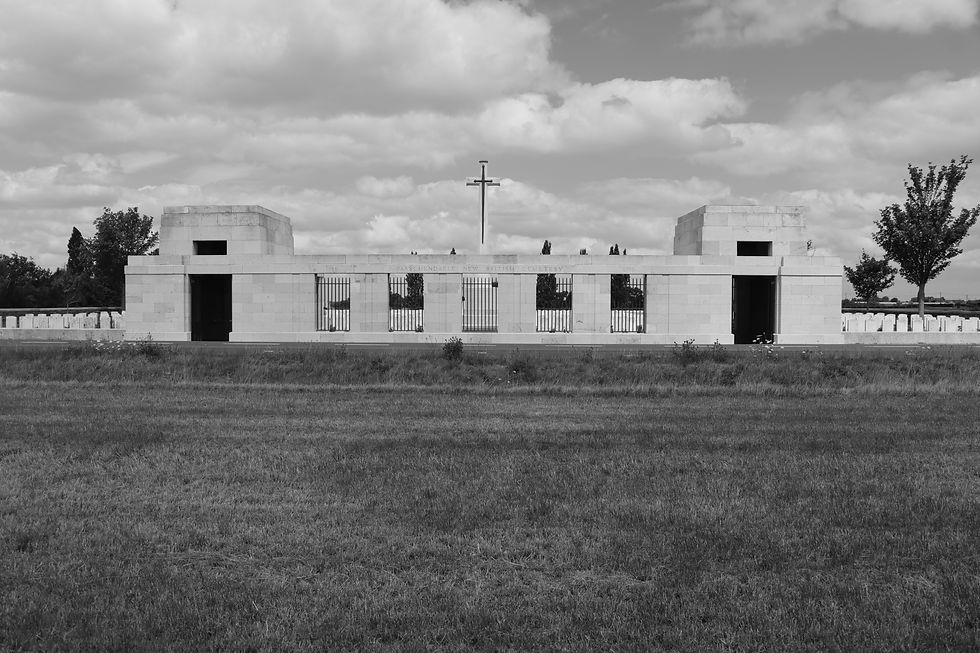
Grootebeek British Cemetery, CWGC, Ouderdom, is a beautiful cemetery which is set back from the Bellestraat, a road leading from the N308 connecting Ieper to Poperinge via Vlamertinge, and is located in the hamlet of Ouderdom and near to the village of Reninghelst which were in Allied hands from the autumn of 1914 to the end of the First World War. From March 1915, Commonwealth burials were made in the Reninghelst Churchyard Extension and the Reninghelst New Military Cemetery, but in April 1918, during the Battles of the Lys, a new cemetery was made by Field Ambulances and fighting units near the hamlet of Ouderdom, on the Poperinghe-Wytschaete road. It was originally called Ouderdom Military Cemetery, but later renamed Grootebeek British Cemetery, from the stream (Grootebeek, or Groote Kemmelbeek) which runs beside it. It was used at intervals until the end of September 1918 and it absorbed a small Indian cemetery made on the spot at the end of April 1915.

Tankodrome at Ouderdom
The British had been preparing for an attack on the Messines Ridge since 1915. It had taken the form of extensive mining and the laying of charges beneath the German defences. Read more here As early as March 1917, it had been foreseen that an attack by tanks was possible and a reconnaissance of the whole of the Ypres area had been under taken by the Heavy Branch. In April the 2nd Brigade, consisting of ‘A’ and ‘В’ Battalions, was selected for this operation. In May these two battalions were equipped with thirty-six Mark IV tanks each. Railheads were selected at Ouderdom and at Clapham Junction (one mile south of Dranouter), and though they were within the shelled area, they fulfilled

most of the requirements demanded of a tank railhead. Advanced parties began arriving at these stations between May 23 and 27, and ‘A’ and ‘В’ Battalions followed them. Supply dumps were then formed, and arrangements were made to carry forward one complete fill for all tanks operating by means of Supply Tanks, which were first used in this battle. These tanks consisted of discarded Mark I machines with specially made supply sponsons fitted to them. On the 24 May 1917, Achiel van Walleghem commented in his diary on this build-up for what was to be the Battle of Messines in which tanks played a small part: ‘They say that tanks have arrived already and are standing in special shelters – huts covering on top – on Cyriel Jacob’s fields at Ouderdom.’ Captain William Watson described the ‘tankodrom’ at Ouderdom: ‘We drove first to Ouderdom, a vast and enticing railhead, which the enemy shelled methodically each night, much to the annoyance of ‘b’ tank battalion, who lived, for reasons of state, at the edge of the railhead. Their tanks were housed with disarming naivety in a series of canvas stalls surrounded by a high canvas screen. The whole erection was perhaps three-quarters of a mile in circumference. The tanks were so obviously concealed that the enemy never suspected their existence’ ‘В’ Battalion tanks being hidden away in wood, and ‘A’

Battalion's in specially built shelters representing huts. The tracks left by the tanks, as they moved to these positions, was obliterated by means of harrows so that enemy aircraft would not notice anything suspicious on the ground. On the 5 June 1917 Achiel Van Walleghem wrote: ‘I hear that in the night various tanks left Ouderdom over the fields and streams in front of and behind the farm of Cyriel Lamerant towards the front, and where the monsters pass all is pressed into the ground as if it were butter. Every day we await the attack.’ For Third Ypres the tanks would be faced by water obstacles in the form of the Ypres-Comines canal which ran parallel to the front of attack this required causeways and bridges to be built over the canal as well as the Kemmelbeek and the Lombartbeek this work was carried out by 184 Tunnelling Company. The only example remaining of a ‘bridge for tanks’ carries the road over the Kemmelbeek that links Vierstraat and Hallebast and was built in August 1918. Read more here
Camps around Ouderdom
Ouderdom served as a vital logistical hub, light railway centre, and had a number of rest camps located in the area. Because of the massive troop concentrations in the Ypres Salient, Ouderdom and its immediate roads were surrounded by a network of tented settlements, wooden hutments, and supply lines. Notable military camps in and directly around Ouderdom included:
Downshire Camp & Downshire Lines: An extensive logistical and hutted camp area situated just to the east and north-east of Ouderdom.
Micmac Camp: Located very close to the Ouderdom railway sidings, this camp was frequently used for troops moving in and out of the front lines near St Eloi and Dickebusch.
Ottawa Camp: Situated alongside the railway networks in the Ouderdom-Reningelst area, this camp was one of the many facilities housing Canadian and British units.
Halifax Camp: Positioned along the Vlamertinge-Ouderdom road, this was a key transit and reorganization camp

Victoria Cross Holder

1272 Private John ‘Jack’ Lynn, V.C., D.C.M., Cross of the Order of St George, 4th Class (Russia), 2nd Battalion Lancashire Fusiliers, 12th Infantry Brigade, 4th Division. Killed in action 2 May 1915, age 27. Grave Vlamertinghe Churchyard Memorial. His father is unknown and beyond her name, Lily Lynn, nothing is known of his mother. He was fostered when he was three days old by Philip and Elizabeth Harrison. He attended Christ Church School, Forest Hill and was known as John Harrison and when aged ten, he was sent to North Surrey District School, Anerley, Upper Norwood, Surrey from 1 September 1899 however, he ran away. On 18 October 1899 the Lewisham Poor Law Union sent him to the Training Ship Exmouth. John would stay on the Exmouth until he was discharged on 12th January 1901 and enlisted as a bandsman in 3rd Lancashire Fusiliers under his real name. He served with 2nd Battalion in Malta, India and at Wellington Barracks in Bury, Lancashire, transferring to the Reserve early in 1914 and took a job in the armour plate grinding department of Messrs Armstrong-Whitworth in Openshaw. He was engaged to Alice Mason, and a wedding was planned for November 1914, but it was cancelled because of the outbreak of war. As a Reservist John was recalled to his Regiment and went to France on the 26 August and

didn’t see Alice again. John was soon in the thick of the fighting and was awarded the Distinguished Conduct Medal for his actions at Le Touquet in the Battle of Armentieres on 21st October 1914; he took charge of an isolated machine gun when Corporal Edgar Parkinson was killed, brought it out of action when it jammed and returned it to the firing line with fresh ammunition when it was repaired and brought it back into action. His award of the DCM for this action was gazetted on 17th December 1914. On the 2 May 1915, the Germans used incendiary shells and poison gas against the Lancashire Fusiliers trench positions near Mousetrap Farm forcing them to abandon their front line and withdraw towards Ypres however, the Germans did not move into the vacated trenches so allowing the Lancashire Fusiliers to retake their positions. An extract from the London Gazette, dated 29th June, 1915, records the following: ‘For most conspicuous bravery near Ypres on 2nd May 1915. When the Germans were advancing behind their wave of asphyxiating gas, Pte. Lynn, although almost overcome by the deadly fumes, handled his machine gun with very great effect against the enemy, and when he could not see them he moved his gun higher up on the parapet, which enabled him to bring even more effective fire to bear, and eventually checked any further advance. The great courage displayed by this soldier had a fine effect on his comrades in the very trying circumstances. He died from the effects of gas poisoning.’ He manned his machine-gun for several hours without a rudimentary gas mask which was then in use and was found barely alive in the trenches. He had been awarded the Distinguished Conduct Medal and the Order of St George (Russia) for his actions at Le Touquet. The War Diary records the Battalion casualties for 2 May as ‘9 men killed, 38 other ranks wounded, 18 officers and 431 other ranks admitted to hospital from the effects of gas.’ John died of gas poisoning at a Field Ambulance at St Julian.
28th (SA) Infantry Brigade, 9th (Scottish) Division.
Owing to casualties in action and the very low numerical strength of the 1st South African Infantry Brigade it was decided, from 24 April 1918, to form the remnants of the Brigade into the South African (Composite) Regiment. Brought into the Brigade were two British Battalions, 2nd Battalion Royal Scots Fusiliers, and the 9th Battalion Cameronians (Scottish Rifles). The new Brigade to be known as 28th (SA) Infantry Brigade.

1st South African Infantry Regiment, 28th (SA) Infantry Brigade, 9th (Scottish) Division. RR/1651 Private Daniel McArthur, Died of wounds 27 April 1918, age 24. Grave D.10. Son of Daniel and Eleanor McArthur, 836 Shettleston Road, Shettleston, Glasgow. On the 24 April the remnants of the 1st, 2nd, 3rd and 4th South African Regiments came out of the line at La Clytte and moved to a camp at Remy Siding, Lijssenthoek, to undertake reorganisation. On 27 April the Regiment received orders to move up to the front line and they left Remy Siding Camp at 5pm to occupy a position on the La Clytte to Dickebusch line near Hallebast Corner. 9th Battalion Cameronians (Scottish Rifles),
There are seven men from 9th Battalion Cameronians (Scottish Rifles) buried here and who were killed in action on 26 April 1918. The Battalion was in the Cheapside Line at Vierstraat when at 6.30am the Germans opened a heavy bombardment along the entire Battalion front and at 7am attempted to advance. This was repulsed with the enemy suffering heavy casualties from rifle and machine-gun fire, but managed to press back ‘A’ Company on the left of the line at Brasserie Farm however, this was recaptured by a counter-attack by the Sussex Regiment who took some prisoners and a machine-gun. At 3pm the Germans again mounted an attack which was repulsed. The Battalion was relieved by the 2nd Battalion Royal Scot Fusiliers at 9pm on 26 April in the line from Ridge Wood to Vierstraat. 42399 Lance Corporal John Clifford Green, Died of wounds 26 April 1918, age 19. Grave C.8. One of two sons of John and Frances Green, of Priory Cottages, 33 Lincoln Street, Worksop, Notts. 42322 Sergeant Archibald Brabner, Died of wounds 26 April, age 18. Grave C.9. Son of the late David Brabner, of Edinburgh. His unmarried aunt Cecilia Brabner, 7A Leslie Place, Edinburgh, was the Guardian to him and his four sisters. 42518 Private Joseph Elder, Died of wounds 26 April 1918. Grave A.7. One of six sons of Thomas and Esther Elder, 56 Abercromby Street, Calton, Glasgow. 2nd Battalion Royal Scots Fusiliers, 28th (SA) Infantry Brigade, 9th (Scottish) Division. 24447 Private William McNie, Died of wounds 26 April 1918. Grave C.7. Husband of Agnes McNie, and they lived with their daughter at 12 Harcourt Drive, Dennistoun, Glasgow. At 9pm on the 26 April 1918 the Battalion relieved the 9th Battalion Cameronians (Scottish Rifles) in the front line from Ridge Wood to Vierstraat.

Royal Scots
Second Lieutenant William Halkerston Clunie, 11th Battalion, 27th Infantry Brigade, 9th (Scottish) Division. Killed in action 25 April 1918. Grave B.4. Son of Mr. James. R. Clunie, 11 Deanpark Street, Edinburgh. He was commissioned from the ranks on 25 September 1917 while with the 9th Battalion and joined the 11th Battalion. The CWGC records him as serving with the 9th Battalion however, the Graves Registration Report lists him as serving with the 11th Battalion and his date of death as 25 April. The Official History of the Royal Scots lists the 11th Battalion casualties for the period 21 to 27 April 1918 as one officer and seven men killed, four officers and fifty six men wounded, and three men wounded. On the 25 April the Battalion had moved from their Camp at Ouderdom into the line running from Beaver Corner to Cheapside as far as the Willebeek stream on their left.


14th Battalion Argyll & Sutherland Highlanders, 42nd Infantry Brigade, 14th (Light) Division The Battalion was raised in Stirling in 1915 and went to France on 5 June 1916, joining the 120th Infantry Brigade, 40th Division and saw action across the British sector of the Western Front. On 7 April 1918, the Battalion was reduced to cadre and was transferred to the 90th Infantry Brigade, 30th Division going to ‘P’ Camp in the Poperinghe area and on 9 April went to Elverdinghe and took over accommodation at White Mill Camp. On the 16 April 90 men moved into 90th Brigade reserve and they were in Mordacq Farm before moving to Eerie Camp at Brandhoek. They had moved to Buysscheure, France on 1 May and then went to Gamaches on 16 May and they were ordered to join the 140th American Infantry Battalion at La Haie Camp and undertook training of the American Battalion. On 29 May they moved to Mille Bosc undertake the training of the American 139th Infantry Battalion and they stayed here until 15 June when

they left for Etaples. On 17 June they were back in the UK at Brookwood and in billets at Cowshot Camp. On 3 July they embarked for Boulogne having been reconstituted, absorbing the 17th Battalion, and joined the 42nd Infantry Brigade, 14th (Light) Division. On the 27 September the Battalion HQ and ‘D’ Company moved to Voormezeele Switch with the remainder of the Battalion taking up positions in the Canal sector. At 1am the Battalion took up positions for an attack from the St Eloi Craters towards Piccadilly Farm and the attack was launched at 5.30am after an artillery and machine-gun barrage. They had taken their objectives by 7am as well as eighty PoWs, six machine-guns, and four trench mortars. The War Diary recording the Battalion casualties: ‘Capt GAC Smith MC & 3 O.R. killed. 42 wounded.’ Captain George Alan Campbell Smith M.C., Killed in action 28 September 1918, age 22. Grave D.3. Son of George and Mary Campbell

Smith (nee Edgar), of Dulwich College, London. Educated Rugby School. Scholar Elect of Trinity College, Cambridge but took up a commission in the Argyll’s and went to France as Second Lieutenant with the Battalion on 5 June 1916. He was promoted to Captain in September and was awarded the Military Cross in November 1916 for ‘carrying out a daring raid against the enemy with great courage and determination.’ In November 1917 he returned to England for six months home duty before returning to France in May 1918. He was killed by shell fire when leading his men in the attack on 28 September. His Colonel wrote to his parents: ‘Though young in years, he had an old head, with much discretion. I could trust any duty to him knowing that it would be well and faithfully carried out.’ S/24140 Private John Bennet McDonald, Killed in action 28 September 1918, age Grave H.4. Son of Alexander and Janet MacDonald, 14 Mossvale Street, Paisley. 21878 Lance Corporal George Alexander Simpson, Killed in action 28 September 1918, age 26. Grave D.2. Son of George and Mary Ann Simpson, of The Police Station, Balerno, Midlothian.

Indian Army Plot
These are all men killed in action on 27 April 1915. The Lahore Division, Sirhind Brigade, made their ill-fated failed attack at Hill Top Ridge on 27 April, Major Bernard Maynard Brodhurst, 1st Battalion, 4th Gurkha Rifles was killed in that attack and is buried at La Brique Cemetery No.2.

Location
Grootebeek British Cemetery is located 8 km west of Ieper town centre on the Bellestraat, a road leading from the N308 connecting Ieper to Poperinge via Vlamertinge. From Ieper town centre the Poperingseweg (N308), is reached via Elverdingsestraat then directly over two small roundabouts in the J. Capronstraat. The Poperingseweg is a continuation of the J. Capronstraat and begins after a prominent railway level crossing. On reaching the village of Vlamertinge take the left hand turning onto the Bellestraat, after crossing the N38 Ieper Poperinge road the cemetery lies a further 5 km along the Bellestraat which changes its name to Vlamertingseweg. The site is on the right hand side of the road in the hamlet of Ouderdom.
The cemetery was designed by W.H. Cowlishaw.
Burials
The cemetery contains 109 Commonwealth burials and commemorations of the First World War. One grave destroyed by shell fire is now represented by a special memorial, and another special memorial records the name of Private J. Lynn, VC, who was buried in Vlamertinghe Churchyard but whose grave was similarly destroyed. The two Second World War burials date from May 1940 and the withdrawal of the British Expeditionary Force ahead of the German advance.
UK – 97
New Zealand – 1
South African – 1
Bermuda – 1
India – 7
Unnamed - 1


Comments