


Locre No.10 Cemetery

Locre No.10 Cemetery, CWGC, Dranouter, is one of a number made by the French troops in the Spring of 1918, but the graves of 248 French soldiers were later removed to another burial ground. This is a Concentration Cemetery. The British, Commonwealth, and German graves were brought into the cemetery from the battlefields after the Armistice. The Germans are in mass graves. The British graves are mainly men from the 2/14th Battalion (2nd London Scottish), 2/16th Battalion (2nd Queen’s Westminsters), and the 2nd South Lancashire Battalion, all 89th Brigade, 30th Division. In his book ‘On the Western Front, Soldiers’ Stories from France and Flanders, 1914-18’ John Laffin recounts the story of Captain W G Padstow, he was passing this cemetery in heavy rain in a Staff car in late 1914, following a convoy of five-ton supply lorries which after a while came to a stop. He sat in the car for some time before getting out to find out what the holdup was. He encountered the leading lorry facing a squadron of French cuirassier cavalry and the officer in charge was waving his sword in the air. The French officer was confronted by a small Army Service Corps Sergeant and neither was willing to give way until the Sergeant, hands on hips, shouted ‘You can fermez your flamin’ frog-face and ally off the perishing pave, you son of a knight in shinin’ armour.’ The French officer bowed his head and led his men off the road. Padstow described it as British diplomacy. The cemetery is

on the edge of the village of Dranouter, on the road to Locre, and for one weekend each year, at the beginning of August, it is surrounded by Heras Fencing to protect it from the revellers at the Dranouter Music Festival. Locre (now Loker) was in Allied hands during the greater part of the war, and Field Ambulances were stationed in the Convent of St. Antoine. The village changed hands several times between 25 and 30 April 1918, when it was recaptured by the French. The hospice, or convent, was the scene of severe fighting on 20 May, but was not retaken until first week in July.
2nd South Lancashire Battalion, 89th Brigade, 30th Division
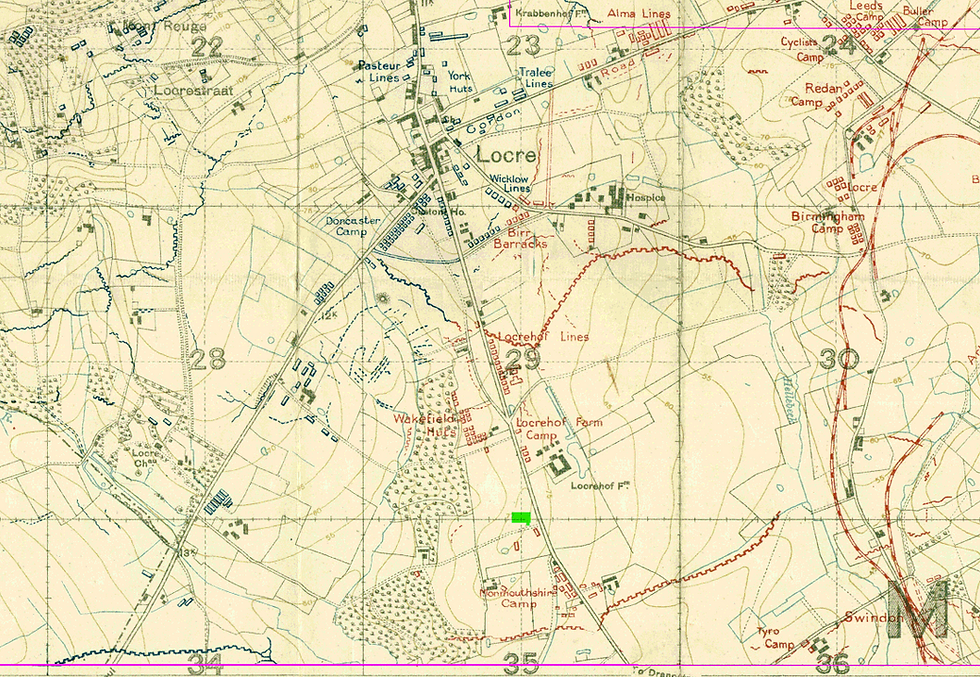
On the 19 August the Battalion received orders to attack Locrehof Farm Ridge with the objective of capturing the ridge on the night of 20/21 August. All troops were in their positions for the attack by 1am on 20 August. On their right was the 7th/8th Battalion Inniskilling Fusiliers and on their left the 2nd/14th Battalion (London Scottish). The Battalion attacked on a 400 yard front with two companies in the front line, each with two platoons in the front line and two platoons in rear as moppers up, who formed the support line on reaching the objective. At 02.05am the barrage opened 150 yards in front of the leading companies and moved forward 100 yards every four minutes. The German counter battery came down 50 yards in the rear of the troops but was deemed not to be a ‘serious barrage.’ The attacking companies moved forward and met a certain amount of resistance form German machine-guns with the final objective taken within 52 minutes of the opening of the attack and consolidation begun. They took 50 prisoners along with 3 machine-guns. From 9am on 21 August the Germans began to shell the new line and this increased in intensity as the day wore on and at 10pm they launched a counter

attack capturing the left of the Battalion line however, this was immediately restored following a counter attack. The Battalion casualties were two officers killed, and three wounded. Other Ranks, 18 killed, 91 wounded, 22 missing. 31097 Private William Jaundrell, Killed in action 21 August 1918, age 30. Grave Special Memorial 3. Son of Benjamin and Emma Jaundrell, 8 Hollinswood, Oakengates, Shropshire. He was employed as a Moulder in a local Iron Works. Second Lieutenant Herbert Victor Larsen, 3rd Battalion attached 2nd Battalion, Killed in action 23 August 1918, age 23. Grave C.17. Son of Fanny Adeline Larsen, 145 Warwick Road, Carlisle, and the late Louis Francois, Larsen. He enlisted in the 20th Battalion Royal Fusiliers and went to France on 15 November 1915. He was gazetted a Second Lieutenant on 17 December 1917 and joined the 3rd Battalion South Lancashire Regiment and was attached to the 2nd Battalion. The War Diary records his death: ‘2/Lieut H.V. Larsen Killed 21st August’

2/14th Battalion (2nd London Scottish), 90th Brigade, 30th Division
The Battalion was involved in the attack by 30 Division on 20/21 August. They attacked through Wakefield wood which proved to be a considerable obstacle but was overcome due to the artillery barrage. The Battalion gained all their objectives by 3am and consolidation began. They had to pull back their right flank to conform with the 2nd Battalion South Lancs on their right. 511724 Private Edward Wells, Killed in action 21 August 1918, Grave Special Memorial 1. 514244

Private Stanhope Marcus Hamilton Medrington, ‘A’ Company, Killed in action 21 August 1918, age 37. Grave Special Memorial 2. Son of Arthur Stanhope Medrington and Marion Medrington, 58 Leyland Road, Southport. He was married to Grace Annie Medrington, 44 Grosvenor Road, Birkdale, Southport. They did not have any children. He was working as a Photographer when he enlisted on 10 December 1915. He then spent a considerable period of time on Home service on the Army Reserve before being sent overseas to Salonika on 19 February 1917. On the 27 February he was diagnosed with German measles and spent time in hospital and recuperating before he rejoined the Battalion on 7 April. The Battalion was in Palestine when it was sent to France in July 1918. Following his death his wife wrote to the Military authorities on the 8 September 1918 looking for more information about the whereabouts of her husband. A letter sent to him had been returned to her marked ‘…Missing 29th Aug. & that is all we know. We have not heard from him since August 24th….’ A reply to her letter is not on his file. His personal possessions were returned to his wife and they consisted of photographs, two pairs of glasses in cases, and a piece of music.
15th Battalion Sherwood Foresters (Notts and Derby Regiment), 105th Brigade, 35th Division. The Battalion was in the line in the Kemmel sector relieving the 358th French Infantry Regiment on the night of 5 July and the Battalion went into reserve. They then rotated in and out of the line relieving the 4th Battalion North Staffs. They undertook night working parties and patrolling work on the front line. On the night of 17/18 July they were relieved by the 15th Battalion Cheshire Regiment and went into reserve billets recording their casualties for the period 9 to 18

July as ‘36 casualties during tour in Front Line & Support.’ They again went into the line on 21 July and were providing night working parties and patrolling the front line. They do not record any casualties for this period from 21 July to 31 July. 14204 Private Levi Richardson, Killed in action 17 July 1918, age 29. Grave C.3. Son of Abraham and Charity Richardson, 60 High Street, New Mills, Derby. They had three sons and four daughters. The 1911 census shows that he was working as a Labourer in a print works and was a boarder. He went to France on 14 July 1915. 24529 Corporal William Albert James Penny M.M., Killed in action 25 July 1918, age Grave A.1. Son of Jennie Penny, 18c Peabody Buildings, Lille Road, Fulham. Second Lieutenant Charles Edward Woodroffe, 15th Battalion, Killed in action 27 July 1918, age 30. Grave A.5. He was born in Wallasey, Cheshire, one of four sons and a daughter of Charles and Harriet Woodroffe, Mere Bank, Promenade, Liscard, Cheshire. He married Miss J. Simcock in Wallasey on 5 March 1918. He enlisted in the Lancashire Hussars on the 7 September 1914 and was serving with them as Lance Corporal until he was gazetted Second Lieutenant on 17 December 1917.
Location
Locre No. 10 Cemetery is located 11.5 Kms south-west of Ieper town centre, on a road leading from the Dikkebusseweg (N375). From Ieper town centre the Dikkebusseweg is reached via Elverdingsestraat, straight over a roundabout onto J.Capronstraat (for 30 metres), then left along M.Fochlaan. Immediately after the train station, the first right hand turning is the Dikkebusseweg. On passing through the village of Dikkebus the road continues for 6 Km to the village of Loker. Continuing through the village of Loker the road becomes the Dikkebusstraat which runs for 2 Km to the village of Dranouter. The cemetery is located 1.5 Kms after this turning on the right hand side of the road.
The cemetery was designed by W H Cowlishaw.

Burials
The cemetery now contains 58 Commonwealth burials and commemorations of the First World War. 14 of the burials are unidentified but there are special memorials to three casualties known or believed to be buried among them. Only three of the 75 German burials are identified.
UK – 55 (14 of which are unnamed)
German - 150


Comments