


La Brique Military Cemetery No.2

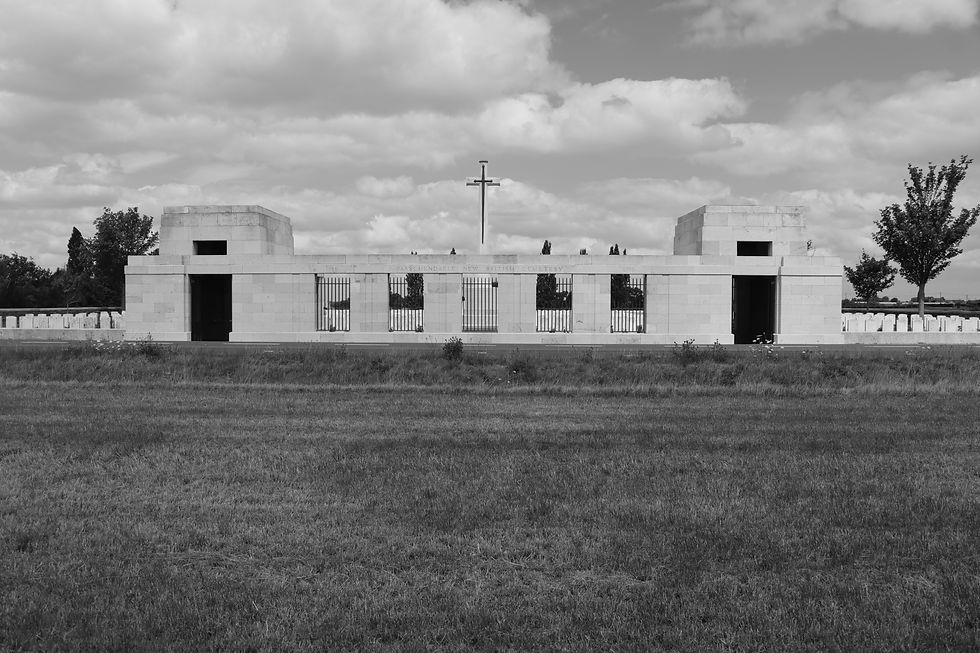
La Brique Military Cemetery No.2, CWGC, Ypres, is opposite La Brique Military Cemetery No.1 on the main road (Pilkemseweg). La Brique is a small hamlet named from an old brick works that used to stand nearby before the First World War. La Brique Military Cemetery No.2 was begun in February 1915 and used until March 1918. The original cemetery consisted of 383 burials laid out in 25 irregular rows in Plot I. After the Armistice, graves were brought in from the battlefields to create Plot II and extend the original Plot I.

The Case of the Unknown Cavalry Officer
Lieutenant John Herbert Butler Hollings, 21st (Empress of India’s) Lancers attached 9th (Queen’s Royal) Lancers, Killed in action 30 October 1914, age 26. Grave I.D.6. Son of Herbert John Butler Hollings, D.L., J.P. and Nina Hollings of "Watchetts", Frimley, Surrey. He was educated at Eton and Magdalene college, Cambridge. He applied for a cadetship at the Royal Military Academy at Sandhurst after he left Eton but was unsuccessful due to problems with his eyesight. He was admitted to Magdalene College in 1907 and he then joined the Hampshire Imperial Yeomanry and then transferring to the 21st Lancers, a part of the Indian Army. He was in Cairo in 1911 and on the outbreak of war he was on leave in England. On 24 September 1914 he was transferred to the 9th Lancers and went to France. On the 30 October the Regiment were involved in heavy street fighting in the village of Messines and what happened to John is in a report, later submitted by Captain Charles Moncreiff, King’s Own Scottish Borderers, on 3 February 1915: ‘I regret to say that in Messines on the night of 31st October, in the garden of the Convent school there, I found the body of a subaltern of the 21st Lancers. He seemed to have been standing on a ladder looking out over the garden wall, and to have been killed by a shell which had brought down the wall at this place, as well as the ladder on which he was standing. As the hour was very late, I did not look for his identity disc, and next morning before I had been to the place again to identify and to arrange for his burial, we were ordered to retire from Messines; but if the casualty lists of the time do not allow for the death of any other subaltern of the 21st Lancers at that time and place, I am afraid that he must be identified as Mr. Hollings. He was in a remote corner of the garden, and it is probable that no one else of the Cavalry Brigade saw him killed.’ His body was exhumed on 4 January 1922, identified from clothing and buttons, and reburied at La Brique No.2 Cemetery as an Unknown British Officer and his name was listed on the Menin Gate. It was following an investigation in 1992 that all the evidence proved that the Unidentified Officer at La Brique No.2 Cemetery was John.

Alias
101125 Private Maurice Bourque (served as Maurice Burke), 49th Battalion Canadian Infantry. Killed in action between 2 June and 5 June 1916, age 37. Grave I.U.30. Son of Olivier Bourque and Exibert Eauclaire, his wife, of Corbeil, Ontario. His body was exhumed from a battlefield burial at Sanctuary Wood it was identified from his disc, along with three other Canadians one of whom was Lieutenant M.M. Carthen who was killed in the counter-attack on 3 June, and reburied at La Brique No.2 on 21 November 1921. The Battalion was involved in a counter-attack following the German attack at Observatory Ridge on 2 June 1916. They attacked the German lines on 3 June with the War Diary recording heavy casualties amongst the officers and the Other Ranks 45 killed, 257 wounded, and 69 missing. His date of death is given as between 2 and 5 June however, it is recorded in the Canadian records as 2 June. It is more likely to have been on 3 June.

Victoria Cross Holder
S/107 Corporal Alfred George Drake, 8th Rifle Brigade (The Prince Consort’s Own), 41st Infantry Brigade, 14th (Light) Division. Killed in action 23 November 1915, age 22. Grave I.C.2. Son of Robert and Mary Ann Drake, 62 Copley Street, Stepney, London. He won his V.C. at La Brique. An extract from his citation in The London Gazette of 21 January 1916 states: ‘For most conspicuous bravery on the night of 23rd Nov. 1915, near La Brique, Belgium. He was one of a patrol of four which was reconnoitring towards the German lines. The patrol was discovered when close to the enemy who opened heavy fire with rifles and a machine gun, wounding the Officer and one man. The latter was carried back by the last remaining man. Corporal Drake remained with his Officer and was last seen kneeling beside him and bandaging his wounds regardless of the enemy's fire. Later a rescue party crawling near the German lines found the Officer and Corporal, the former unconscious but alive and bandaged, Corporal Drake beside him dead and riddled with bullets. He had given his own life and saved his Officer.’ On the 16 November 1916, his father was presented with Alfred’s V.C. by King George V at an investiture ceremony at Buckingham Palace. The officer rescued by Alfred was Lieutenant Henry Tryon, Rifle Brigade. After he recovered from his wounds he rejoined the Rifle Brigade and was killed in action at Flers-Courcelette on 15 September 1916.

Gas Attack
Lieutenant Alexander Evan Fraser, Mentioned in Despatches, 2nd Battalion Monmouthshire Regiment, 12th Infantry Brigade, 4th Division. Killed in action 2 May 1915, age 34. Grave I.K.34. Son of James C and Emily Fraser, of Ingleside, Lynton, Devon. The Battalion was in Divisional reserve at La Brique. The front line trenches being held by the Essex Regiment came under a chlorine gas attack and part of the line was evacuated with the defenders being overcome by gas however, a few men of the Essex Regiment stayed to defend the trenches and were supported by ‘C’ Company of the Monmouthshire Regiment in holding the line. At 7pm ‘B’ Company sent two Platoons to reinforce the Royal Irish Rifles in their trenches. The War Diary records the Battalion casualties as ‘2 Officers Killed (Lieut A E Fraser and 2 Lieut Reid), one officer wounded, 5 Other Ranks killed, 22 wounded, and 4 missing with 40 men gassed.’
Failed attack by the Lahore Division
Major Bernard Maynard Lucas Brodhurst, 1st Battalion, 4th Gurkha Rifles, 9th (Sirhind) Brigade, 3rd (Lahore) Division, Indian Corps. Killed in action 27 April 1915, age 41. Grave I.G.21. Son of the late Mr. Justice Maynard Brodhurst, of the High Court, United Provinces, India, and Mrs. Mary Brodhurst. He was educated at Clifton College and the Royal Military College, Sandhurst. He joined the Indian Army and was gazetted to the unattached list in September 1892 and served with the 2nd Battalion Border Regiment for twelve months and in January 1894 he was appointed to the 1/4th Gurkha Rifles and promoted to Lieutenant. He was made Adjutant in 1900 and promoted to Captain in September 1901 and from 1903 to 1906 he was Inspector of Signalling for the Imperial Service Troops. The Battalion arrived in Marseilles from Egypt on 30 November 1914 and deployed to the front line in December. On 27 April Bernard was in temporary command of the Battalion when the Sirhind Brigade was to support a half-hearted French attack around Langemark and to retake the trenches and ground lost during the German gas attack of 22 April. The Brigade already had two Battalions employed in the British forward area the 15th Sikhs on the left against the Langemark to Ypres road, and the 1st Battalion Highland Light Infantry to their right. The plan was for the 1/1st Gurkhas and the 1/4th Gurkhas to pass through the lines. It should be noted at this stage of the battle the British commanders were knowingly sacrificing the lives of their men against ill-defined objectives in order to keep the French happy. The Brigade went forward at Hill top Ridge and in no time was taking heavy casualties from sever frontal cross fire from rifles and machine guns. The leading battalions slowed and halted and progress into what was later to be named Colne Valley in front of Canadian Farm was made. A small party of the 1/4th Gurkhas entered the farm but they could not be reinforced until after 4pm when the 4th King’s moved forward. By now all movement forward has stopped due to heavy enemy fire, the French having not left their positions as they were pinned down. The attack was a failure and the day ended with heavy casualties in the Indian Division. Bernard being one of them. His body was exhumed from a battlefield burial near St Jean on 16 December 1921 and reburied at La Brique No.2 Cemetery. His body was identified from his identity disc, the disc was handed to a relative who was present at his reburial.
Boy Soldiers
In the Ypres Salient, we are drawn to the graves of 6322 Private John Condon, 2nd Battalion Royal Irish Regiment, killed in action in May 1915, age 14 and the youngest known battle casualty of the war, although this is now questioned, and the grave of 5750 Valentine Strudwick, 8th Rifle Brigade, killed in action in January 1916, age 15. Strudwicks grave attracts a great deal of attention because of its location at Essex Farm and that locations association with Lieutenant Colonel John McCrae and the poem ‘In Flanders Fields.’ There are many more ‘Boy Soldiers’ buried across the Salient and who are not remembered in the same way and these include three from Falkirk District Private William Jamieson, age 17, Private James Duchart, age 16, and Private Herbert Richmond, age 17. There were many reasons why under age boys enlisted in 1914 and 1915 boredom with their jobs, looking for adventure, and escaping family pressures. The checks on age and qualification to enlist were more relaxed than later in the war. The army preferred younger recruits, there was a history of boy soldiers in the army going back over one hundred years. At Waterloo the army had a number of boy soldiers in their ranks. The army preferred younger recruits as they would follow orders and accept discipline more readily than older men. The boys had a belief in their own indestructibility and were prepared to take more risks. We tend to also forget the number of boys who served in the Royal Navy and we do not seem to have the same passionate response to their service as we do those who fought on the Western Front. With regards to the army, the difference was the sheer number who served on the Western Front and there were more boy soldiers in 1915 than served in Wellington’s army at Waterloo. For further reading on this subject see Richard Van Emden’s excellent book Boy Soldiers of the Great War.
There are six Boy Soldiers buried here.
2236 Private W.A. Auther, 1st/2nd Battalion Monmouthshire Regiment, 12th Infantry Brigade, 4th Division. Killed in action 3 May 1915, age 17. Grave I.K.31. Son of Jane Auther, 12 Rochfield Houses, Osborne Road, Pontypool. The Battalion was in Divisional reserve at La Brique when it was heavily shelled. G/7858 Private Frank Charles Baker, 1st Battalion The Buffs (East Kent Regiment), 16th Infantry Brigade, 6th Division. Killed in action 19 April 1916, age 17. Grave I.U.17. Son of Richard William and Charlotte Baker, 7 Wood Road, Hythe, Kent. On the 19 April the Battalion was in the line in the Morteldje sector with the War Diary recording that the Germans had opened a barrage on the Battalion positions at 7.30pm with the casualties being recorded as 15 Oher Ranks killed and 9 Other Ranks wounded. 5701 Rifleman Cecil Richard Enfield, 3rd Battalion Rifle Brigade (The Prince Consort’s Own), 17th Infantry Brigade, 6th Division. Killed in action 6 September 1915, age 17. Grave I.P.29. Son of Walter and Elizabeth Mary Enfield, 21 Mile End, Colchester. He had an older brother Walter. The War Diary records that the Battalion was in the trenches near Wieltje. The War Diary only records the casualties of ‘2 killed 1 wounded’ on 6 September. 5078 Rifleman Thomas Alexander Maynard, 3rd Battalion Rifle Brigade, (The Prince Consort’s Own), 17th Infantry Brigade, 6th Division. Killed in action 2 October 1915, age 17. Grave I.H.16. Son of Thomas James and Annie Delve Maynard, 1 Waterworks Cottages, Friston, Eastbourne. The War Diary records that the Battalion was in the line near Wieltje. At 9am on 2 October the trenches were heavily shelled with the casualties recorded as ‘5 Other Ranks killed, 11 Wounded, and 3 Died of Wounds.’ 5/379 Corporal Jack Heath, 8th Battalion Rifle Brigade, (The Prince Consort’s Own), 41st Infantry Brigade, 14th (Light) Division. Killed in action 12 December 1915, age 17. Grave I.B.14. Son of Thomas and Alice Heath, 48 Lees Street, Lodge Road, Birmingham. 17367 Private William Edgar Yates, 1st Battalion King’s Shropshire Light Infantry, 16th Infantry Brigade, 6th Division. Killed in action 30 September 1915, age 17. Grave I.O.37. Son of Agnes Fryer (formerly Yates), of 177, Ladypool Road, Sparkbrook, Birmingham, and the late William Yates. Native of Colton, Rugeley. The War Diary records that the Battalion was in the support trenches at La Brique. They were subjected to constant shell fire and fire from trench mortars. At 11.30am three heavy shells burst over ‘D’ Companies trench killing one and wounding 17 men who were working on the new Company HQ. At 8.15pm two shrapnel shells killed 2 and wounded 2 men of ‘D’ Company.
Location
The cemetery is located to the North-East of the town of Ieper. From the station turn left and drive along M.Fochlaan to the roundabout, turn right and go to the next roundabout. Here turn left into M.Haiglaan and drive to the next roundabout. Here turn right into Oude Veurnestraat, this then changes into Diksmuidseweg and Brugseweg drive along this road to the traffic lights, at the lights turn left into Industrielaan then turn first right into Pilkemseweg, the cemetery is approximately 300 metres on the right.
The cemetery was designed by Sir Reginald Blomfield
Burials
There are now 840 Commonwealth servicemen of the First World War buried or commemorated in this cemetery with 400 of the burials unidentified, but special memorials commemorate four casualties known or believed to be buried among them.
UK – 788
Australian – 18
New Zealand – 9
Canadian – 23
South African – 7
Of the total there are 389 unidentified


Comments