


Oak Dump Cemetery
Updated: Mar 21

Oak Dump Cemetery, CWGC, Ypres, was established by fighting units during the summer months of July, August, and September 1917. One grave from 1914 was relocated here after the Armistice, notably that of Second Lieutenant A K Nicholson. This cemetery occupies what was once No Man’s Land and is now bordered on three sides by the Pallingbeek Country Club golf course.
On 14 February 1915, the 2nd Battalion East Surrey Regiment, part of the 85th Infantry Brigade, 28th Division, launched an attack on the nearby Triangular Wood, located just south of Oak Dump Cemetery. Their objective was to reclaim a lost trench. The assault began at 2 PM, but the troops faced significant challenges as they crossed exposed and open ground. ‘A’ Company suffered devastating losses, nearly losing all their officers, while ‘C’ Company also faced heavy casualties. In the autumn of 2025, archaeologists conducted a dig at the site of Triangular Wood, uncovering remnants of this fierce battle.


On 7 June 1917, the opening day of the Battle of Messines, British trenches were situated approximately 150 metres east of Oak Dump, with German lines about 200 metres beyond. At 3:10 AM, the 1/7th Battalion London Regiment launched an attack, capturing Oak Trench, Oak Support, and Oak Reserve. They encountered their first significant resistance at the White Chateau, where machine guns targeted the Company assigned to take Oak Switch. Despite the fierce opposition, the Battalion succeeded in taking the objective, capturing 80 prisoners, three machine guns, and two minenwerfers. A tank, called for during the assault, arrived at 8:15 AM, by which time the Chateau had been secured, and consolidation efforts were underway. The British repurposed the Chateau’s cellar as an Advanced Dressing Station.

Second Lieutenant Eric Henderson, of the 8th (City of London) Battalion (Post Office Rifles), was killed in action on 7 June 1917, at the tender age of 21. He was the son of Reverend Joseph Graham Henderson and Emily Alice Henderson, residing at "Spenholme," 13 Marriott Road, Barnet, Herts. His epitaph poignantly captures his mother’s grief: "TREAD SOFTLY O'ER MY BEAUTIFUL ERIC'S GRAVE FOR A MOTHER'S LOVE LIES HERE." Eric enlisted in the 28th Battalion London Regiment in July 1915 as a Private and was later commissioned. He joined the 8th Battalion and participated in the attack alongside the 7th Battalion on the German trenches at Oak Trench and White Chateau. Tragically, he was killed during the assault on White Chateau. Initially buried near Voormezeele, his body was lost and later listed on the Menin Gate Memorial. In 2017, workers widening the road at Eekhofstraat near Voormezeele discovered his remains. Eric was reburied with full military honours at Oak Dump Cemetery on 16 May 2018, with a burial party provided by the Royal Artillery Regiment.
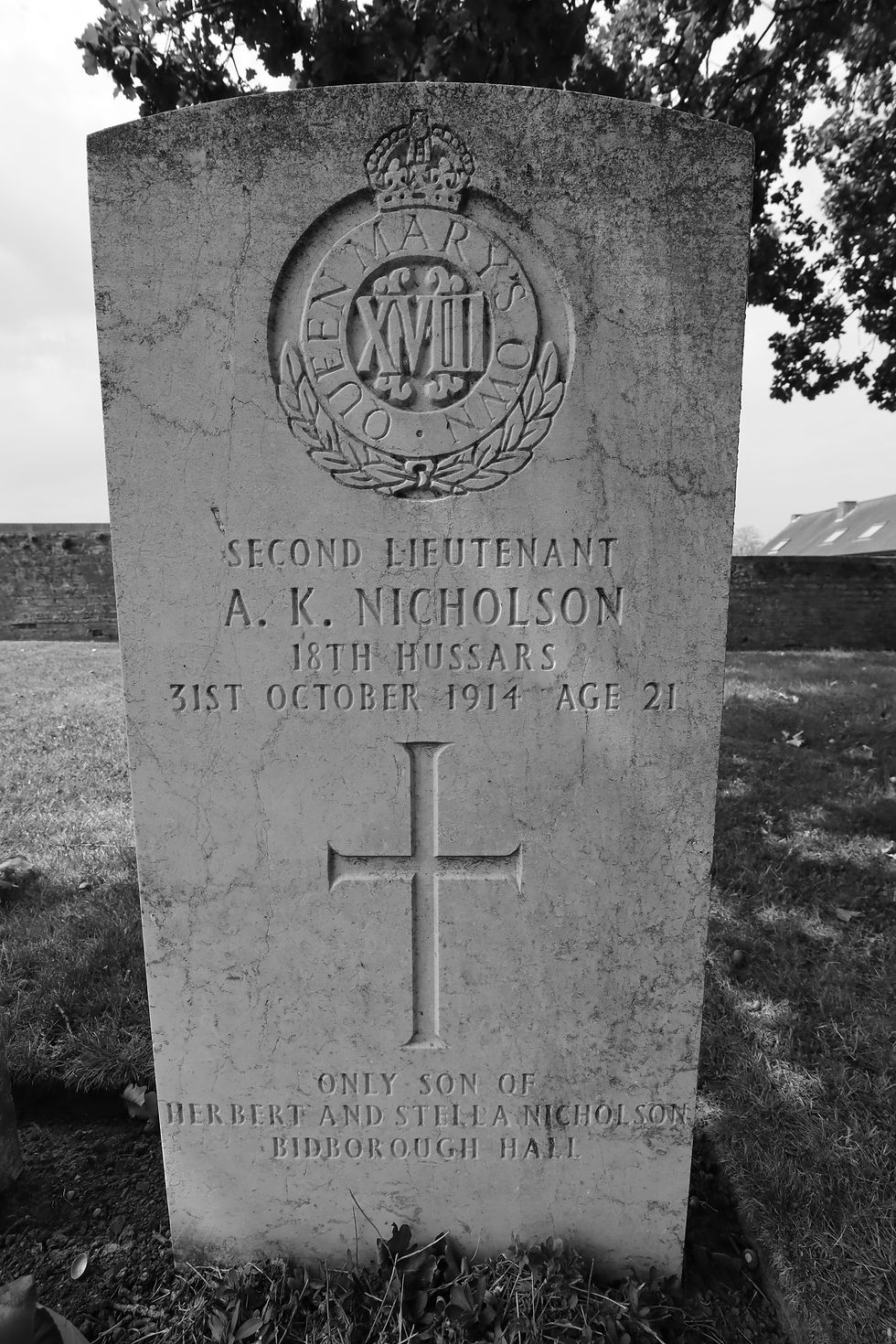
Second Lieutenant Arthur Knight Nicholson, ‘B’ Squadron 18th (Queen Mary’s Own) Hussars, 2nd Cavalry Brigade, 1st Cavalry Division. Killed in action 31 October 1914, age 21. Grave J.7. The only son of Herbert and Stella Nicholson, of Bidborough Hall, Tunbridge Wells, Kent. He was educated at harrow before being admitted to the Royal Military College at Sandhurst form 1911 to 1912 from where he was gazetted as a Second Lieutenant and joined the cavalry. He went to France on 15 August 1914. On the 30 October the Regiment had moved into the line having taken over the sector from troops of the 3rd Cavalry Brigade and the 129th Duke of Connaught’s Own Baluchis, a Regiment of the British Indian Army, near Hollebeke Chateau. The trenches occupied by ‘B’ Squadron were attacked on the afternoon of 31 October by Germans from their trenches on front of them and this was fought off with twelve dead Germans being observed int eh Chateau grounds. Arthur was killed by a sniper firing from the German trenches that ran along the road south west of the Chateau when he was observing the enemy line from his trench. He was buried in Voormezeele Enclosure No.3 under a ‘Memorial Cross Without Remains’ and it would seem that his body was subsequently found, exhumed, and reburied here after the Armistice.

Second Lieutenant Osmond Pickard Brown, 3rd Battalion attached 11th Battalion Queen’s Own ( Royal West Kent Regiment), 122nd Infantry Brigade, 41st Division. Killed in action 31 July 1917, age 19. Grave C.21. Born at Aylestone. Son of Mr. and Mrs. A. E. Brown, The Firs, Aylestone, Leicester. The Battalion was in the line and preparing for the opening attack of third Ypres on 31 July. They were assembling in the vicinity of White Chateau and were coming under artillery fire. At 3.20am the Germans spotted the left Company during the assembly and put down a barrage 100 yards to their rear. A few casualties were recorded. They advanced from White Chateau on Hollebeke and had taken their objectives with 60 prisoners being sent down the line. On consolidating their line they had been subjected to machine gun fire Hollebeke and sniper fire from the vicinity of the canal. Osmond’s death is not recorded nor are the casualty figures.
Shared Grave Plot
There are six men buried in shared grave plots from the 22nd (County of London) Battalion (The Queen’s) London Regiment, 142nd Infantry Brigade, 47th Division, all killed in action on 6 July 1917. The Battalion trenches near White Chateau were heavily shelled that morning. During the night, ‘C’ Company relieved ‘A’ Company in the front line. Unfortunately, the Germans shelled the Battalion lines during this relief, resulting in several casualties. The Battalion transport was returning from the section dump at Bois Confluent at 11pm when they were also heavily shelled, leading to two men killed and four wounded. Total casualties for the 6/7 July were Other Ranks 15 killed and 10 wounded, including 5 killed and 5 wounded from XII Corps Cyclists attached to the Battalion.
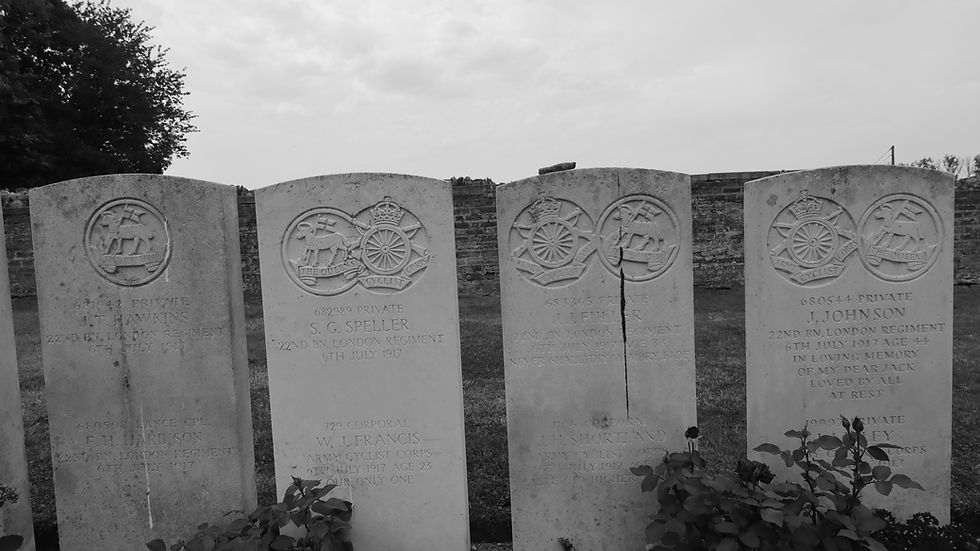
The key reasons for two names on a headstone:
Proximity of Burials: In areas with heavy casualties, like battlefields or hospital cemeteries, soldiers were sometimes buried in narrow trenches or mass graves, side-by-side. Inability to Separate Remains: If two identified bodies were found together, perhaps intertwined, they were sometimes buried as one unit, requiring a single memorial. Space Constraints: When burials were close, the Commonwealth War Graves Commission (CWGC) would sometimes use a single stone for two (or even three) men to conserve space, occasionally omitting elements like the cross or regimental badges to fit the names. Communal Graves: While many communal burials have individual headstones, the 'two names' scenario often arises from adjacent, identified graves where a single marker was more practical.
In essence, it's a practical solution by the CWGC to commemorate identified soldiers when physical separation wasn't possible or feasible due to wartime conditions, ensuring both men received a memorial.
8th (City of London) Battalion (Post Office Rifles), 140th Infantry Brigade, 47th Division. Killed in action 14 July 1917. There are six men buried here who were killed in action on the same day. On the 14 July 1917, the Battalion relieved the 6th Battalion London Regiment on the night of 14/15 and moved into the left support trenches with their HQ in Spoilbank. The casualties during the relief were two officers wounded and six Other Ranks killed and six wounded.

Artillery
In March 1918, a sap (an observation post) opposite the cemetery was blown in, resulting in the deaths of seven men from the 180th Siege Battery, Royal Garrison Artillery. Their bodies were discovered in 1927 and subsequently buried in the cemetery.


Location
Oak Dump Cemetery is located 5 Kms south of Ieper town centre, on the Bernikkewallestraat a road leading from the Rijselsesweg (N365) connecting Ieper to Armentieres. From Ieper town centre the Rijselseweg is located via the Rijselsestraat, through the Rijselpoort (Lille Gate) and by crossing the Ieper ring road, towards Armentieres and Lille. The road name then changes to Rijselseweg.3 Kms along the Rijselseweg lies the left hand turning onto the Vaartstraat. 1 Km along the Vaartstraat lies the first right hand turning onto the Bernikkewallestraat. The cemetery itself lies 1 Km along the Bernikkewallestraat on the right hand side of the road.

The cemetery was designed by W H Cowlishaw.
Burials
The cemetery now contains 111 Commonwealth burials of the First World War, five of them unidentified. Two of the graves destroyed by shell fire are represented by special memorials.
UK – 109 (Includes 5 Unknown)
Australian - 2


Comments