


Passchendaele New British Cemetery
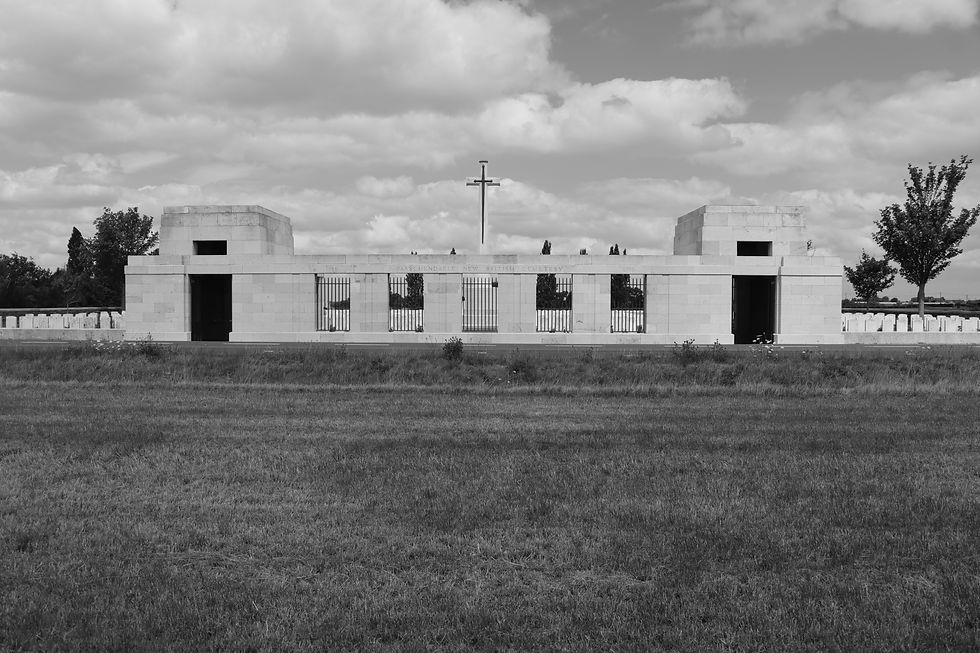
Passchendaele New British Cemetery was created after the Armistice and is a concentration cemetery with the graves exhumed from the battlefield. The entrance to the cemetery is rather austere and is akin to the entrance to a fortress. There is an Albertina Marker to the right of entrance, they mark the 50th anniversary of the death of King Albert I of Belgium and the 70th anniversary of the outbreak of World War I. The 97th Infantry Brigade, 32nd Division launched a night attack on the German lines on 2nd December. The Brigade included the 16th and 17th Battalions HLI and you can read the account taken from their War Diary of the 17th Battalion below. This cemetery has the largest number of Canadian burials, many unknown, outside of Tyne Cot and Lijssenthoek Military Cemetery. The village of Passchendaele provided billets for the Household Cavalry, the Life Guards and the Royal Horse Guards, of the 7th Cavalry Brigade in October 1914, and they handed over Passchendaele to the French Cavalry and

Territorials on 18 October, and on 20 October it was in German hands, where it remained for the next three years. On 6 November 1917, after the severest fighting in most unfavourable weather, the 5th Canadian Infantry Brigade took, and passed, the village; this fight was part of the Second Battle of Passchendaele, the last of the Battles of Third Ypres, 1917. In the middle of April 1918, in the Battles of the Lys, the Allied line was withdrawn far back on the road to Ypres, but on 29 September, in the course of the Allied offensive in Flanders, Belgian forces recaptured the devastated village. There are six Memorials on the wall of the Town Hall, two of which commemorate units of WWII. The other three, one is the Western Front Association Passchendaele Memorial, and the others commemorate the 4th Belgian Carabiniers and the Belgian Grenadiers. There is also a plaque to the Canadians who won the V.C. during the Battle of Passchendaele.

In the church of Sint-Audomarus there is a stain glass Memorial window commemorating the 66th (2nd East Lancashire) Division with the names of Lancashire towns around the central figure of St George. On the road from Passchendaele to Broodseinde is the Memorial to the Canadian 85th Infantry Battalion (Nova Scotia Highlanders) it is set back in fields along a 150 yard grass path. It lists the names of thirteen officers and 135 other ranks who were killed in action here and marks the site of the battle HQ. It is the only Canadian battalion memorial on the Western Front that lists the dead. It was erected here in 1919 before the Battalion had returned to Canada. The main Canadian Memorial is located at Crest Farm approximately 500m west of the Passchendaele church along the Vierde Regiment Karabinierstraat road.


Canadian
Alias

454827 Private Joseph Bertrand (served as Bertroud), 2nd Battalion (Eastern Ontario Regiment), 1st Canadian Brigade, 1st Canadian Division. Killed in action 6 November 1917, age 26. Grave IV.C.17. Son of Edward Bertrand and Marguerite David, 386 Craig Street, Montreal. He was employed as a Lumberman when he enlisted on 13 March 1915 and giving his age as 22 and his name as Joseph Bertroud of New Port, Quebec. He arrived in England on 23 November 1915 and joined the 2nd Battalion in France on 15 March 1916. He was wounded by a gunshot wound to the right leg on 20 September and spent time in the 3rd General Hospital in Boulogne and then in the Duston Hospital in Northampton before going to the Canadian Casualty Assembly Centre at Folkstone where he was evaluated to determine whether he was fit to return to active service. He discharged to the 6th Reserve Battalion on 25 January and rejoined the 2nd Battalion in the field on 9 March 1917. On the 28 August he received a gunshot wound to the head and was transferred to the No.22 General Hospital at Comines and then to the Base at Etaples and from there he rejoined the Battalion on 8 September. On the 5 November 1917 the Battalion was in the centre section of the Brigade front line at Capricorn West with their HQ in Waterloo Farm and were preparing for the attack on the Brigade front on 6 November up the Bellevue Ridge. Both the 1st and 2nd Battalions had their joint HQ in Meetcheele Pill Box located on the Mosselmarkt Road. At 6am the Battalion went forward behind a supporting barrage with the objectives of Vegetable Farm, Mosselmarkt, and Valour Farm on the Passchendaele Ridge. Due to flooding around Furst Farm the Battalion had to reduce their frontage from 300 yards to 100 yards squeezing through a narrow strip of land under intense German artillery fire. By 9.30am the Battalion had achieved all their objectives with casualties reported as 300 from all ranks. They reported difficulty in recovering the wounded and burying the dead due to enemy shell fire on the road leading from Meetcheele Pill Box to Waterloo Farm.


231462 Private Alexander Decoteau, 49th Battalion (Edmonton Regiment), 7th Infantry Brigade, 3rd Canadian Division. Killed in action 30 October 1917, age 28. Grave XI.A.28. Son of Peter and Dora Pambrun Decoteau, of Battleford, Saskatchewan. Alexander was a first nation Cree Indian and was educated at the reserve day school and then the Battleford Industrial School. He then worked as a farm hand before he moved to Edmonton and was then employed as a Blacksmith with his brother-in-law. In 1909 he joined the Edmonton City Police and was promoted to Sergeant in 1914. He was an accomplished athlete representing Canada and competing as a middle or long distance runner in the 1912 Olympics in Stockholm and finished eighth place on the 5,000 metres, he was hindered by leg cramps. Between 1909 to 1916 he hardly lost a middle/long distance race he entered in western Canada. He enlisted 24 April 1916 joining the 202nd Infantry Battalion arriving in England on 30 November 1916 and was posted to the 49th Battalion on 27 May 1917. He was to be killed in action during the Canadian advance up the Ravebeek valley on 30 October 1917. In 1985 his relatives and friends held a ceremony in Edmonton to bring his spirit back, it was a belief of the Cree Indians that since he had not had a Cree burial his spirit was left to wander. The ceremony was attended by the Cree Indian Council Members, native veterans, the Canadian army, and a ten man honour guard was provided by the Edmonton Police Department with a Piper from the Edmonton Police playing a lament, and a burial song was sung to guide his spirit home.

Captain Rider Lancelot Haggard, No.3 Company Princess Patricia’s Light Infantry, Killed in action 30 October 1917, age 24. Grave VIII.A.19. Son of Major Arthur Haggard and Mrs Emily Haggard, 27J Bramsham Gardens, Kensington, London. He was educated at Hinwick House, Wellingborough and at Wellington College leaving here in 1911 and emigrating to Canada where he entered the banking business. He listed his trade as a Bank Clerk when he enlisted in Ottawa on 25 August 1914 as a Private in the PPCLI. He was the nephew of the novelist Sir Rider Haggard the author of King Solomon’s Mines and She. His father was the founder of the Veteran’s Club in London which had a membership of 8,000, including many Canadians. On the 18 February 1915 he was admitted to the No.2 Canadian Stationery Hospital in Le Touquet with jaundice and was again in hospital on 23 March 1915 this time the No.9 General Hospital in Rouen with a perforated ear drum and an ulcer on his right foot, this his records record was contracted by his boot rubbing on his foot and occurred when he was at Dickebusch and he was transferred to the Royal Victoria Hospital in Netley. There is a wonderful description of the medical treatment for his foot ulcer in his records. He was granted a commission on 10 August 1915 as acting Lieutenant and was detailed for 14 days attachment to a Canadian Battalion from 1 to 17 December 1915 and he then joined a General Instruction course at Shorncliffe on 30 December and was then posted to the PPCLI on 29 January 1916. Now a Lieutenant he was wounded, gunshot wound right arm, on 19 September 1916 and was in the No.14 General Hospital in Boulogne and was transferred to the Northumberland War Hospital in Newcastle-on-Tyne. On discharge from here on 7 October 1916 he rejoined the PPCLI. He was promoted to Captain on 21 January 1917 and then to acting Major while commanding a Company from 10 April to 4 June reverting to Captain. He was killed in action during the Canadian advance up the Ravebeek valley on 30 October 1917.
Highland Light Infantry
There are 15 men from the Regiment buried here. One serving with the 9th (Glasgow Highlanders) Battalion, four from the 15th Battalion, nine from the 16th Battalion, one from the 17th Battalion.

9th (Glasgow Highlanders) Battalion, 100th Infantry Brigade, 33rd Division
350222 Private William King, Killed in action 28 November 1917, age 33. Grave XVI.D.1. Son of Morris and Jessie King, 3 Annan Place, Largs, Ayrshire. Formerly enlisted with the Royal Scots Fusiliers. On the 28 November the War Diary records: ‘Coys at Disposal of O.C. Coys for feet massage and Coy Inspections.’ The Battalion was at Potijze and were providing working parties carrying stores and ammunition to the front line along the duckboard walk ways. The area was shelled heavily by various calibre of guns. A vivid account is given in Alec Weir’s Book Come on Highlanders! when he quotes from Colonel A. K. Reid’s book Shoulder to Shoulder: ‘The way up to the front line was along miles of duckboard tracks through a sea of mud in which it is scarcely an exaggeration to say that at no place could one see a shell hole which was not touching another… the tracks – which could not be hidden from the enemy -were well known to the enemy, and were constantly under fire…’
15th Battalion (1st Glasgow), 14th Infantry Brigade, 32nd Division
The four men were all killed on 29 November 1917. The Battalion were in support at Bellevue in shell hole positions and providing carrying parties to the front line and the Passchendaele Salient which was 1,000 metres wide and extended to a depth of 3,000 metres with the whole area overlooked by the enemy and shelled by guns of various calibres and by gas shells. There was a single duck board track that was shelled day and night and casualties were considerable. The men were not only subjected to constant shelling but survived in shell hole positions with cases of trench foot, cold, and sickness.
242230 Private Fred Auty, Grave XII.E.10. Son of Mary Auty, 49 Staincliffe Road, Dewsbury. 3702 Private Duncan Cameron, age 23. Grave XII.D.4. One of three sons and three daughters of Duncan and Lily Cameron, 18 Gilcomston Terrace, Aberdeen.
22523 Private Thomas Hewitson, age 22. Grave XII.E.9. Son of John Hewitson, Glengyron Row, Old Cumnock, Ayrshire. Thomas was employed as a Miner, his family were living in miners cottages, when he enlisted in the Royal Scots Fusiliers on 22 August 1914 but was discharged on 14 October 1914 under Para 392(iii) King’s Regulations, not liable to become an efficient soldier. He was either medically unfit or was considered unfit within three months of enlisting. At this time of the war the Army was still fussy about who they took. Many of those rejected early in the war later re-enlisted. 350282 Private William Hillyard, age 27. Grave XII.D.5. One of three sons and two daughters of Edwin and Minnie Hillyard, 55 Beech Road, Luton. He originally enlisted with the South Staffordshire Regiment.
16th Battalion (2nd Glasgow), 97th Infantry Brigade, 32nd Division
Of the nine men of this Battalion five were killed on the 28 November and the other four on 2 December 1917. Selected here are the five men killed on 28 November. These men were buried on the battle field and their graves concentrated here after the Armistice. On the night of the 27 November the Battalion was relieved by the 2nd Battalion Inniskilling Fusiliers and proceeded to camp at Wurst Farm with the relief completed by 10pm. Battalion casualties were Other Ranks 5 killed, 18 Wounded, and 12 Missing. 42331 Lance Corporal Charles Comfort, age 24. Grave VIII.A.4. Son of James Comfort. He was married to Hectorina Webster Comfort, 71 Cross Street, Fraserburgh, Aberdeenshire. 353093 Corporal George Duncan McPherson, age 23. Grave VIII.C.19. Son of Elizabeth and the late Ronald McPherson, 76 Raeburn Place, Edinburgh. He originally enlisted in the Royal Scots. 350175 Private Charles Ernest Meredith, age 25. Grave VIII.A.3. Youngest of two sons of Henry and Annie Meredith, of Mill Cottage, Three Cocks, Breconshire. His older brother Henry James was serving with the 1st/5th Battalion North Staffordshire Regiment and was killed in action on 21 December 1917. He is buried in Philosophe British Cemetery, Mazingarbe, Grave III.B.9. 30751 Private Francis Metcalfe, age Grave VIII.C.18. Son of the late Elizabeth Metcalfe, 47 Stonebridge Gate, Ripon. Francis was born in Rutherglen, Glasgow and he enlisted in Glasgow. 30140 Private John Page, age 36. Grave VIII.A.1. He was married to Bessie Cousin Page and they lived with their two year old son Robert at 14 Barnet Crescent, Ramsay Road, Kirkcaldy.
17th Battalion (3rd Glasgow), 97th Infantry Brigade, 32nd Division

42373 Private John Stephen Ramsay, Killed in action 2 December 1917, age 29. Grave VI.C.7. Husband of the late Sarah Ramsay (nee Edwards). Sarah died on 20 July 1917 and their two young children, Ethel age 3 and Willamina age 1, were looked after by their grandmother Mrs Jane Edwards, 9 Rosemount Street, Townhead, Glasgow, as their Guardian. He had originally enlisted with the Royal Scots Fusiliers. On the night of the 1 December the Battalion moved up into the line in conjunction with the other Battalions in the Brigade, in readiness for an attack on the German lines along a frontage of 1850 yards running from along Passchendaele Ridge from Tournant Farm on the left to Teal Cottage on the right. The intention was to advance on this front at zero hour of 1.55am and drive the enemy from positions occupied by him on the Ridge. There were two objectives to be taken the Green Line, running approximately from Veal Cottages on the 17th Battalion’s front and a Red Line running approximately from Tournant Farm to a point opposite No.1 Company of the Battalion. The 17th Battalion HLI were responsible for the capture of the first objective from a point left of Mallet Copse and to the left of Veal Cottages and taking in VAT Cottages. The Battalion assembled on a frontage of 400 yards with the frontage on the final objective to be 500 yards. At zero hour the Battalion moved forward on a two company frontage, the essence of the attack to be surprise therefore there was no increase in artillery fire until eight minutes after zero hour.

The Companies deployed on a two Platoon front in snake formation, this was adopted because of the state of the ground, and advanced in four waves, the distance between each wave being 20 yards and 40 yards between Companies. ‘A’ and ‘B’ Companies were to advance as far as the Green Line capturing and mopping up as they went including the Pill Boxes at VAT and Veal Cottages. ‘C’ and ‘D’ Companies were to leap frog on the Green Line and push forward to the Red Line where consolidation was to take place and preparation made against counter-attack. Unfortunately for the British the Germans knew all about the impending attack and were waiting. They opened intense and heavy machine gun fire on the advancing Companies inflicting heavy casualties, which in the dark and over the difficult ground, had the effect of splitting up the sections and creating confusion. The Battalion pressed and succeeded in reaching their first objective however, the German rifle and machine gun fire was so intense that it was impossible to go any further and they established themselves in shell hole posts where an attempt at consolidation was made. The Battalion hung on all night to their isolated positions with the enemy machine guns and snipers keeping up harassing fire against the men in their isolated and exposed positions. The Germans counter-attacked at 4pm on the afternoon of the 2 December and forced the Battalion back to their original positions. The War Diary recording the outcome: ‘The attack and counter-attack therefore though not exactly a failure had, on account of the unexpected difficulties, only partially succeeded.’ Many wounded were lying out and the Battalion stretcher bearers showed great courage in bringing in the wounded under fire and over difficult ground. Eventually a lull occurred that allowed the stretcher bearers to carry on unhindered and the Germans showed respect for the Red Cross flag and enemy stretcher bearers were also at work, and in some cases reciprocated the help the British had given to their wounded by dressing and carrying the British wounded. The Battalion was relieved by the 5th/6th Royal Scots and went back to Hospital Camp near Vlamertinghe. Battalion casualties were: 7 Officers Killed, 5 wounded. Other Ranks 41 Killed, 130 wounded, 13 missing.
2nd Battalion Rifle Brigade (Prince Consorts Own), 8th Division
There are three men from the Battalion buried here. Two killed in action on 19 November 1917 and the other on 2 December 1917. On the 17 November the Battalion moved into the line, relieving the 47th Canadian Infantry Battalion, north west of Passchendaele and they were subjected to heavy shelling during the relief and throughout the night. On the 18 November during the day there was heavy shelling of their trenches and at night they advanced, to straightened out an indentation in their line, without opposition. On the 19 November they were again subjected to heavy shelling and were relieved by the 2nd Lancashire Regiment. Their casualties for this tour were two officers killed, one wounded. Other Ranks, 37 killed, 83 wounded, and 22 missing. 3423 Rifleman Frederick Thomas Adams. Killed in action 19 November 1917, age 26. Grave XV.E.30. Son of Sarah Adams, 27 Winchester Street, Brighton. There is a note on his CWGC entry: ‘Please note that this casualty was previously commemorated on the Tyne Cot Memorial; his name will be removed when the appropriate panel is next replaced.’ He was employed as a Clerk when he enlisted on 1 March 1909 in Winchester. S/31319 Rifleman William Richard Humphrey, Killed in action 19 November 1917, age 19. Grave XVI.C.10. Son of Mrs Kate Humphrey, 50 Shere Road, Deptford.

S/23516 Rifleman Robert James Norman, 2nd Battalion, Killed in action 2 December 1917, age 35. Grave XVI.B.1. Son of John Norman. He was married to Maud Mary Norman and they lived at 19 Barbara Street, Barnsbury, London with their two young children Robert age 3 and Doris age 1. On the 2 December, at 1.55am, ‘A’, ‘B’, and ‘C’ Companies advanced to the attack on a frontage of 370 yards. ‘D’ Company remained in the original front line. The attacking waves came under immediate heavy and intense machine gun fire and suffered heavy casualties but managed to advance 100 yards beyond their front line and dug themselves in. they did not capture their objective or the redoubt known as Venison Trench in the centre of the Battalion front. Casualties were three Officers killed including the Captain E F Ratcliff M.C., six wounded. Other Ranks, 21 killed, 72 wounded, and 21 missing.
Wrong date of death
1st Battalion Middlesex Regiment, 98th Infantry Brigade, 33rd Division

G/41022 Private Charles Thomas Abbott, Killed in action 8 February 1917, age 31. Grave IX.B.15. Son of Charles Abbott, of High Wycombe, Bucks. He was married to Agnes Elizabeth Abbott and they lived with their two year old son Charles at 47 Wilberforce Road., West Hendon, London. Charles was a Butcher Manager. His was exhumed and reburied here after the Armistice with the CWGC recording his date of death as 8 February 1917. His pension card records his date of death as 8 December 1917. On the 8 February the Battalion was in quarantine at Camp III, Albert following a severe outbreak of German measles. On the 8 December the Battalion were in the line at Crest Farm with Battalion HQ in Hamburg Farm which was located to the left of Tyne Cot. A shell hit the HQ killing eight orderlies.
Chaplain to the Forces

Reverend Harry Dickinson, Chaplain 4th Class, Chaplain of 28th (County of London) Battalion London Regiment (Artists’ Rifles), 190th Infantry Brigade, 63rd (Royal Naval) Division. Killed in action 30 October 1917, age 32. Grave Special Memorial 5. The eldest son of Richard Henry and the late Cicely Dickinson, 438, Shaftmoor Lane, Hall Green, Birmingham. His father was the chief Engineer to the Birmingham Corporation Tramways. He was educated at King Edward’s School and then Queen’s College, Cambridge. He was Head House Master at Stanley House School, Bristol Road and then ordained and appointed a curate at Durham and studied for an M.A. at Durham University, he then moved to St George’s Wolverhampton, and Saltley. He was instituted as a Vicar of St Stephen’s Church, Newtown Row, Birmingham in January 1917 and at the same time he was accepted by the War Office as an army chaplain. He co-wrote the hymn called ‘A Hymn in War Time’ dedicating the hymn to his father and it was published by Novello & Co Ltd in 1917. On the 29 October 1917 the Battalion was in the line at Albatross Farm having taken over from the Nelson Battalion in preparation for the attack to be made in conjunction with the Canadians at 5.50am on 30 October up the Ravebeek valley.
Royal Flying Corps

The Battle of the Menin Road Ridge opened on 20 September 1917 with the objective of the air services to be one of disruption of the enemy forces by low patrolling. This took the form of co-operation with the infantry, strafing of defended positions and of enemy troops; billets behind the immediate front line and the rail networks would be bombed; enemy airfields attacked and every effort made to break up German counter-attacks that were forming up. The fighters were to operate at no more that 500 feet and to keep up the pressure east of the barrage line throughout the day and to attack enemy troop build-ups. Second Lieutenant Stanley Lorne Crowther, Pilot, 29th Squadron, Killed in action 20 September 1917, age 21. Grave VII.E.30. Youngest son of William C. and Kate M. Crowther, 150 St. George Street, Toronto, Ontario. He was educated at Upper Canada College and in May 1915 went to France to drive the U.C.C. ambulance, he was the first designated driver and this ambulance was purchased by former students and governors, and he returned to Canada where he enlisted in the Royal Flying Corps and completed his flying training in England. His brother Major William Beverley Crowther M.C. serving with the Central Ontario Regiment was killed in action at Fresnoy on 3 May 1917. He took off at 10.45am and was flying a Nieuport 27 (B6756) in a ground attack patrol and was seen east of Ypres at 11am. He was first posted as missing in action and later changed to killed in action.
Boy Soldiers
In the Ypres Salient, we are drawn to the graves of 6322 Private John Condon, 2nd Battalion Royal Irish Regiment, killed in action in May 1915, age 14 and the youngest known battle casualty of the war, although this is now questioned, and the grave of 5750 Valentine Strudwick, 8th Rifle Brigade, killed in action in January 1916, age 15. Strudwicks grave attracts a great deal of attention because of its location at Essex Farm and that locations association with Lieutenant Colonel John McCrae and the poem ‘In Flanders Fields.’ There are many more ‘Boy Soldiers’ buried across the Salient and who are not remembered in the same way and these include three from Falkirk District Private William Jamieson, age 17, Private James Duchart, age 16, and Private Herbert Richmond, age 17. There were many reasons why under age boys enlisted in 1914 and 1915 boredom with their jobs, looking for adventure, and escaping family pressures. The checks on age and qualification to enlist were more relaxed than later in the war. The army preferred younger recruits, there was a history of boy soldiers in the army going back over one hundred years. At Waterloo the army had a number of boy soldiers in their

ranks. The army preferred younger recruits as they would follow orders and accept discipline more readily than older men. The boys had a belief in their own indestructibility and were prepared to take more risks. We tend to also forget the number of boys who served in the Royal Navy and we do not seem to have the same passionate response to their service as we do those who fought on the Western Front. With regards to the army, the difference was the sheer number who served on the Western Front and there were more boy soldiers in 1915 than served in Wellington’s army at Waterloo. For further reading on this subject see Richard Van Emden’s excellent book Boy Soldiers of the Great War. There is one Boy Soldier buried here 1054381 Private Harold Samuel Keough, 24th Battalion (Victoria Rifles), 5th Infantry Brigade, 2nd Canadian Division. Killed in action 6 November 1917, age 17. Grave XIII.F.19. Son of Daniel and Elizabeth Keough, 44, St. Julia Street, Quebec. He gave his age as 18 and his trade as a Metal Polisher when he enlisted on the 14 September 1916. He landed in England on 7 April 1917 and went to Shoreham Camp and was posted to the 24th Battalion on 26 August 1917 and went to France joining the Battalion in the field. He was posted as missing on 6 November 1917 and this was changed on 9 August 1918 to died or since died on 6 November 1917. The 24th Battalion (Victoria Rifles) was involved in the attack that took place by the Canadians on 6 November and holding exposed support and reserve positions they suffered heavy casualties from intense German artillery fire with ‘A’, ‘B’, and ‘C’ Companies taking heavy casualties before they were relieved on 8 November.
The cemetery was designed by Charles Holden.
Location
Passchendaele (Passendale) New British Cemetery lies 10.5 Kms north-east of Ieper town centre on the S'Graventafelstraat, a road leading from St Jan to Passendale. Two roads connect Ieper town centre onto the Zonnebeekseweg; the Torhoutstraat leads from the market square onto a small roundabout. At the roundabout the first right turn is Basculestraat. At the end of Basculestraat, there is a crossroads and Zonnebeekseweg is the turning to the left. 7 Kms along the Zonnebeekseweg, in the village of Zonnebeke, lies the left hand turning onto the Langemarkstraat (further on this street name changes to Zonnebekestraat). 2 Kms along this road, and after passing Dochy Farm New British Cemetery, lies the right hand turning onto the 'S Graventafelstraat. 4 Kms along the 'S Graventafelstraat, and after passing the New Zealand Memorial, lies the cemetery on the left hand side of the road.
Burials
The cemetery now contains 2,101 burials and commemorations of the First World War. 1,602 of the graves, some 75%, are unidentified. There are special memorials to seven casualties believed to be buried among them.
UK – 1019
Australian – 292
New Zealand – 126
Canadian – 646


Comments