


Buttes New British Cemetery, Polygon Wood

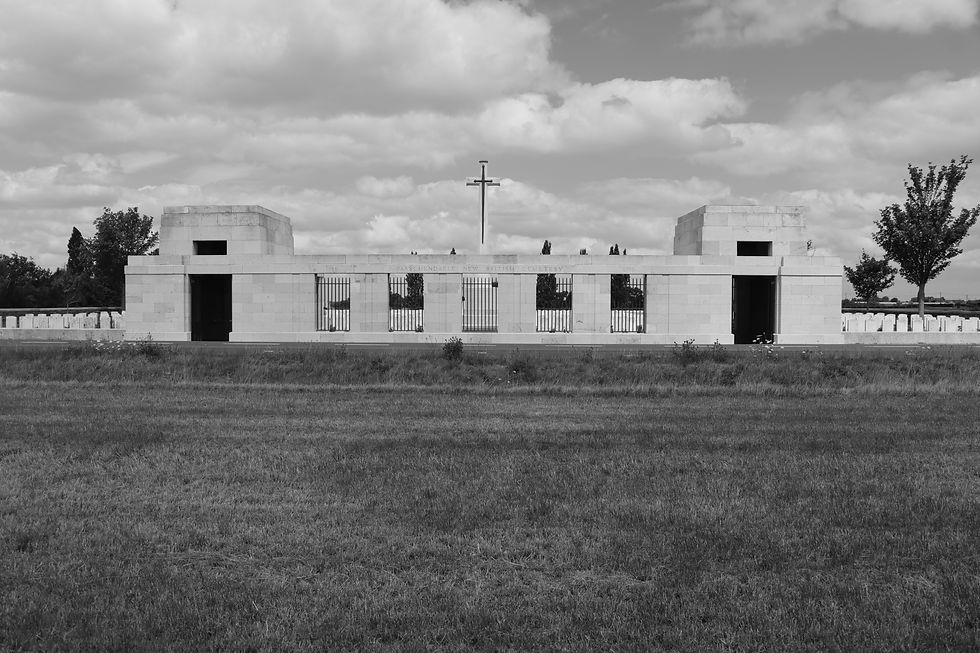
Buttes New British Cemetery was made after the Armistice when a large number of graves, almost all of 1917, but in a few instances of 1914, 1916 and 1918, were brought in from the battlefields of Zonnebeke. The New Zealand Memorial This memorial commemorates 378 officers and men of the New Zealand Division who died in the Polygon Wood sector and have no known grave. Polygon Wood is a large wood 1.6 kilometres south of the village of Zonnebeke which was completely devastated in the First World War. The wood was cleared by Commonwealth troops at the end of October 1914, given up on 3 May 1915, taken again at the end of September 1917 by Australian troops, evacuated in the Battles of the Lys, and finally retaken by the 9th (Scottish) Division on 28 September 1918. Before the war it was referred to as the Racecourse Wood, there was a racecourse used to train horses and gunners in the use of their limbers as well as equestrian events and Lyn Macdonald in her book 1914 recalls the Belgian team for Olympia trained here. There was also a large earthen mound known as the Buttes which had been the backdrop to the Ypres rifle range. 5th Australian Division Memorial Located on the Butte (ridge) overlooking the cemetery, this striking obelisk marks the ground captured by the 5th Australian Division in September 1917. Polygon Wood is a place in which you can escape to and is quiet and moody and you can enjoy a walk here alone with your thoughts and what took place in this setting. There are still remnants of the fighting that took place here but the landscape bears absolutely no resemblance to the scene here during the late summer and autumn of 1917. There are still bunkers and dugouts visible in the wood and you can find out more about these here

Black Watch Corner
Polygon Wood featured early in the fighting around Ypres. On the night of 11/12 November 1914 Brigadier-General Charles Fitzclarence V.C., commanding the 1st Guards Brigade, was killed leading an attack by the 2nd Battalion Grenadier Guards and 1st Irish Guards on German trenches near to Black Watch Corner. This is located in the South East corner of the Wood. His Brigade could muster only 468 men and five officers when it

should have been 4,000 Other Ranks and 100 Officers. The body of Brigadier-General Fitzclarence was lost and he is listed on the Menin Gate. On the 11 November 1914 the 1st Battalion, Scots Guards were in the line at Veldhoek and on this day the Germans launched a major attack on a 9 mile front with 12 Divisions with the aim of breaking the British line and taking Ypres. The day dawned with a mist covering the frontline trenches and this was dispersed by a wind that brought rain which grew heavier as the day went on. At 0630 the Germans began an artillery barrage that grew in intensity and reached its peak by 0900. The main German attack was directed to the front line opposite Gheluvelt and extending from the wood on the south of the Menin Road known to the British as Shrewsbury Forest to Nonnebosschen (Nuns Copse) and the edge of Polygon Wood beyond it. The Scots Guards were overwhelmed and the enemy broke through the British line but isolated pockets in strong points fought them off. About 100 men of the Black Watch, including the battalion staff, managed to hold Verbeek Farm, with some forty men holding the battalion’s own designated strong point ‘Black Watch Corner’ in Polygon Wood, which comprised of a trench inside the hedges of a cottage garden protected by a few strands of barbed wire. In trying to find their way around the British fire the German 1st and 3rd Foot Guard Regiments, some 900 men, pushed into Nonnebosschen and came within 200 yards of the British guns. They were fought off by gunners with rifles, various stragglers from 1st Brigade and the 5th Field Company, Royal Engineers including the latter’s cooks. Nine men from Falkirk District were killed during this action and their names are listed on the Menin Gate Memorial.
The Battle of Polygon Wood
The Battle Nomenclature lists the dates of the Battle of Polygon Wood as 26 September to 3 October 1917 and it was the Australian 5th Division who captured this area. The attack involved the Australian 4th and 5th Divisions and five British divisions, three of which were on the Australian left. During the battle the British deployed fifteen tanks and the front line was pushed back to the Broodsiende Ridge. This was to be the Australian 5th Division’s first engagement since their heavy losses at Fromelles in July 1916. On the 26 and 27 September a major air battle took place over the wood as German and British pilots fought for air supremacy with the British shooting down thirty German aircraft.
Tank Attack
On the 4 October, during what became known as the Battle of Broodseinde, tanks from the 1st Tank Brigade attacked from Black Watch Corner in an easterly direction. Markers indicated the route had been laid however, these had been destroyed in subsequent shelling and in order to maintain the attack Captain Clement Robertson, commanding the tanks unit, led the force on foot. He was killed in this action and was awarded a posthumous V.C. and is buried in Oxford Road Cemetery.
Memorial to a Cameron Highlander

In nearby Glencorse Wood there is a Private Memorial to Captain Ewen James Brodie, 1st Battalion Cameron Highlanders, who was killed in the wood during the desperate fighting on 11 November 1914. He has no known grave and is listed on the Menin Gate Memorial. The son of the Lord Lieutenant of Nairn and succeeded to Lethen on the death of his brother in 1908. Educated at Harrow and Trinity College, Cambridge, he entered his regiment from the militia in 1900 and served in the Mediterranean, South Africa and China, and later as Adjutant to the Lovat's Scouts. He married in 1910 and had two sons and a daughter. Brodie was acting Adjutant and one of only three officers remaining from thirty who left Edinburgh Castle ten weeks before, when the Camerons were heavily shelled on the morning of 11th November. The Prussian Guards, in great strength, broke into the British lines and

Captain Brodie gathered together all the men he could find at the brigade headquarters in Glencourse Wood (now part of Nonnebossen,) where Brigadier General Fitzclarence VC (who was killed the next day) ordered him to organise the defence. With the aid of orderlies, grooms, and telephonists, Brodie succeeded in driving the enemy back but fell in the ensuing counterattack. He was buried by men of the Connaught Rangers. A memorial window to Captain Brodie, gifted by Mrs Brodie, was dedicated in Auldearn Church on April 6th 1916. After the War the grave could not be found but the location was accurately recorded. Mrs Brodie bought the piece of land and in 1923 had a memorial built of Scottish stone. In 1929, now remarried, her new husband colonel Campbell visited the site and asked the IWGC (now CWGC) to look after the memorial and it has been cared for by the CWGC ever since. In 1931 Mrs Brodie, by then Mrs Campbell, received a letter from a German officer who had had the grave looked after until he was posted elsewhere in October 1916. He had just visited the battlefield again, came across the memorial and wrote to assure her that it was in the right place. (Western Front Association accessed 20 September 2026.)
Two Commanding Officers Killed Together
A rare instance where two commanding officers are buried just steps apart. On October 1 1917, during a frontline relief in Polygon Wood, the 27-year-old Australian commander (Scott) was briefing his 25-year-old British counterpart (Turnbull) when a single sniper's bullet killed both men. Lieutenant Colonel Alan Humphrey Scott, D.S.O., Mentioned in

Despatches, Commanding Officer, 56th Battalion Australian Infantry, 14th Brigade, 5th Australian Division. Killed in action 1 October 1917, age 27. Grave II.A.12. Son of Donald Allan Hyde Scott and Maria Caroline Scott, of Edgmond, Wahroonga, New South Wales. He was educated at Sydney Grammar School and after schooling he joined Dalgety & Co. as a clerk. A member of East Sydney Amateur Athletic Club, he was in 1913 New South Wales high-jump champion. In 1909-13 he served with a volunteer unit, the 1st Battalion, New South Wales Scottish Rifles. Scott joined the Australian Imperial Force as a Lieutenant on 28 August 1914 but by October, when he embarked for Egypt with the 4th Battalion, he was already a captain. His unit landed at Anzac Cove soon after dawn on 25 April 1915 and Scott's Point, the farthest spot reached on the day of the landing, was named after him. He won his D.S.O., awarded in July 1915, at Lone Pine, when commanding the 4th Battalion AIF and during the evacuation of Anzac in December he was in command of the last thirty men of the Battalion to leave the trenches. He was promoted to Lieutenant Colonel when in Egypt and took command of the 56th Battalion on 14 February 1916 and he was the longest serving Commanding Officer of the Battalion, and one of the youngest in the AIF. His brothers, Major William John Rendell Scott and Lieutenant Lee Scott, also served with

the A.I.F. Lieutenant Colonel Dudley Ralph Turnbull, D.S.O., Mentioned in Despatches, Gordon Highlanders, Commanding 20th Battalion Manchester Regiment, 22nd Infantry Brigade, 7th Division. Killed in action 1 October 1917, age 25. Grave I.C.9. Son of Col. C. F. A. Turnbull (retired) and Mrs. Evelyn S. Turnbull, of "Redclyffe," Warren Road, Torquay. He was gazetted Second Lieutenant on 13 March 1912 and posted to the 1st Battalion Gordon Highlanders and went with the Battalion to France in August 1914. He was placed in command of the machine gun section and won his D.S.O. on 13 October 1914 for ‘conspicuous gallantry in serving his Maxim gun when he detachments were all wounded until he also was wounded in two places and his gun damaged and he recovered the gun bringing it away on his shoulder.’ On recovering from his wounds he was posted to the 2nd Battalion and was promoted to Captain on 1 October 1915 and appointed to the Staff. He was to rejoin his Battalion and on the death of his Commanding Officer he took command of the 2nd Battalion. He was gazetted brevet Major and took up the post on the Divisional School of Instruction and then joined the Divisional Staff and was then appointed temporary Lieutenant Colonel and he took command of the 20th Battalion Manchester Regiment. On the 1st October 1917 the 2nd Battalion Gordon Highlanders were in a camp on the outskirts of Dickebusch and the War Diary records: ‘Lieut. Col D R Turnbull DSO 2nd Gordon Highrs Cmdg 20th Manchester Regiment was killed by a sniper in front of Polygon Wood on the 30 Sept 1917.’ The War Diary of the 20th Manchesters records: ‘The Commanding Officer (Lt Col D.R. Turnbull D.S.O.) was killed by a sniper at 7.15am.’
2nd Battalion Royal Scots Fusiliers

Two men from the Regiment killed in action four years apart. 10420 Private Timothy Winters, 2nd Battalion, 21st Infantry Brigade, 7th Division. Killed in action 31 October 1914, age 21. Grave XXI.D.19. Son of John and Catherine Winters, Baillieston, Glasgow. He also had three sisters. On the 31 October 1914 the Battalion was in the line near Gheluvelt. The Germans opened heavy shelling in the morning and it suddenly became evident that the enemy had taken Gheluvelt on the Battalions left due to the 3rd Brigade retiring and leaving the Battalions left flank in the air. The Germans now surrounded the Battalion by the gap between the Bedfords and the Battalion with the trenches being overwhelmed and the Commanding Officer, Adjutant, 2nd in Command and three other officers killed or captured and only 151 NCOs and men left in the Battalion and this number included men from the transport and not fighting strength. The Battalion casualties were five officers and 400 Other Ranks with the 21st Infantry
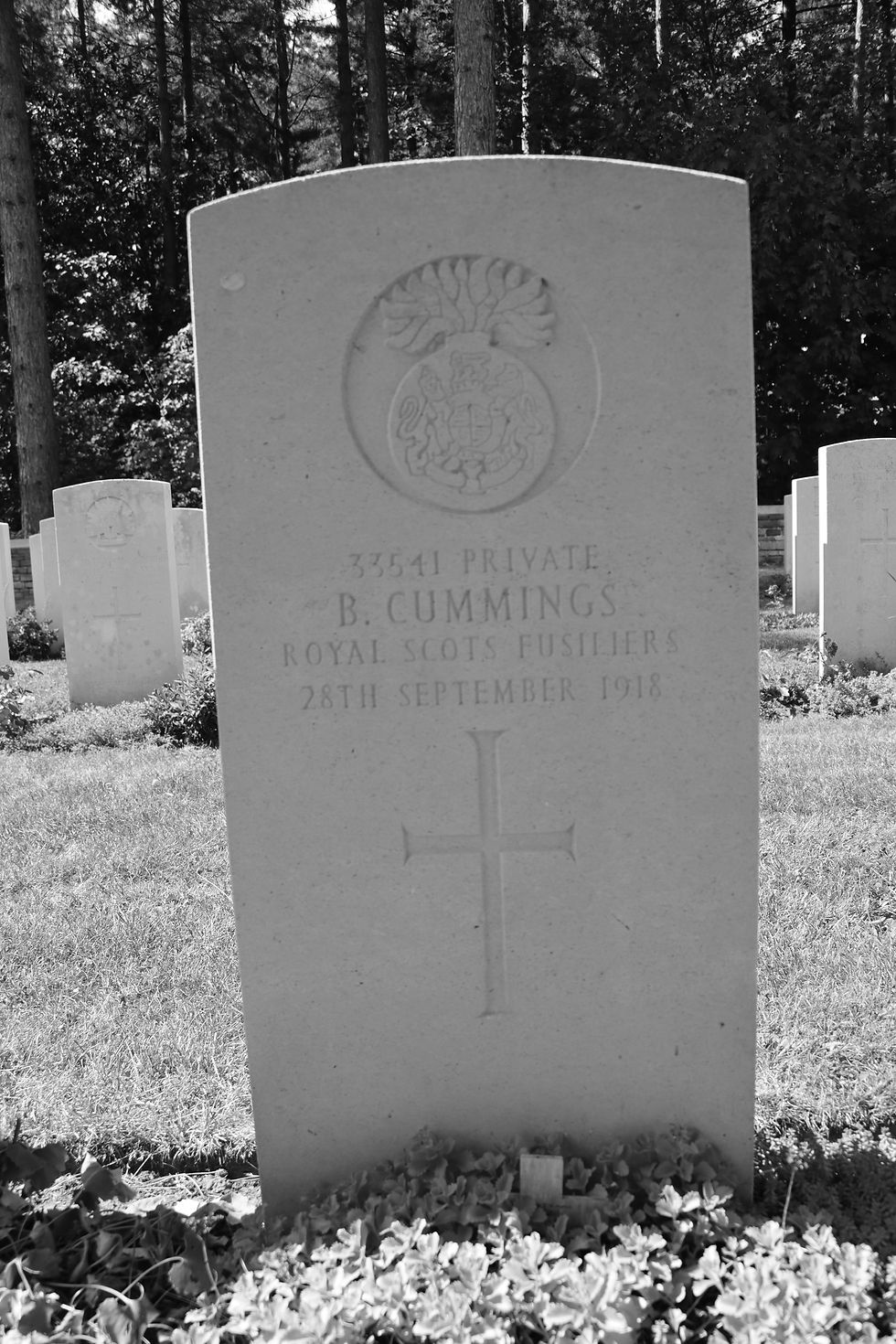
Brigade reduced to 11 Officers and 750 Other Ranks. 33541 Private Bernard Cummings, 2nd Battalion, 28th Brigade, 9th (Scottish) Division. Killed in action 28 September 1918, age 31. Grave XXV.A.9. He was employed as a Miner and living at No.4 United Buildings, Fauldhouse when he attested on 15 December 1914 joining the Royal Scots. His sister Sarah was listed as his next of kin. He was posted to the 3rd Reserve Battalion on 18 December 1914 and then to the 14th Battalion on 26 December and remained with them until 2 October 1915 when he went to France. He was wounded on 31 January 1916 in the chest and arm and on 1 September 1916 was in Reserve when on 4 December 1916 he was transferred to the 1st Battalion Royal Scots Fusiliers. He was wounded again on 10 April 1917, gunshot wound to the right leg and was then admitted to the Scottish Command Depot on 8 August 1917. He was in the Depot on 1 September 1917 when he was declared deserted. He rejoined from desertion on 9 July 1918. On the 29 July 1918 he was convicted at a District Court Martial of ‘absence without leave’ and sentenced to one year’s detention, fined £4.6.4 for the loss of his equipment. On the 5 August he was posted to the 3rd Battalion Royal Scots Fusiliers at Fort Matilda, Nigg, Cromarty and then to the 2nd Battalion on 14 August 1918 and embarked at Dover for Calais and joined the Battalion on 23 August 1918. On the 28 September 1918 the Battalion was part of the attack of the 9th (Scottish) Division with the objective of taking the Polygon Wood to a point about 500 yards to the south of Broodseinde. The assaulting troops were the 28th Brigade on the right, with the Royal Scots Fusiliers in the line, and the 26th Brigade on the left. By 11.45 am they had taken their objectives in the Broodseinde area. Looking at Bernards record, this was a man who had been wounded twice and was on edge when he decided to desert when he did.
1st/24th (County of London) Battalion London Regiment, 142nd Brigade, 47th (London) Division On the night of the 24 August 1917, the 1/24th The London Regiment entered the frontline trenches near Westhoek. The War Diary records several episodes of shelling throughout the 25 - 26 August, including a 90 minute artillery bombardment beginning at 23:00 hours on the 25 August in which three soldiers were killed and 14 wounded. The three men who died in the bombardment were Private Albert Wilfred Saunders Culling, Private Charles William Green and Private Albert Henry Hale. They were buried in a shared field grave until March 1920, by which time any marker which might have recorded their names had been lost. As a consequence, they could not all be identified when they were reburied here. All three wore regimental insignia identifying them as members of the 24th Battalion The London Regiment, and one had an identity disc which allowed him to be identified as Private Hale. All three were reburied next to each other, the two unidentified men were buried with the inscription: ‘A Soldier of the Great War – 24th Bn London Regiment – Known Unto God’. Separately, the names of Private Culling and Private Green were engraved on the CWGC’s Ypres (Menin Gate) memorial to the missing. More than 100 years later, research proved the two previously unidentified burials were those of Private Culling and Private Green. A rededication service took place on 20 March 2024. 723022 Private Albert Wilfred Saunders Culling, ‘C’ Company, Killed in action 26 August 1917, age 21. Grave XXIX.B.12. One of two sons and three daughters of Albert and Eliza Kate Culling, Castle Street., Keinton Mandeville, Taunton, Somerset. He was employed as a Stonecutter when he attested on 11 December 1915 and went to the Army Reserve before being called up on 27 January 1916 and went to France on 15 June 1916. His brother Francis was also serving in the Army. 722574 Private Charles William Green, Killed in action 26 August 1917. Grave XXIX.B.13. Charles was living at 20 Hawley Road, Camden when he enlisted. 722581 Private Albert Henry Hale, Killed in action 26 August 1917, age 42. Grave XXIX.B.14. Son of the late Isaac and Elizabeth Hale, of Ruardean, Gloucestershire.
2nd Battalion Royal Welsh Fusiliers, 19th Infantry Brigade, 33rd Division
There are six men buried here, four from the 1st Battalion and two from the 2nd Battalion. All killed between 26 September and 10 October 1917. Selected are the two men from the 2nd Battalion killed on 26 September. A coincidence that both had the same surname. On the 26 September 1917 the Battalion was ordered to attack a line from Cameron House to the Reutelbeek by passing through the Australian lines west of Polygon Wood. They moved off from Stirling Castle area at 10.05am and proceeded via Black Watch Corner and suffered 15 casualties here from German shelling. They formed up for the attack at 12 noon with casualties from machine gun and shell fire while

forming up. They went forward reaching Carlisle Farm and taking and occupying gun emplacements and pill boxes with the casualties sustained of 120 including eight officers. At dusk the front companies fell back in conjunction with the Australians due to a shortage of ammunition. Battalion casualties were Officers 4 killed, 2 wounded. Other Ranks 31 killed, 121 wounded, 36 missing. 56517 Private Charles Frederick Andrews, age 42. Grave XXX.C.15. Husband of Sarah Andrews, and they lived at 105 Henry Street, South Shields with their three children. Charles was employed as an Engineer timekeeper responsible for tracking the workforce hours and attendance. 4849 Private John Andrews. Grave XX.C.14. He listed his mother Ellen, 1 Victoria Buildings, Bridge Street, Chester, as his next of kin.
27th Field Ambulance, Royal Army Medical Corps, 9th (Scottish) Division
The Field Ambulance was managing the wounded from the 9th (Scottish) Division attack with the objective of taking the Polygon Wood to a point about 500 yards to the south of Broodseinde. The 27th Field ambulance had sent bearer party’s to assist the 28th Field Ambulance. As stretcher bearers both men would have been in the open dealing with and collecting the wounded to take them back to the Advance Dressing Station. Both their bodies were exhumed from a site near to the trench line known as Judge Cross Roads east of Polygon Wood and in the line of advance and reburied here after the Armistice. 42856 Private James Brown, Killed in action 29 September 1918, age 23. Grave XIV.A.15. Son of Thomas and Jeannie Brown, of Kelvinlea, Kirkintilloch, Glasgow. 72557 Private Albert Edward McLenaghan, Killed in action 29 September 1918, age 24. Grave XIV.A.16. The 1911 census lists Albert as living as a ‘Boarder’ at the home of May Wilkins. His age is shown as 27. He married May Wilkins on 16 April 1911 and they had a son Norman who was being looked after by his grandparents. Albert gave his marital state as widower on his Attestation form. He living at 19 Albany Road, Northamptonshire and was employed as a finishing machine operator in the shoe trade and gave his age as 21 when he attested on 25 October 1915. He went to France on 24 September 1916.
New Zealand

30154 Private Hugh Colin Aiken, 12th (Nelson) Company, 3rd Battalion Canterbury Regiment, Killed in action 22 November 1917, age 20. Grave Special Memorial IX.AA.7. Son of Christina Aiken, 114 Glasgow Street, Wanganui, New Zealand, and the late Arthur H. Aiken. Hugh was employed as a Farm Hand when he enlisted on 21 August 1916 and was posted to ‘F’ Company New Zealand Rifle Brigade. He sailed for England on 3 December 1916 and landed at Plymouth on 3 March 1917 he then went to France on 28 May and joined the Canterbury Regiment. On the 5 September 1917 he was in No.4 New Zealand Field Ambulance and was then sent down the line to Rouen base hospital and he rejoined the Battalion on 9 October 1917. On the night of 21/22 November, 3rd Canterbury Battalion relieved the 3rd Auckland Battalion at a position called Joiners Rest, at Polygon Wood and it can be presumed he was killed during this event.
Australian Engineers

There are six men from the Australian Engineers buried here and who were killed in action from 26 September to 4 October 1917. Two killed in action on 26 September have been selected. On the 25 September the Company was preparing for the assault of the Australian 5th Division to capture Polygon Wood, this was to be the Australian 5th Division’s first engagement since their heavy losses at Fromelles in July 1916. The Field Company was involved in bringing up engineering material, creating dumps, putting up noticeboards in the trenches that the RE sections were to man. On the 26 September the attack opened at 5.50am with the infantry going forward with the Field Company following up with the aim of capturing the Butte and Polygon Wood. During the attack the infantry encountered a number of pill boxes and two of these can be seen in the wood today, one named Scott Post after the commanding Officer of the 56th Battalion. With the Polygon Wood taken the Engineers began the consolidation under fire.
6026 Sapper John Livingstone Parker, 15th Field Company, 5th Australian Division. Age 27. Grave XXVIII.C.2. Son of John Livingstone Parker and Susan Nelson Parker, of Warrigul Road, Oakleigh, Victoria, Australia. He gave his trade as Farmer when he enlisted on 11 August 1915 joining the Field Company Engineers. He went to Alexandria and then to Marseille landing there on 29 June 1916 and then went sick with influenza on 22 August and was discharged on 5 September. 3951 Lance Corporal William White, 15th Field Company, age 37. Grave XXVIII.D.9. Son of William and Emily Jane White, of Tamworth, New South Wales. He was employed as a Labourer when he enlisted on 10 August 1915 in the 12th Battalion and was transferred to the 15th Field Company on 18 March 1916 when in Alexandria. He was promoted to Lance Corporal on 17 February 1917

Boy Soldiers
In the Ypres Salient, we are drawn to the graves of 6322 Private John Condon, 2nd Battalion Royal Irish Regiment, killed in action in May 1915, age 14 and the youngest known battle casualty of the war, although this is now questioned, and the grave of 5750 Valentine Strudwick, 8th Rifle Brigade, killed in action in January 1916, age 15. Strudwicks grave attracts a great deal of attention because of its location at Essex Farm and that locations association with Lieutenant Colonel John McCrae and the poem ‘In Flanders Fields.’ There are many more ‘Boy Soldiers’ buried across the Salient and who are not remembered in the same way and these include three from Falkirk District Private William Jamieson, age 17, Private James Duchart, age 16, and Private Herbert Richmond, age 17. There were many reasons why under age boys enlisted in 1914 and 1915 boredom with their jobs, looking for adventure, and escaping family pressures. The checks on age and qualification to enlist were more relaxed than later in the war. The army preferred younger recruits, there was a history of boy soldiers in the army going back over one hundred years. At Waterloo the army had a number of boy soldiers in their ranks. The army preferred younger recruits as they would follow orders and accept discipline more readily than older men. The boys had a belief in their own

indestructibility and were prepared to take more risks. We tend to also forget the number of boys who served in the Royal Navy and we do not seem to have the same passionate response to their service as we do those who fought on the Western Front. With regards to the army, the difference was the sheer number who served on the Western Front and there were more boy soldiers in 1915 than served in Wellington’s army at Waterloo. For further reading on this subject see Richard Van Emden’s excellent book Boy Soldiers of the Great War. There is one Boy Soldier buried here 4563 Private Leslie Clegg McMurdo, 31st Battalion, 8th Brigade, 5th Australian Division. Killed in action 26 September 1917, age 17. Grave XXIV.D.7. Son of Beatrice McMurdo and the late Thomas McMurdo, 602 Stamford Hill Road, Durban, South Africa. He gave his age as 18 and employed as a Labourer when he enlisted on 21 September 1916. He sailed for England on 22 December 1916 and landed in Plymouth on 3 March 1917 and went to France on 30 July and joined the Battalion in the field on 18 August 1917. The Battalion was part of the 5th Australian Division and he was killed in the action to take Polygon Wood on 26 September 1917. Epitaph: GAVE HIS LIFE TO BRING IN A WOUNDED COMRADE DEEPLY MOURNED.
The cemetery was designed by Charles Holden.
Location
Buttes New British Cemetery is located 8 kilometres east of Ieper town centre, on the Lange Dreve a road leading from the Meenseweg (N8), connecting Ieper to Menen. From Ieper town centre the Meenseweg is located via Torhoutstraat and right onto Basculestraat. Basculestraat ends at a main cross roads, directly over which begins the Meenseweg. 4.7 kilometres along the Meenseweg and after passing the Bellewaerde theme park lies the left hand turning onto Oude Kortrijkstraat. 2 kilometres along the Oude Kortrijkstraat the road crosses the A19 motorway. Immediately after this bridge is the left hand turning onto the Lotegatstraat, which borders Polygon Wood. 800 metres along the Lotegatstraat is the right hand turning onto Lange Dreve. The Cemetery is located 1 kilometres along the Lange Dreve on the left hand side of the road.
Burials
There are now 2,108 Commonwealth servicemen of the First World War buried or commemorated in Buttes New British Cemetery. 1,677 of the burials are unidentified but special memorials are erected to 35 casualties known or believed to be buried among them.

The BUTTES NEW BRITISH CEMETERY (NEW ZEALAND) MEMORIAL, which stands in Buttes New British Cemetery, commemorates 378 officers and men of the New Zealand Division who died in the Polygon Wood sector between September 1917 and May 1918, and who have no known grave.
UK – 1317
Australian – 564
New Zealand – 167
Canadian – 50
Known Unto God - 30


Comments