


Polygon Wood Cemetery

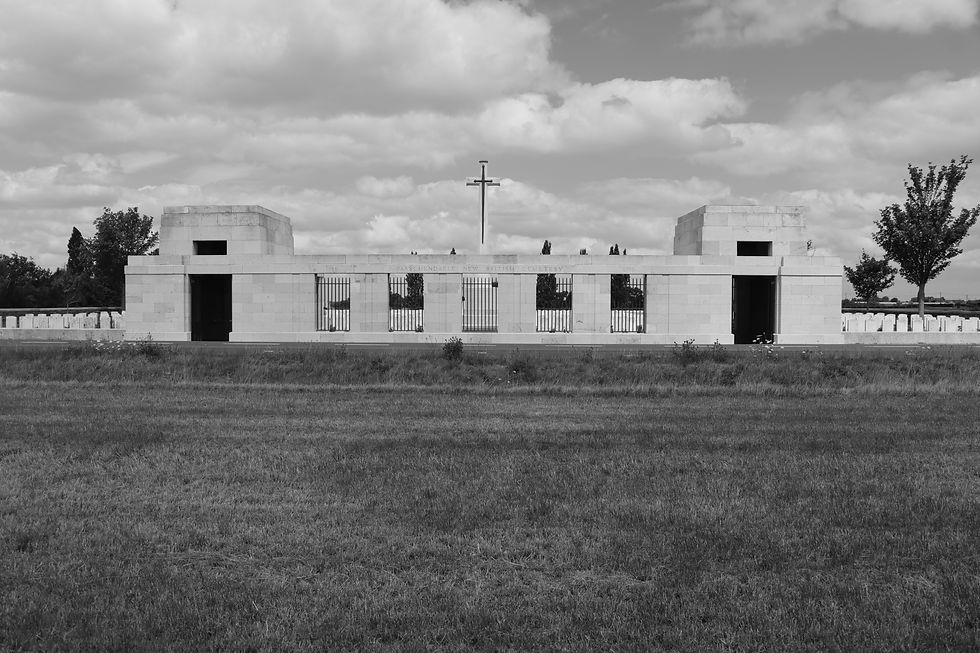
Polygon Wood Cemetery is an irregular front-line cemetery made between August 1917 and April 1918, and used again in September 1918. There was a German cemetery made between 1914 to 1915 that contained 347 burials, Kriegerfriedhof des Reserve Infantry Regiment 248 am Polygonenwald, that was next to the British cemetery, if you look carefully you will see newer stonework on the backwall and this was the entrance to the German cemetery that was removed. Polygon Wood is a large wood 1.6 kilometres south of the village of Zonnebeke which was completely devastated in the First World War. The wood was cleared by Commonwealth troops at the end of October 1914, given up on 3 May 1915, taken again at the end of September 1917 by Australian troops, evacuated in the Battles of the Lys, and finally retaken by the 9th (Scottish) Division on 28 September

1918. Before the war it was referred to as the Racecourse Wood, there was a racecourse used to train horses and gunners in the use of their limbers as well as equestrian events and Lyn Macdonald in her book 1914 recalls the Belgian team for Olympia trained here. There was also a large earthen mound known as the Buttes which had been the backdrop to the Ypres rifle range. Today, the 5th Australian Division Monument stands on top of the Buttes located in the Buttes New British Cemetery. Polygon Wood is a place in which you can escape to and is quiet and moody and you can enjoy a walk here alone with your thoughts and what took place in this setting. There are still remnants of the fighting that took place here but the landscape bears absolutely no resemblance to the scene here during the late summer and autumn of 1917. There are still bunkers and dugouts visible in the wood and you can find out more about these here
Black Watch Corner
Polygon Wood featured early in the fighting around Ypres. On the night of 11/12 November 1914 Brigadier-General Charles Fitzclarence V.C., commanding the 1st Guards Brigade, was killed leading an attack by the 2nd Battalion Grenadier Guards and 1st Irish Guards on German trenches near to Black Watch Corner. This is located in the South East

corner of the Wood. His Brigade could muster only 468 men and five officers when it should have been 4,000 Other Ranks and 100 Officers. The body of Brigadier-General Fitzclarence was lost and he is listed on the Menin Gate Memorial. On the 11 November 1914 the 1st Battalion, Scots Guards were in the line at Veldhoek and on this day the Germans launched a major attack on a 9 mile front with 12 Divisions with the aim of breaking the British line and taking Ypres. The day dawned with a mist covering the frontline trenches and this was dispersed by a wind that brought rain which grew heavier as the day went on. At 0630 the Germans began an artillery barrage that grew in intensity and reached its peak by 0900. The main German attack was directed to the front line opposite Gheluvelt and extending from the wood on the south of the Menin Road known to the British as Shrewsbury Forest to Nonnebosschen (Nuns Copse) and the edge of Polygon Wood beyond it. The Scots Guards were overwhelmed and the enemy broke through the British line but isolated pockets in strong points fought them off. About 100 men of the Black Watch, including the battalion staff, managed to hold Verbeek Farm, with some forty men holding the battalion’s own designated strong point ‘Black Watch Corner’ in Polygon Wood, which comprised of a trench inside the hedges of a cottage garden protected by a few strands of barbed wire. In trying to find their way around the British fire the German 1st and 3rd Foot Guard Regiments, some 900 men, pushed into Nonnebosschen and came within 200 yards of the British guns. They were fought off by gunners with rifles, various stragglers from 1st Brigade and the 5th Field Company, Royal Engineers including the latter’s cooks. Nine men from Falkirk District were killed during this action are their names are listed on the Menin Gate Memorial.
The Battle of Polygon Wood
The Battle Nomenclature lists the dates of the Battle of Polygon Wood as 26 September to 3 October 1917 and it was the Australian 5th Division who captured this area. The attack involved the Australian 4th and 5th Divisions and five British divisions, three of which were on the Australian left. During the battle the British deployed fifteen tanks and the front line was pushed back to the Broodsiende Ridge. This was to be the Australian 5th Division’s first engagement since their heavy losses at Fromelles in July 1916. On the 26 and 27 September a major air battle took place over the wood as German and British pilots fought for air supremacy with the British shooting down thirty German aircraft.

Tank Attack
On the 4 October, during what became known as the Battle of Broodseinde, tanks from the 1st Tank Brigade attacked from Black Watch corner in an easterly direction. Markers indicated the route had been laid however, these had been destroyed in subsequent shelling and in order to maintain the attack Captain Clement Robertson, commanding the tanks unit, led the force on foot. He was killed in this action and was awarded a posthumous V.C. and is buried in Oxford Road Cemetery.
Memorial to a Cameron Highlander
In nearby Glencorse Wood there is a Private Memorial to Captain Ewen James Brodie, 1st Battalion Cameron Highlanders, who was killed in the wood during the desperate fighting on 11 November 1914. He has no known grave and is listed on the Menin Gate

Memorial. The son of the Lord Lieutenant of Nairn and succeeded to Lethen on the death of his brother in 1908. Educated at Harrow and Trinity College, Cambridge, he entered his regiment from the militia in 1900 and served in the Mediterranean, South Africa and China, and later as Adjutant to the Lovat's Scouts. He married in 1910 and had two sons and a daughter. Brodie was acting Adjutant and one of only three officers remaining from thirty who left Edinburgh Castle ten weeks before, when the Camerons were heavily shelled on the morning of 11th November. The Prussian Guards, in great

strength, broke into the British lines and Captain Brodie gathered together all the men he could find at the brigade headquarters in Glencourse Wood (now part of Nonnebossen,) where Brigadier General Fitzclarence VC (who was killed the next day) ordered him to organise the defence. With the aid of orderlies, grooms, and telephonists, Brodie succeeded in driving the enemy back but fell in the ensuing counterattack. He was buried by men of the Connaught Rangers. A memorial window to Captain Brodie, gifted by Mrs Brodie, was dedicated in Auldearn Church on April 6th 1916. After the War the grave could not be found but the location was accurately recorded. Mrs Brodie bought the piece of land and in 1923 had a memorial built of Scottish stone. In 1929, now remarried, her new husband Colonel Campbell visited the site and asked the IWGC (now CWGC) to look after the memorial and it has been cared for by the CWGC ever since. In 1931 Mrs Brodie, by then Mrs Campbell, received a letter from a German officer who had had the grave looked after until he was posted elsewhere in October 1916. He had just visited the battlefield again, came across the memorial and wrote to assure her that it was in the right place. (Western Front Association accessed 20 September 2026.)
Gordon Highlanders

23495 Private John Robertson Thomson, 2nd Battalion, 20th Infantry Brigade, 7th Division. Killed in action 4 October 1917, age 26. Grave Collective Grave D.2A. Husband of Annie Thomson, 13 Auchterderran Road, Lochgelly, Fife. Epitaph: FARE THEE WELL OUR SCOTTISH SOLDIER REST IN PEACE YOUR BATTLE'S O'ER. He was killed during the fighting at Broodseinde Ridge and his body lost and his name listed on the Tyne Cot Memorial. His remains were found in a private garden in 1998 and he was formally identified from his cap badge and engraved penknife. He and was reburied here on 20 October 2004. Buried beside him are two other soldiers found with him but who could not be identified.
9th (Scottish Division)
Royal Scots Fusiliers
41115 Private Robert Christie, 2nd Battalion, 28th Brigade, 9th (Scottish) Division. Killed in action 28 September 1918, age 20. Grave B.7. Son of Robert Christie, 50 Wallace Street, Ayr. On the 28 September 1918 the Battalion was part of the attack of the 9th (Scottish) Division with the objective of taking the Polygon Wood to a point about 500 yards to the south of Broodseinde. The assaulting troops were the 28th Brigade on the right, with the Royal Scots Fusiliers in the line, and the 26th Brigade on the left. By 11.45 am they had taken their objectives in the Broodseinde area. Queen’s Own Cameron Highlanders S/20715 Private Robert McPhee, 5th Battalion, 26th Infantry Brigade, 9th (Scottish) Division. Killed in action 28 September 1918, age 25. Grave B.6.One of five sons and a daughter of George and Isabela McPhee, Dornoch, Sutherland. He had a daughter, Jean age 2, looked after by a ‘Guardian’ Jessie Brown as per the Pension records, although she is listed in Soldiers Effects as his widow. On the 28th September 1918 the Battalion was in the line and part of the 9th (Scottish) Division attack with the objective of Broodseinde Ridge.
2nd Battalion Durham Light Infantry, 18th Infantry Brigade, 6th Division
The Battalion was in the line in the Reutel sub-section in front of Polygon Wood. The Brigade front was being held by three Battalion but on 13 April the 11th Essex were withdrawn and the front was now held by two Battalions. The 2nd Battalion DLI

sidestepped northwards and took over the portion of the line that was held by the Essex and ‘A’ Company went into support with the Battalion HQ in the area of today’s Polygon Wood Cemetery. The War Diary records: ‘Lt Keatinge & 3 O.R. killed, and 1 O.R. wounded.’
Lieutenant Eustace Gabriel Laurence Keatinge, 3rd Battalion Northumberland Fusiliers attached ‘A’ Company, 2nd Battalion Durham Light Infantry, Killed in action 13 April 1918, age 26. Grave H.2. Son of Gabriel and Elisabeth Keatinge, of Ashbourne, Westoe, South Shields. He was educated at South Shields High School and Oxford University. While at University he joined the Officer Training Corps and on he outbreak of war he enlisted gazetted 2nd Lieutenant in August 1914 and joining the 3rd Battalion Northumberland Fusiliers. He was to be wounded at Ypres on 2 May 1915. He joined the Battalion on 11 April from the Northumberland Fusiliers. 79951 Private Thomas Brown, 2nd Battalion Durham Light Infantry, Killed in action 13 April 1918, age 36. Grave H.4. He was married to Emily and they lived with their four children at 105

Newcastle Road, Talke, Stoke-on-Trent. Thomas was employed as a Postman when he enlisted on 9 December 1915, he had previous service with the 3rd Dragoon Guards, and was not called up until 1 June 1916 being designated ‘Group 35’. This allowed men to attest (volunteer) for military service, under the Derby Scheme, but defer their actual mobilisation until their demographic group was called up. Men who attested were placed into one of 46 distinct groups based entirely on their age and marital status and took the oath of allegiance, received one day’s pay, and were technically transferred into Section B of the Army Reserve. Thomas went to France on 28 March 1918 and joined the Battalion on 2 April 1918. 300173 Sergeant Robert Castling D.C.M., 2nd Battalion Durham Light Infantry, Killed in action 13 April 1918, age 23. Grave H.3. Son of Robert and Mary Castling, 8 Betheny Gardens, Annfield Plain, County Durham. He enlisted age 18 in the Territorial Force on 31 March

1913. He went to France on 18 April 1915 and was posted to No.3 Company, 2nd Battalion in the field and was promoted to Corporal on 16 March 1917 and was evacuated sick on the same going to the Base hospital at Rouen and from here to England. On recovering he was posted back to his Battalion on 7 July 1917 and was promoted to Sergeant on 1 December 1917. He was awarded the D.C.M. For conspicuous gallantry and devotion to duty when in charge of a section. On the 21 March 1918 near Bapaume after being driven out of their post he reformed his section and retook it driving the enemy back. He showed great courage and determination. His DCM was gazetted on 3 September 1918. Robert’s medals are held by the DLI Medal collection.

1/5th Battalion York and Lancaster Regiment, 148th Infantry Brigade, 49th Division
There are eight men buried here from the 1st/5th Battalion and killed in the fighting during March 1918. Three of those killed in action on 8 March have been selected. The Battalion had moved into the Reutel sub-section which encompassed the ruins of Reutel village situated east of Polygon Wood and which gave them a good view of the German front line trenches known as Juniper Support and rear areas. The War Diary records that on 8 March at 6am: ‘Major Charles Frederick Willis killed whilst going round the line.’ At 9am they were subjected to heavy shelling that continued all day on the Battalion front and on the 37th Division front who were on their right. During the night of the 8/9 March the Germans attacked and got into the British trenches on the right but were ejected at dawn on the 9 March. Major Charles Frederick Willis, age 35. Grave B.4. Son of Kate Eliza Willis, of Rotherham, and the late Gervase Willis. He was married to Muriel Willis, 132 Gladstone Street, Bedford. Charles qualified as a solicitor in 1905 and in 1908 he married Muriel Constance and they lived with their two children at Brentwood, St Anne’s Road, Rotherham. He enlisted in the then Volunteers, on 26 June 1900 and was commissioned in 1902. He went to France on 13 April 1915. On 27 August 1917 he returned from a period of instruction and took over as Brigade School instructor. 204567 Private Thomas Appleyard, age 25. Grave B.3. Son of Benjamin and Louisa Appleyard, of Robinson Lane, Kippax, Leeds. He attested on 11 December 1915 and was employed as a Collier Banksman. Although he attested in December 1915 he went in to the Army Reserve and he was not called up until 20 March 1917 and he went to France on 17 July 1917 and joined the Battalion on the 12 August 1917. 200660 Private Thomas Hunt, age Grave B.2. He went to France with the Battalion on 13 April 1915.
Royal Engineers

Second Lieutenant John Jackson Low M.C., M.M., ‘F’ Special (Cylinder) Company, Special Brigade, Royal Engineers. Killed in action 3 December 1917, age 23. Grave B.9. Son of James and Margaret Low, 3 Orrock Place, Jeanfield, Perth. He was educated at Perth Academy and the University of Edinburgh where he studied Physics graduating in 1915. Following the German gas attack in May 1915 a recruitment drive was made to identify and train men in the use of chemical warfare. They enlisted in the Royal Engineers with the rank of Corporal. He enlisted in 1915 as a Corporal in the Royal Engineers and went to France on 31 July 1915 and he was present at the British gas attack on the opening day of the Battle of Loos on 25 September 1915. He was commissioned on 6 August 1916 and was posted to ‘F’ Special Company. He was wounded on 4 April 1917 while involved in the attack the village of Givenchy-en-Gohelle in support of the Canadian 4th Division. On the 3 December 1917 the Company was supporting the New Zealand Division in their attack to take the Polderhoek Chateau by firing 110 drums of phosgene gas via Livens projectors (simple mortar weapon) against the German lines around Becelaere. John was killed returning from the font line trench. He was awarded the Military Medal gazetted in August 1916 and the Military Cross on 4 October 1916. ‘For conspicuous gallantry in action. When in command of special apparatus in the front trench, he displayed great coolness and determination under heavy shell fire and in most difficult circumstances.’ His older brother James served as a Sapper in the Royal Engineers and was wounded by shrapnel in the left thigh on 22 July 1916 at High Wood on the Somme. On recovery he was transferred to the Army Reserve on 14 December 1916 and on 1 February 1918 was discharged as unfit for military service. Another brother David, served as a Pioneer in the Royal Engineers enlisting on 17 May 1916 and was posted to the Army Reserve being called up on 10 October 1916 but was returned home under age on 15 October and was recalled on 8 January 1917 and went to France on 30 March 1917. He was discharged in Class Z Army Reserve on 6 February 1919. Learn more about Gas Warfare in WW1 here
The cemetery was designed by Charles Holden.
Location
Polygon Wood Cemetery is located 8 kilometres east of Ieper town centre, on the Lange Dreve a road leading from the Meenseweg (N8), connecting Ieper to Menen. From Ieper town centre the Meenseweg is located via Torhoutstraat and right onto Basculestraat. Basculestraat ends at a main cross roads, directly over which begins the Meenseweg.
4.7 kilometres along the Meenseweg and after passing the Bellewaerde theme park lies the left hand turning onto Oude Kortrijkstraat. 2 kilometres along the Oude Kortrijkstraat the road crosses the A19 motorway. Immediately after this bridge is the left hand turning onto the Lotegatstraat, which borders Polygon Wood. 800 metres along the Lotegatstraat is the right hand turning onto Lange Dreve. The Cemetery is located 1 kilometres along the Lange Dreve on the left hand side of the road.

Burials
The cemetery contains 89 Commonwealth burials of the First World War, and there are Special Memorials to seventeen British and thirteen New Zealanders known or believed to be buried among the unnamed.
UK – 32
New Zealand – 57
German – 1
Known unto God – 11
Unnamed - 17


Comments