


Maple Leaf Cemetery
- Admin
- May 8
- 8 min read
Updated: Jul 29

Maple Leaf Cemetery, CWGC, Ploegsteert, Romarin, was begun in December 1914 and was used until December 1917 for British burials. There are nine German burials here dating from April 1918 when the area was occupied by the Germans. The 3rd Canadian Field Ambulance Advanced Dressing Station was here from July 1915 to April 1916 when the cemetery was named by them. Canon Frederick Scott, Senior Chaplain to the Canadian 1st Division, mentions a stay at a farm in Romarin in his memoirs: ‘I moved to Romarin and made my home in a very dirty little French farmhouse. The Roman Catholic chaplain and I had each a heap of straw in an outhouse which was a kind of general workroom. At one end stood a large churn, which was operated, when necessary, by a trained dog, which was kept at other times in a cage. The churn was the breeding place of innumerable blue-bottles, who in spite of its savoury attractions annoyed us very much by alighting on our food and on our faces…’ A building on the main street in Ploegsteert was used as a clubhouse by the British chaplain and this was taken over by Canon Scott when the British chaplain moved on with his division. Across the street was the Mayor’s house and he had a young girl there as a servant and he kept the keys of the clubhouse. Canon Scott was told of the heroism of the young girl who, when the town was heavily shelled, saved the lives of some British wounded who were lying in the house and she carried them over on her back to a nearby farmhouse. To do this she had to pass down the road which was under fire. He brought the heroism of the girl to the attention of General Seely who he asked to raise the matter with King George V and after collecting written statements from witnesses which were presented to the King, the girl was awarded the bronze medal of the Order of St John of Jerusalem. This was presented to the girl in a ceremony at the Mayor’s house in Romarin and Canon Scott recounts: ‘The girl, who had an open face, was on the verge of giving way to tears. The Mayor and some other of the chief inhabitants were arrayed in their best clothes, and a Highland regiment had lent us their pipers. One of the citizens presented the heroine with a large bouquet of flowers. General Alderson made a nice speech, which was translated to the townsfolk, and then he presented the medal. We were invited into the house, and the girl’s health was proposed and drunk by the General in a glass of Romarin Champagne.’
Alias
There are two men who served under an alias buried here.

28/44 Private Thomas Lothian (Served as Thomas Anderson), 19th Battalion (Tyneside Pioneers), Northumberland Fusiliers, 35th Divisional Troops. Died of wounds received 6 July 1916, age 37. Grave J.11. Son of William and Mary Lothian, of Pitts Terrace, Alnwick, Northumberland. At the time of this man’s death the Battalion were in France at Acheux.
17751 Private Harry Watson (Served as John William Black), 1st Battalion, Otago Regiment, 1st Infantry Brigade, New Zealand Division. Killed in action 6 May 1917, age 36. Grave N.9. Son of John and Mary Watson, of Herbert, North Otago, New Zealand. He was born in Paisley, Scotland. ‘Black’ was killed during the shelling of the New Zealand position opposite Messines on the night of 6 May 1917. After his death it was found that 'Black' was an assumed name and that he was in fact Harry Watson from Herbert, North Otago. He had been

sentenced to be Shot at Dawn for desertion on 18 April 1917, but this was commuted to 10-years penal servitude by General Plumer, commanding Second Army. He had absconded from a draft on 21 November 1916 and was arrested on 16 March 1917. He was one of 28 New Zealand servicemen who were court-martialled and sentenced to death during WW1 and only four of the sentences were carried out. Two of those Shot at Dawn were from the Otago Regiment, Private John Braithwaite, on 29 October 1916, and Private Victor Spencer in 1917. Braithwaite was supposedly a journalist before the war, however, over the period from 1911 to 1915 he appeared in court in New Zealand for a number of criminal offences, including theft of jewellery and a bicycle. He also appears to have spent time on Rotoroa Island, an alcohol rehabilitation facility run by the Salvation Army, for at least a part of 1912. He was acquitted of one offence, in February 1915. In 1916 he was convicted of mutiny and executed by firing squad. He was posthumously pardoned in September 2000 through the passage of the Pardon for Soldiers of the Great War Act 2000. Victor Spencer was executed for desertion on 24 February 1918, despite later suggestions that he was severely traumatised by shellshock, having fought and survived several campaigns. He is buried in The Huts Cemetery at Dickebusch.

Royal Engineers
97501 Lance Corporal Samuel Hullis, 171st Tunnelling Company. Accidentally killed 25 October 1916. Grave L.13. He was married to Ada and they lived with their five children at 2a Querrin Street, Townmead Road, Fulham. On the 25 October 1916, an explosion occurred in the Company store which resulted in the death of Samuel. The store was partly destroyed by fire and the adjoining farm building was also partly destroyed. Four Other Ranks were slightly injured when assisting with fighting the fire.

Lieutenant Richard Houlbrook Whitfield, 104th Field Company, Royal Engineers, 24th Division. Killed in action 12 May 1916, age 29. Grave I.13. Son of Thomas and Frances Whitfield, 56A Cambridge Road, Southport, Lancs. Native of Stoke Manor, Salop. He enlisted as a Private in the Kings Shropshire Light Infantry and was commissioned as Second Lieutenant, gazetted 30 September 1914, and he joined the Royal Engineers. His brother John was also serving as a Lieutenant with the Royal Engineers and was killed four months earlier. The Company was working on the trench lines in the areas of Le Rossignol at Hill 63. The War Diary records: ‘9pm Lt Whitfield killed beside me behind extension of Winter Trench, probably fixed rifle shot.’

532173 Driver William Frederick Baulcomb, 490th Field Company, Royal Engineers, 8th Division. Killed in action 16 September 1917, age 22. Grave K.2. One of two sons and a daughter of Thomas Joshua and Harriett Sophia Baulcomb, 16 Oakhurst Road, Eastbourne. He was unmarried and employed as a Decorator when he enlisted. The Company was in the Le Bizet sector just south of Ploegsteert and near to Gunners Farm. The War Diary records: ‘Coy HQ shelled at 3.55 AM our hut damaged our Driver killed…’ 532121 Sapper Cecil Russell Burt, 490th Field Company, Killed in action 22 October 1917, age 22. Grave I.2. Son of Eldred Russell Burt and Annie Burt, they also had a daughter, and resided at 210 Latimer Road, Eastbourne. He was unmarried and employed as a Electrical Engineer when he enlisted. The Company was working on the trench line in the area of Le Touquet and the trench known as Barkenham Avenue this work was done under shell fire.

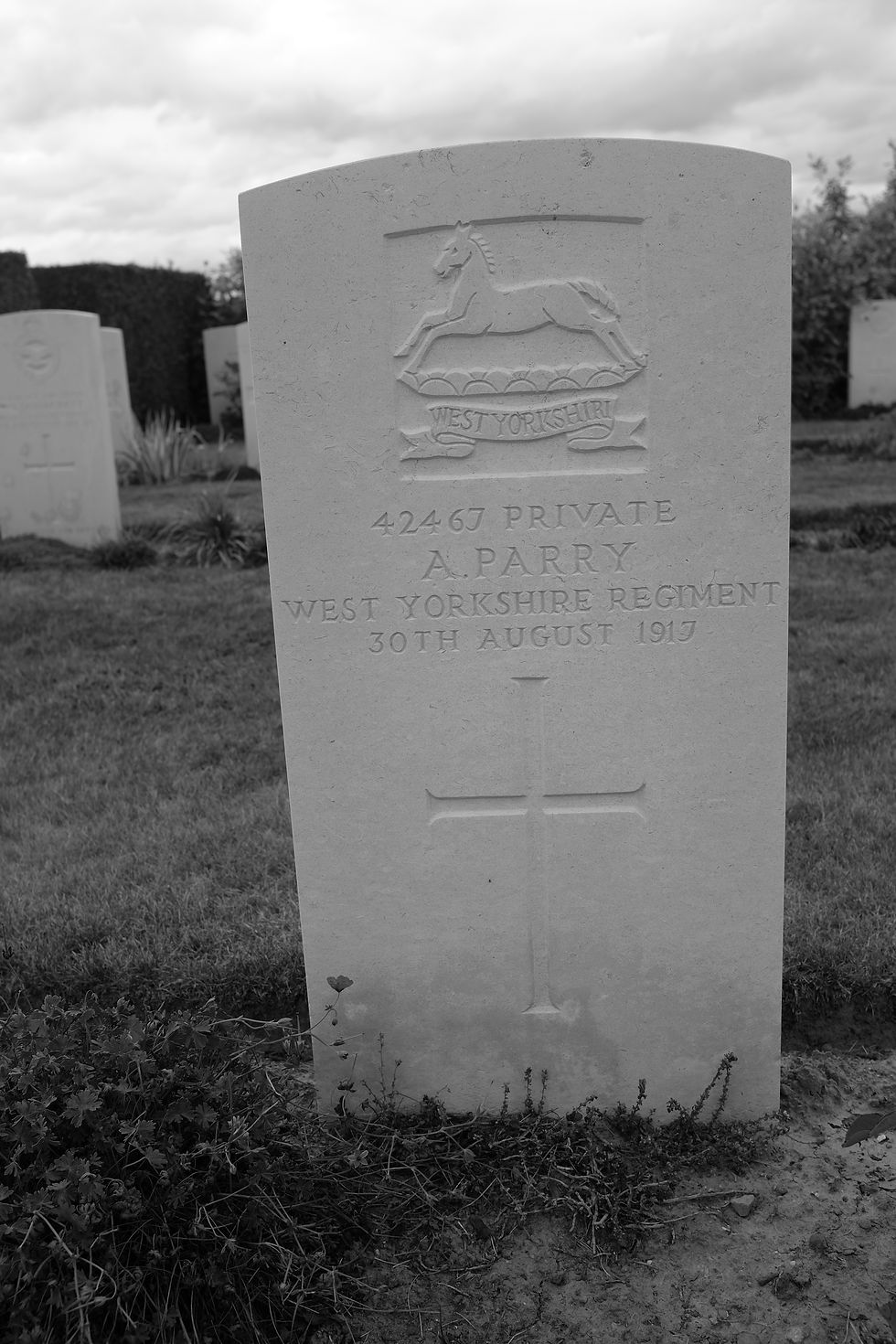
42467 Private Albert Parry, 2nd Battalion West Yorkshires, 23 Brigade, 8th Division. Shot at Dawn 30 August 1917, age Grave K.4. Husband of Alice Maude Parry and they lived with their two young children at 11 Empringham Terrace, Dalby Street, Hull. He was shot for desertion, and was the eighth soldier to be shot for desertion. Alice was granted a widows pension 25s 5d under Article 11 of the Royal Warrant. Article 11 pensions, often referenced in conjunction with Article 13, were for widows of soldiers who died during the war. It was often specifically linked to widows over 40 years of age or those with children eligible for allowances. The base war widow's pension at the end of the war was relatively low, around 13s 9d, but additional allowances were available for children. A condition was that widows needed to prove their marriage occurred before the soldier's enlistment or before the start of the war. Read more about War widows and their Pensions
Boy Soldiers
In the Ypres Salient, we are drawn to the graves of 6322 Private John Condon, 2nd Battalion Royal Irish Regiment, killed in action in May 1915, age 14 and the youngest known battle casualty of the war, although this is now questioned, and the grave of 5750 Valentine Strudwick, 8th Rifle Brigade, killed in action in January 1916, age 15. Strudwicks grave attracts a great deal of attention because of its location at Essex Farm and that locations association with Lieutenant Colonel John McCrae and the poem ‘In Flanders Fields.’ There are many more ‘Boy Soldiers’ buried across the Salient and who are not remembered in the same way and these include three from Falkirk District Private William Jamieson, age 17, Private James Duchart, age 16, and Private Herbert Richmond, age 17. There were many reasons why under age boys enlisted in 1914 and 1915 boredom with their jobs, looking for adventure, and escaping family pressures. The checks on age and qualification to enlist were more relaxed than later in the war. The army preferred younger recruits, there was a history of boy soldiers in the army going back over one hundred years. At Waterloo the army had a number of boy soldiers in their ranks. The army preferred younger recruits as they would follow orders and accept discipline more readily than older men. The boys had a belief in their own indestructibility and were prepared to take more risks. We tend to also forget the number of boys who served in the Royal Navy and we do not seem to have the same passionate response to their service as we do those who fought on the Western Front. With regards

to the army, the difference was the sheer number who served on the Western Front and there were more boy soldiers in 1915 than served in Wellington’s army at Waterloo. For further reading on this subject see Richard Van Emden’s excellent book Boy Soldiers of the Great War. There is one Boy Soldier buried here. 63199 Private Sidney Currie, 3rd Battalion (Toronto Regiment), 1st Canadian Infantry Brigade, 1st Canadian Division. Killed in action 3 July 1915, age 17. Grave C.11. Son of Mr. Oswald Currie, 13 York Mansions, Southampton Street, Camberwell, London, England. He listed his profession as Labourer when he enlisted in Montreal on 27 November 1914. He of course lied about his age stating that he was 19 years and four months. He died of his wounds at No.2 Canadian Field Ambulance which was located in the village of Romarin. The Battalion HQ was in the Piggeries at Ploegsteert and the Battalion was in reserve and providing working parties to improve the trench line. This was dangerous work even in the hours of darkness with the men working in the open. The War Diary for No.2 Canadian Field Ambulance records on the 3 July: ‘#6199 Pte S Currie, 3rd CAN. Bn. Died at 10pm today from Bullet wound in the head, buried in military Cemetery Romarin on 4 July. Chaplain Capt. Wm Baston.’

Location
Maple Leaf Cemetery is located 14 Kms south of Ieper town centre, on a road leading from the Rijselseweg, N365, which connects Ieper to Wijtschate, Mesen, Ploegsteert and on to Armentieres. From Ieper town centre the Rijselsestraat runs from the market square, through the Lille Gate (Rijselpoort) and directly over the crossroads with the Ieper ring road. The road name then changes to the Rijselseweg. On reaching the village of Ploegsteert, turn right at the church onto Rue du Romarin. At the end of this road lies the left hand turning onto Niepkerkestraat (for only 50 metres), then immediately right onto Zakstraat. The cemetery is located 50 metres beyond the right hand turning onto Zakstraat.
The cemetery was designed by G H Goldsmith.
Burials
The cemetery contains 167 Commonwealth and nine German burials of the First World War.
UK – 80
Australian – 4
New Zealand – 43
Canadian – 39
South African – 1
German – 9


Comments