


Westoutre British Cemetery
Updated: Jul 28

Westoutre British Cemetery, CWGC, is located within the village of Westoutre (now Westouter) and the village remained in Allied hands from the early months of the First World War to the Armistice, but in the summer of 1918, after the Battles of the Lys, it was within 2.4 Kms of the front line. Westoutre British Cemetery, CWGC, was begun in October 1917. It was used until the following April and again in August-October 1918. Fifty graves were concentrated here from BIXSCHOTE GERMAN CEMETERY, also known as Friedhof XI, and KEMMEL FRENCH CEMETERY No.2, which was near Kemmel French Cemetery No.1, after the Armistice. French units used the cemetery in April-August 1918, when they were defending the Mont des Flandres but these graves were later removed. The cemetery is located some 500 metres from the Westoutre Churchyard and Extension.


Billets in Westoutre
The 3rd Division spent time in Westoutre after First Ypres arriving in the village on 21 November. Billy Congreve recorded in his diary: ‘At last we are being relieved – by the French – and go off to rest and get up to strength again. I believe we go to Westoutre, half-way to Bailleul.’ The 3rd Division were in the village for four days resting and recuperating and they had their headquarters in the Mont Noir Chateau with the command post located on the Scherpenberg. He wrote: ‘We are going to keep the chateau as our night headquarters and use the Scherpenberg Hill as a day headquarters. This latter is a high conical hill with a windmill and farm on top of it, and one gets an excellent view of Wytschaete, Messines and Ypres. On a real clear day, one can even see as far as the sea somewhere near Ostend.’ The Royal Irish Rifles were in billets in Westoutre in January 1915 and in his diary Gerald Burgoyne, Royal Irish Rifles, wrote about the church in Westoutre being used as a billet: ‘..It’s different when troops have to be billeted in a Church, as at West Outre, but even that I believe is unnecessary. Our RC Chaplain had to stop men billeted there smoking during Mass, which he says in the Chancel..’ He also recorded in his diary of two spies being caught in Westoutre: ‘Yesterday two spies were caught in West Outre, one in a sort of khaki uniform, and six spies were caught in Kemmel last week.’
Chinese Labour Corps
There are three men from the 105th Company CLC buried here. A disturbance took place on Christmas Day 1917 involving the 55th and 105th Companies in Reninghelst. What started this is unclear although Father Achiel Van Walleghem records in his diary '... the New Zealanders... swig and swill and reel and rant and pick quarrels with the Chinese. The Chinese become resentful and band together and in the afternoon and evening, fights break out in several places. Such wild fellows.' He recorded the next day: 'We hear that several Chinese who had been in fights with the New Zealanders yesterday were shot this morning on Mont Noir.' The incident is also mentioned by Captain J C Dunn in his memoirs 'The War the Infantry Knew': '... an urgent message called for two armed parties of 100 men each to deal with an outbreak - 'mutiny,' 'insurrection' were words one heard - among the Chinese labourers. By the time our parties reached the Chink camp the Chinks were strolling in by twos, threes, and half-dozens, as quietly satisfied as men coming from a Band of Hope Meeting... the half company here had just walked over to Reninghelst, and joined their other half company in killing the sergeant-major. They said that he squeezed them too much, took 5 francs from each man on the voyage, and flogged them too readily;... They had beaten him until he was nearly dead, then shot him. They had not handled the two English officers more roughly than was needed to prevent them protecting the sergeant-major, who had fled for shelter to the officers quarters.' In an official report of IX Corps it was recorded that 150 men from the 55th Company had come over from Poperinghe and rushed the camp in Reninghelst in order to kill the head ganger (sergeant-major). The report recorded that five men died, two, including the sergeant-major, killed by the Chinese, and three killed by the British. Three of the men buried here are Chang Feng An, Grave BB.3, Chang Chih Te, Grave BB.2, and Wu En Lu, Grave BB.1. The two others are buried in Bailleul Communal Cemetery Extension.

Victoria Cross Holder Buried here
Major Eric Stuart Dougall M.C., V.C. ‘A’ Battery, 88th Royal Field Artillery, 19th (Western) Division. Killed in action 14 April 1918, age 32. Special Memorial 1. Son of the late Andrew Dougall, of Tunbridge Wells, and of Emily Elizabeth Dougall, 16A, Loudoun Road. St. John's Wood, London. He was educated at Grove House School, Tunbridge Wells and Pembroke College, Cambridge and completed his degree in 1908. From 1908 to 1912 he was training under the Chief Engineer of the Mersey Docks and Harbour Board at Liverpool. In March 1912, he sailed to take up an appointment as an Assistant Engineer to the Bombay Port Trust, and was subsequently placed on the permanent staff. Soon after the outbreak of war, being unable to come home, he joined the Bombay Light Horse, and it was not till the end of 1915 that he obtained leave to return to England and apply for a commission. After training as a cadet at St. John’s Wood he was gazetted to the Special Reserve, R.F.A., July 7th 1916, and proceeding to France in the same month, came safely through the latter part of The Battles of the Somme, 1916, including the Battle of the Ancre, November 13th to 18th, and the capture of Beaumont Hamel on the 13th. The Brigade then moved to the Ypres Sector, and on May 11th 1917, he was promoted to Acting Captain as second in command of his Battery, A/88th Brigade, R.F.A. On June 7th 1917, the first day of The Battle of Messines, he was awarded the Military Cross, the following paragraph appearing with the announcement in the Gazette of August 27th 1917: ‘2nd Lieut. E. S. Dougall, R.F.A. (S.K.). For conspicuous gallantry and devotion to duty as Group Intelligence Officer and F.O.O. He took up a succession of observation posts in advanced and exposed positions, from which he successfully maintained communication with Headquarters. He was slightly wounded, but remained at duty and has frequently performed work requiring initiative under heavy fire with great coolness and gallantry.’ He remained in the Ypres

Sector until January 1918, and on January 7th was promoted Lieutenant (S.R.), retaining his acting rank. The Brigade had moved south again, and when the German offensive on the Somme opened on March 21st 1918, his Battery was right at the point of the salient on the Cambrai front and, being the last to withdraw from that area, retired fighting over the approximate line Ribecourt – Trescault – Bus – Le Transloy – Courcelette. On April 4th 1918, he took over command of his Battery, and they moved to Ypres to meet the German offensive in Flanders. He won his V.C. for the action on 10 April on the Messines Ridge an extract from "The London Gazette," dated 31st May, 1918, records the following: ‘For most conspicuous bravery and skilful leadership in the field when in command of his battery. Capt. Dougall maintained his guns in action from early morning throughout a heavy concentration of gas and high-explosive shell. Finding that he could not clear the crest owing to the withdrawal of our line, Captain Dougall ran his guns on to the top of the ridge to fire over open sights. By this time our infantry had been pressed back in line with the guns. Captain Dougall at once assumed command of the situation, rallied and organised the infantry, supplied them with Lewis guns, and armed as many gunners as he could spare with rifles. With these he formed a line in front of his battery which during this period was harassing the advancing enemy with a rapid rate of fire. Although exposed to both rifle and machine gun fire this officer fearlessly walked about as though on parade, calmly giving orders and encouraging everybody. He inspired the infantry with his assurance that "So long as you stick to your trenches I will keep my guns here". This line was maintained throughout the day, thereby delaying the enemy's advance for over twelve hours. In the evening, having expended all ammunition, the battery received orders to withdraw. This was done by man-handling the guns over a distance of about 800 yards of shell-cratered country, an almost impossible feat considering the ground and the intense machine gun fire. Owing to Captain Dougall's personality and skilful leadership throughout this trying day there is no doubt that a serious breach in our line was averted. This gallant officer was killed four days later whilst directing the fire of his battery.’ He was killed on 1 April by a shell splinter that struck him on the left side of his neck whilst directing his Battery at Mount Kemmel. His V.C. was presented to his sister by King George V at Buckingham Palace on 10th July 1918. She bequeathed the medal to Pembroke College on her death in 1969 and the medal still remains there.
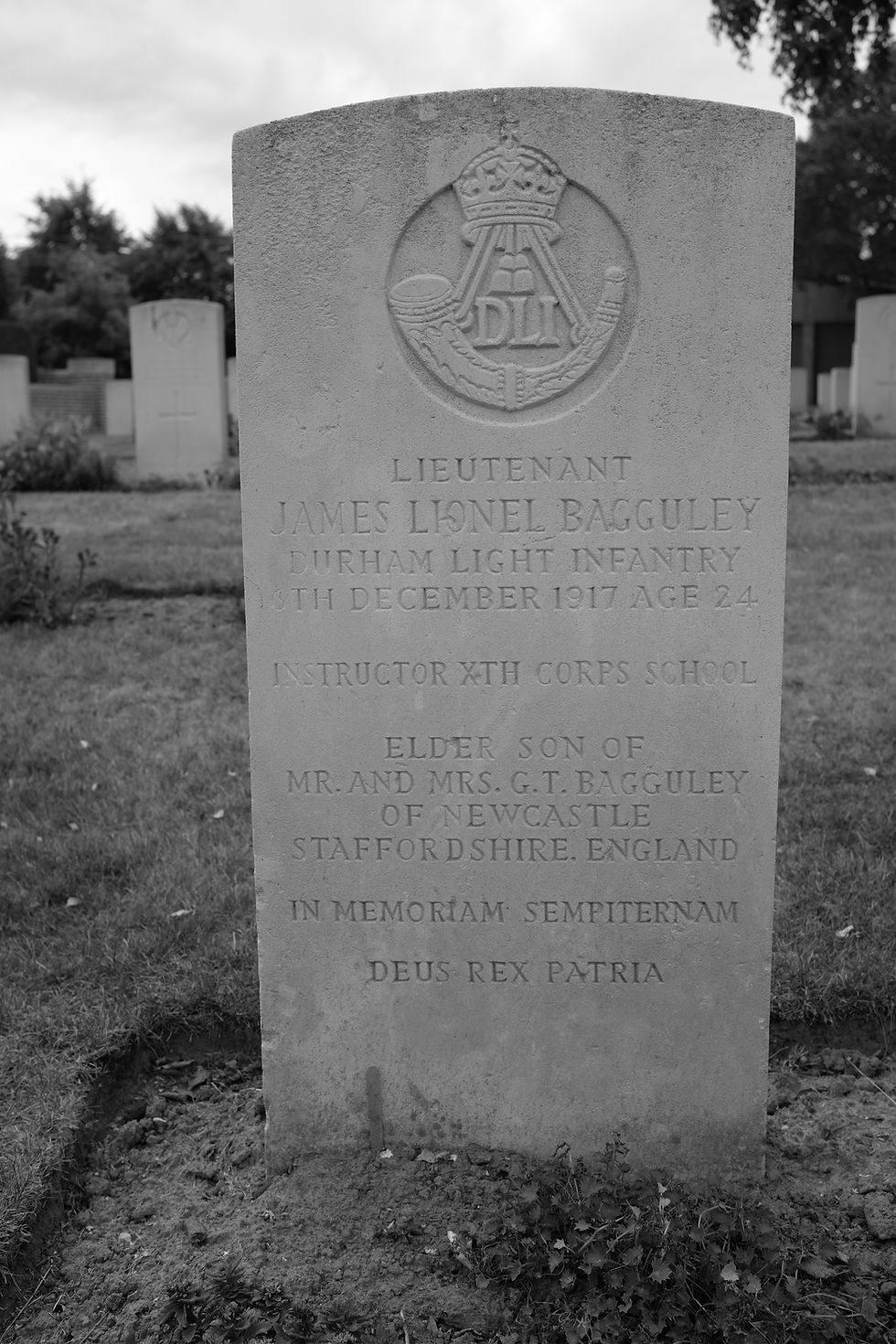
Lieutenant James Lionel Bagguley, 13th Battalion Durham Light Infantry, Instructor Xth Corps School. Accidentally killed 6th December 1917, age 24, Grave B.1. Eldest son of George Thomas and Edith Bagguley, of High Street, Newcastle, Staffs. He was educated at Newcastle-under-Lyme High School. He was working in his father’s Book Selling business on the outbreak of war and he enlisted in the 5th (Territorial) Battalion The Prince of Wales’s (North Staffordshire) Regiment. He was gazetted as a Second Lieutenant on 23 February 1915 and went to France on 24 February joining the 11th (Pioneer) Battalion Durham Light Infantry. On the 5 January 1916 he was transferred, as part of an exchange with another officer, to the 13th Battalion, he had originally belonged to the 13th Battalion. He rejoined the Battalion on 16 January which was in the line at Armentieres. He was promoted to Lieutenant in December 1916. He was attached to the Trench Mortar Battery and saw action on the Somme. In October 1916 he was sent as an instructor on the light trench mortar for a short period and rejoined his battery in time to see action during the Battle of Messines. In late June 1917 he took the Divisional Examination of Instructorship and coming first in his group was appointed an Instructor at the Xth Corps School. He enjoyed a period of leave in October 1917 and was accidentally killed on 6 December 1917 by a premature explosion of a trench mortar shell. He was twice recommended for the Military Cross.

Royal Air Force
Second Lieutenant Fred Butterworth, 4th Squadron, RAF and 1st/2nd Battalion, West Yorkshire Regiment (Prince of Wales's Own), Killed in action 14 September 1918, age 25. Grave O.4. Son of John and Alice Butterworth. Lieutenant Tom Ormand Henderson, 4th Squadron RAF, Killed in action 14 September 1918, age 19. Grave O.5. Son of Tom Ormand Henderson and Sara Helen Henderson, 1 Massey Park, Liscard, Cheshire. On the 14 September they were flying in an RE8 on a combat patrol south east of Ypres when they were shot down and killed by Leutnant Friedrich Kresse of Jasta 7. This was his only victory as he was to be shot down on 16 September by Camel aircraft of number 209 Squadron over Houplines and died of his wounds as a PoW.
Sergeant William Robinson Clarke, the first black pilot to fly for Britain, flew for 4th Squadron. On the outbreak of war Clarke, aged 19, travelled to England from Jamaica at his own expense. He joined the Royal Flying Corps on 26 July 1915 as an Air Mechanic and then as a driver for an observation balloon company. Read more about the Ypres Salient Airmen
Royal Engineers
There are eight men from the Royal Engineers buried here.

486691 Sergeant Alfred Ernest Rider, 470th Field Company, Royal Engineers, 59th Divisional Troops. Killed in action 16 April 1918, age 42. Grave E.5. He was married to Jenny Rider and they lived at 25 Simpson Street, Porthill, Stoke-on-Trent with their three children. He was employed as a French Polisher when he enlisted. The Company had proceeded to Kemmel Hill and was working on building defensive posts in the front line and the reserve line. They made and manned the Reserve Trench at Kemmel Windmill on 16 April and had three men killed and eleven wounded.
Three men from the 19th Divisional Signal Company have been selected. They were all killed in action on 14 April 1918. The War Diary is silent on any action or casualties on the day these men died. A Divisional Signal company was responsible for maintaining communications between Divisional HQ to Brigade HQ and artillery and this was achieved primarily using telephone lines, visual signals, despatch riders, and later wireless. They maintained the lines of communication, particularly telephone lines, under intense artillery fire and they would send out parties to repair cables and manned stations. Signallers were exposed to shellfire and gas while working, resulting in significant casualties. 64984 Sapper William Nicholson, age 24. Grave D.10. Son of Robert James and Mary Ann Nicholson, 76 Torrens Buildings, Torrens Street, City Road., London. 171995 Sapper Thomas O’Leary, Son of Jane O’Leary, 35 Kipling Street, Long Lane, Bermondsey. Grave D.12. 191478 Sapper Ernest Edward Froud, age 37. Grave D.11. He was employed as a Sorting Clerk and Telegraphist Post Office when he enlisted. He was unmarried and lived with his mother Emma Froud at 100 Barden Road, Tonbridge, Kent. She received a pension under Article 21 of the 1918 Royal Warrant and this specifically provided for pensions based on pre-war dependence Article 21(1)(a) and parents could receive a pension equal to the amount of pre-war dependence or 3s. 6d. a week, whichever was greater, up to a maximum of 15s a week. Her award was 5/- per week or 25p today.
Boy Soldiers
In the Ypres Salient, we are drawn to the graves of 6322 Private John Condon, 2nd Battalion Royal Irish Regiment, killed in action in May 1915, age 14 and the youngest known battle casualty of the war, although this is now questioned, and the grave of 5750 Valentine Strudwick, 8th Rifle Brigade, killed in action in January 1916, age 15. Strudwicks grave attracts a great deal of attention because of its location at Essex Farm and that locations association with Lieutenant Colonel John McCrae and the poem ‘In Flanders Fields.’ There are many more ‘Boy Soldiers’ buried across the Salient and who are not remembered in the same way and these include three from Falkirk District Private William Jamieson, age 17, Private James Duchart, age 16, and Private Herbert Richmond, age 17. There were many reasons why under age boys enlisted in 1914 and 1915 boredom with their jobs, looking for adventure, and escaping family pressures. The

checks on age and qualification to enlist were more relaxed than later in the war. The army preferred younger recruits, there was a history of boy soldiers in the army going back over one hundred years. At Waterloo the army had a number of boy soldiers in their ranks. The army preferred younger recruits as they would follow orders and accept discipline more readily than older men. The boys had a belief in their own indestructibility and were prepared to take more risks. We tend to also forget the number of boys who served in the Royal Navy and we do not seem to have the same passionate response to their service as we do those who fought on the Western Front. With regards to the army, the difference was the sheer number who served on the Western Front and there were more boy soldiers in 1915 than served in Wellington’s army at Waterloo. For further reading on this subject see Richard Van Emden’s excellent book Boy Soldiers of the Great War. There is one Boy Soldier buried here. 6587 Private Michael Cush, ‘A’ Company. 7th (South Irish Horse) Battalion, Royal Irish Regiment, 21st Infantry Brigade, 30th Division. Killed in action 17 August 1918, age 17. Grave M.1. Son of James and Mary Cush, of Boley, Craanford, Co. Wexford. The Battalion was in the line at Locre the Germans attempted a raid on the Battalion positions and this was repulsed with two men wounded.
Canadian

436949 Private Charles Duncan, 49th Battalion (Edmonton Regiment), 7th Infantry Brigade, 3rd Canadian Division. Killed in action 5 June 1916, age 32. Grave H.11. Son of James and Magdalene Duncan, Kincardineshire, Scotland. He was married to Mary T. Duncan, of Fort Garry Hotel, Broadway, Winnipeg, Manitoba. He listed his profession as Grocer when he enlisted on 18 February 1915 in Edmonton. The Battalion embarked for the UK on 3 June 1915 and then went to France on 9 October 1915. On the 2 June 1916, the Battalion along with the 52nd Battalion, counter-attacked the German positions at Sanctuary Wood and to retake the trenches lost in the earlier German attack. They attacked at 2.10am and held all the positions that they took. They were relieved during the night of 4/5 June. The Battalion casualties were heavy with 45 Other Ranks killed, 257 wounded,

and 69 missing. Charles was recorded as wounded and missing and this was later changed to killed in action. His remains were found in a battlefield burial and was identified from letters and photos. He was concentrated here after the Armistice. 427995 Private John Browne Rix, 58th Battalion, 9th Infantry Brigade, 3rd Canadian Division. Killed in action 19 August 1916, age 31. Grave N.18. Son of the late John and Fanny Rix, of Tasburgh. Norfolk, England. He was unmarried and listed his profession as Carpenter when he enlisted on 10 September 1915. The Battalion embarked for the UK on 22 November 1915 and went to France on 22 February 1916. The Battalion was in the Zwarteleen sector near to Hill 60 with casualties recorded for the 19 August as ‘1 OR killed, 6 OR wounded, 1OR shell shock’ His remains were concentrated here from his burial on Hill 60 after the Armistice.
Location
Westoutre British Cemetery is located 11.5 Kms south-west of Ieper town centre on a road leading from the N375 Dikkebusseweg. From Ieper town centre the Dikkebusseweg (N375) is located via Elverdingsestraat, straight over a roundabout onto J.Capronstraat (for 30 metres), then left along M.Fochlaan. Immediately after the train station, the first right hand turning is the Dikkebusseweg. 10 Kms along the Dikkebusseweg lies the right hand turning onto the N315 Sulferbergstraat. 2.5 Kms along the N315 lies the village of Westouter.
The cemetery itself is located on the Poperingestraat, 200 metres from the village centre, opposite the fire station.
The cemetery was designed by W H Cowlishaw.
Burials
The cemetery now contains 175 Commonwealth burials and commemorations of the First World War. Of these, fifty two are unidentified but there are special memorials to five casualties known or believed to be buried among them. The four Second World War burials all date from May 1940 and the withdrawal of the British Expeditionary Force to Dunkirk ahead of the German advance. There is also one French burial from this period.
UK – 157
New Zealand – 3
Canadian – 2
Chinese Labour Corps – 3
Known Unto God – 2
Special Memorials to five British men known or believed buried among the unnamed.


Comments