


Irish House Cemetery

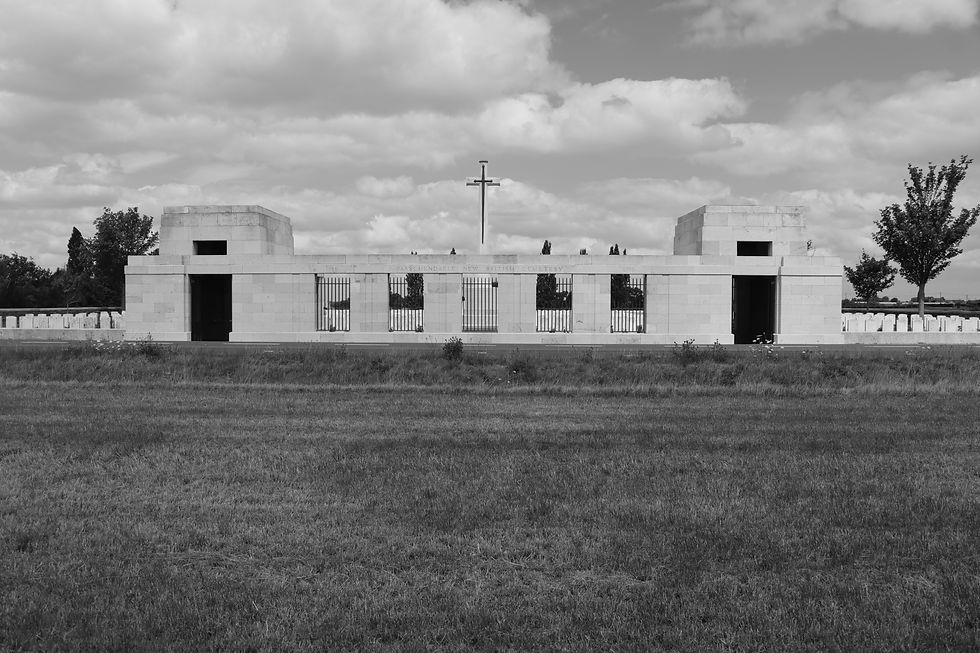
Irish House Cemetery, CWGC, Kemmel, Ypres, owes its name to a small farmhouse 90 metres to the west, not the farm you see today, known to the troops as ‘Irish House’. It was begun in June 1917 by the 16th (Irish) Division, and used at intervals until September 1918. In Row A are the graves of 33 Officers and men of the 1st Gordon Highlanders, killed in action in December 1914 in the 3rd Division's attack on Wytschaete, and reburied here by the 11th Royal Irish Rifles in June 1917. The ground was in German hands from April 1918 to the end of the following August.
Nearby are the mine craters at Maedelstede Farm, Petit Bois, and Peckham Farm, blown on 7 June 1917. On the 7 June 1917 the British Second Army launched its attack along the Messines Ridge with the detonation of nineteen mines comprised of one million pounds of ammonal explosive beneath the German defenders. The Battle of Messines was the most effective integration of mines with an infantry attack that was supported by an artillery barrage which stupefied the German defenders. The overall objectives of the British Second Army attack were to seize the villages of Wytschaete and Messines and to move beyond them to establish a line, the Black Line, just over the crest of the ridge. The first phase would see nine divisions move forward and had a series of subsidiary objectives to take supported by the fire of the artillery that lifted and moved forward at a precise time.

It was a regular valley of death The attack by 2nd Battalion Royal Scots and 1st Battalion Gordon Highlanders 8th Brigade, 3rd Division, 14 December 1914. This was an ill-conceived attack that lacked any tangible artillery support and cost the lives of over 400 men. Captain Billy Congreve, ADC to General Haldane, 3rd Division, wrote in his diary about the Gordon Highlanders attack: ‘Imagine sending a battalion alone to attack a strongly wired position up a hill and over mud a foot deep, under frontal and enfilade fire. It was a regular Valley of Death. The losses were, of course, very heavy. They lost seven of nine officers and 250 men. Such was the attack ordered by Sir John French. Next day, I read in a paper: British troops hurl back Germans at Wytschaete. A beautiful epitaph for those poor Gordons who were little better than murdered.’
1st Battalion Gordon Highlanders, 8th Infantry Brigade, 3rd Division

There are three men buried here along with the remains of thirty men in one grave. Their remains were found and buried by 11th Royal Irish Rifles in June 1917. Lieutenant William Findlay Robertson Dobie, Mentioned in Despatches. Age 27. Grave A.30. Son of Dr and Mrs. D. Robertson Dobie, of Earncliff, Crieff, Perthshire. He was a Regular Soldier joining the Black Watch and received his commission in 1911. He was seconded to the Royal Flying Corps in July 1914 and involved with home defence in the first few months of the war. He joined the Battalion as part of a draft three weeks before he was killed in action. He was mentioned in Field Marshal Sir John French’s Despatch of 12 February 1915. Lieutenant James Julian Gordon McWilliam. Age 19. Grave A.30. Son of James McWilliam, 22 Forbes Road, Edinburgh, Solicitor Supreme Courts, Edinburgh, and his wife Ella Julie de Lorn (nee MacDougall). 9870 Company Quartermaster Serjeant Archibald McKinley. Grave A.31. Son of Jessie McKinlay, 26 New Hunterfield, Arniston, Gorebridge, Midlothian. He was unmarried and a Regular Soldier.
Thirty NCO’s and Men

Royal Scots Fusiliers
40772 Private William Paterson, 2nd Battalion, 90th Infantry Brigade, 30th Division. Died of wounds 8 November 1917. Grave C.4. Son of Robert and Agnes Clement Paterson, of Glencairn, Dumfriesshire. The Battalion was in the line in front of Derry House near Wytschaete and were relieved on the evening of 7 November and moved back to Vroilandhoek Camp. Enemy aircraft were active at 3am on 8 November and dropped bombs on the Transport Lines killing one man and wounding two.

Second Lieutenant Walter Barrie, 3rd Battalion King’s Own Scottish Borderers attached 6th Battalion Border Regiment, Killed in action 7 June 1917, age 37. Grave A.15. He was the youngest son of the late Mr. and Mrs. John Barrie, of South Berryfell, Hawick. He was working on the family farm at the outbreak of war and he enlisted in the Lothian and Border Horse Yeomanry. As a Sergeant he landed in France in September 1915. He was selected for officer training and gazetted as a Second Lieutenant and joined the King’s Own Scottish Borderers. On the 7 June 1917, the Battalion had moved forward to Vierstraat Switch in readiness to advance on the opening day of the Battle of Messines. At 1.30pm they moved forward to the trench known as Chinese Trench and halted. At 2.45pm they went forward in artillery formation with the objective of taking Van Hove Farm to the east of Wytschaete. At 3.15pm they crossed Wytschaete Ridge and came under very heavy shell fire however, they were not held up and moved forward with comparatively few casualties however, Second Lieutenant Barrie was killed at this point and Major K.M.I. Chance D.S.O. severely wounded. The Battalion went on to capture and consolidate Van Hove Farm.
Australian
There are thirteen Australian men buried here. Two men selected from the 5th Battalion AIF who were killed in action on 18 December 1917. On the 18 December 1917 the Battalion was in the front line east of Wytschaete at Wambeke with dispositions at Derry House, Lumm Farm, Kilo Farm Howe Farm, and Cabin Hill. Intercompany reliefs took place however, the War Diary makes no mention of casualties.

3123 Corporal Stephen Abraham Durant, 5th Battalion, 2nd Brigade, 1st Australian Division. Killed in action 18 December 1917, age 27. Grave C.2. Son of Stephen R. and Emily E. Durant. He was married to Annie Durant, of Bell Street, Heidelberg, Victoria, Australia. He was employed as a Cigar Maker when he enlisted on 12 July 1915. He went to France arriving in Marseilles on 30 March 1916, following action on 17 August 1916, he was admitted to an ANZAC rest station suffering from shell shock and rejoined the Battalion on 19 August. On 1 November he was sent to the 2nd Field Ambulance and discharged on 3 November. On 2 December he was admitted with rheumatism and then pyrexia, a fever, and then to 36th Casualty Clearing Station with NYD, not yet diagnosed, and then to 3rd Stationary Hospital at Rouen. On 14 December he was transferred to the 1st London General Hospital with myalgia and was discharged to furlough on 5 April and then joined at Windmill Camp at Perham Downs on 28 April. He was posted as part of a draft to France on 14 October and immediately reported sick at the Base camp in Le Havre and was sent to the 39th General Hospital as NYD and was then diagnosed with scabies. He was discharged and joined the Battalion on 26 November and was wounded in action and died of his wounds on 18 December at the 2nd Australian Field Ambulance. 6768 L/Cpl Benjamin James Latham, 5th Battalion, 2nd Brigade, 1st Australian Division. Killed in action 18 December 1917, age 33. Grave C.2. Son of James and Rebecca Latham. Born at Olveston, England. He was unmarried and gave his trade as Labourer when he enlisted on 9 September 1916. He sailed with a draft from Melbourne to Plymouth on 25 October 1916 landing in Plymouth on 28 December 1916 and going to the camp at Larkhill. He was absent without leave from 1 to 4 February 1917 and received ten days Field Punishment No.2, he was shackled in irons, heavy fatigues, and deducted fifteen days’ pay. He went as part of draft to the Base camp at Etaples on 15 March 1917 and joined the Battalion on 20 March. He was promoted to Lance Corporal on 19 August. He was admitted to the 2nd Australian Field Ambulance on 18 December with a gun shot wound to the chest and died of his wounds.

Location
Irish House Cemetery is located 7.5 km south of Ieper town centre on the Savaardlindestraat, a road leading from the N365 connecting Ieper to Wijtschate and on to Armentieres. From Ieper town centre the Rijselsestraat runs from the market square, through the Lille Gate (Rijselpoort) and directly over the crossroads with the Ieper ring road. The road name then changes to the Rijselseweg. On reaching the village of Wijtschate the first right hand turn onto the Hospicestraat leads to the village square. The Wijtschatestraat leads from the village square towards Kemmel. 2 km along the Wijtschatestraat lies the right hand turning onto Savaardlindestraat. The cemetery itself is located 800 metres along the Savaardlindestraat on the right hand side of the road.
The cemetery was designed by W H Cowlishaw.
Burials
The cemetery contains 117 Commonwealth burials and commemorations of the First World War. 40 of the burials are unidentified but there is a special memorial to one casualty known to be buried in the cemetery.
UK – 103 (includes 40 unnamed)
Australian – 13
German - 4


Comments