


Lindenhoek Chalet Military Cemetery
Updated: Aug 28

The first burials at Lindenhoek Chalet Military Cemetery, CWGC, Kemmel, Ypres, were made in March 1915 and it continued to be used by fighting units and Field Ambulances until October 1917. It was enlarged after the Armistice when over 100 graves were brought in from the battlefields surrounding Kemmel. A new chalet has been built opposite the cemetery and stands on the site of the old which was used as a Field Ambulance and destroyed during the fighting of 1918, during which the Kemmelberg was constantly shelled. Beatrix Brice writing in her ‘The Battle Book of Ypres’ recalled one of those many actions that saved the day during the desperate fighting of November 1914. Waiting in reserve, and parked to the west of Kemmel Village, was a battery of the 5th Division Royal Field Artillery. A Major on the Lindenhoek to Wytschaete Road sent the senior subaltern back to the bring the guns forward immediately. Realising that the direct road was a target for enemy fire and going around Kemmel Village meant further delay, he took the guns over the Kemmelberg down its eastern slop and past this cemetery and by his actions helped to hold the line.


Kemmel Village
Kemmel Village saw thousands of men pass through or were billeted in the village Captain Gerald Achilles Burgoyne, a company commander with the 2nd Battalion Royal Irish Rifles, spent a few months in Kemmel and recalled in his memoirs ‘The Burgoyne Diaries’: ‘Took a walk around Kemmel town this morning. I don’t think that out of a town of some 4,800 inhabitants there is one house quite intact and undamaged by shrapnel, and half the place is in ruins, blown down completely. We passed one building, the front of which is completely wrecked. The wretched occupier has partly blocked up the frameless windows with bricks, above which one can see a shattered interior. However, outside the door hung a pig; inside we saw portions of the other half, a plate of apples and a few other things on sale. There are some dozen shops of sorts where bread, butter, candles, chocolates and sweets can be bought, and milk and eggs can be easily obtained.’ Arthur Behrend, then a Second

Lieutenant with 279th Siege Battery, he was later to be Adjutant of an Artillery Brigade in 1918, and writing in his memoirs ‘As From Kemmel Hill’, recalled his time there in early 1917 that: ‘ … my section was firing at Germans from a copse of spidery trees alongside the road on the northern outskirts of Kemmel….In Kemmel of early 1917 there seemed little need for deep dug-outs. Indeed none existed…in villages like Kemmel the houses were still fit to be used as billets, at any rate on their ground floors..’ Stories of spies behind the lines abounded in the early war years with Gerald Burgoyne recalling in his diary on 10 January 1915 that: ‘The Northumberland Fusiliers last week caught two spies in the church tower at Kemmel, manipulating the clock hands. They were shot.’ He also wrote of an officer of the Honourable Artillery Company occupying a billet in Kemmel that had been used by the French as a aid post and finding one of the rooms full of amputated limbs.

Durham Light Infantry
There are twenty five men from various Battalions buried here. Of the three Battalions I have selected their dead are from 1915. The Battalions spent their time in the trenches at Kruisstraat. 1st/6th Battalion Durham Light Infantry, 151st Infantry Brigade, 50th Division. 6/2888 Private Alexander Pattison, Killed in action 22 June 1915, age 19. Grave I.D.9. He was one of two sons and five daughters of Alexander and Margaret Jane Pattison, 37 Newton Cop Bank, Bishop Auckland. The Battalion was in the line at Kruisstraat. On the 22 June the day was quiet but with a good deal of sniping. In the early hours of 21/22 June the Germans opened fire with a machine gun on the right of trench E.1 killing Alexander.

1st/7th Battalion Durham Light Infantry, 151st Infantry Brigade, 50th Division
The Battalion went to France on 19 April 1915 landing at Boulogne.
7/2303 Private James Dawson, Killed in action 29 June 1915, age Grave I.E.11. Husband of Martha Todd Dawson, and they lived with their five children at 3 Dixon Square, Monkwearmouth, Sunderland. James landed at Boulogne with the Battalion 19 April 1915. On the 29 June the Battalion was in the line at Kruisstraat having relieved the 6th Battalion. There is no mention of casualties however, there is an indication of the Battalion losses from 19 April to 30 June as the War Diary records that a draft of 160 men arrived and were attached to the various Companies. 7/3084 Private John Blakey, Killed in action 12 July 1915, age 21. Grave I.D.7. Husband of Elizabeth Green (formerly Blakey), 35 Ormonde Street, South Shields. They had no children. Elizabeth remarried on 17 May 1917 to 24643 Private Charles William Green of serving in the DLI. On the 12 July they were in the line at Kruisstraat however, the War Diary makes no mention of casualties but does mention that Lord Cavan, G.O.C. 50th Division visited the trenches. 7/3341 Private Charles Thomas Bell, Killed in action 13 July 1915, age 19. Grave I.C.5. Son of Charles Thomas and Eliza Bell, 54 Wear Street, Sunderland. Charles was employed as a Miner when he enlisted and he was one of the draft that joined the Battalion at the end of June 1915.On 13 July the Battalion was still in the same location. The War Diary records that the trenches of ‘A’ and ‘D’ Companies were heavily bombed (hand grenades) throughout the day. They replied with rifle grenades but did not have enough ammunition to trouble the Germans.

10th Durham Light Infantry, 43rd Infantry Brigade, 14th Division
The Battalion arrived in France on 24 May 1915. There are only two men from this Battalion buried here. The Battalion was in the line at Kruisstraat. 17511 Private Terence McHugh, ‘B’ Company. Killed in action 19 June 1915. Grave I.D.11. Brother of Mrs. Laura Byers, 10 Charlotte Street, Askew Road, Gateshead, Co. Durham. The War Diary records his death as 19 June and not 20 June as shown on his headstone. The War Diary recording: ‘B. Coy No17511 Pte T McHugh killed..’ 24300 Private William Ritchie, Killed in action 20 June 1915, age 20. Grave I.D.10. Son of Thomas B. and Alice Ritchie, 1 School Street, Dawdon Colliery, Co. Durham. William landed in France on 21 May 1915 with the Battalion. His death is not recorded in the War Diary as one of the three killed on 19/20 June. He was among those who subsequently died of their wounds, there were four men listed in this category.

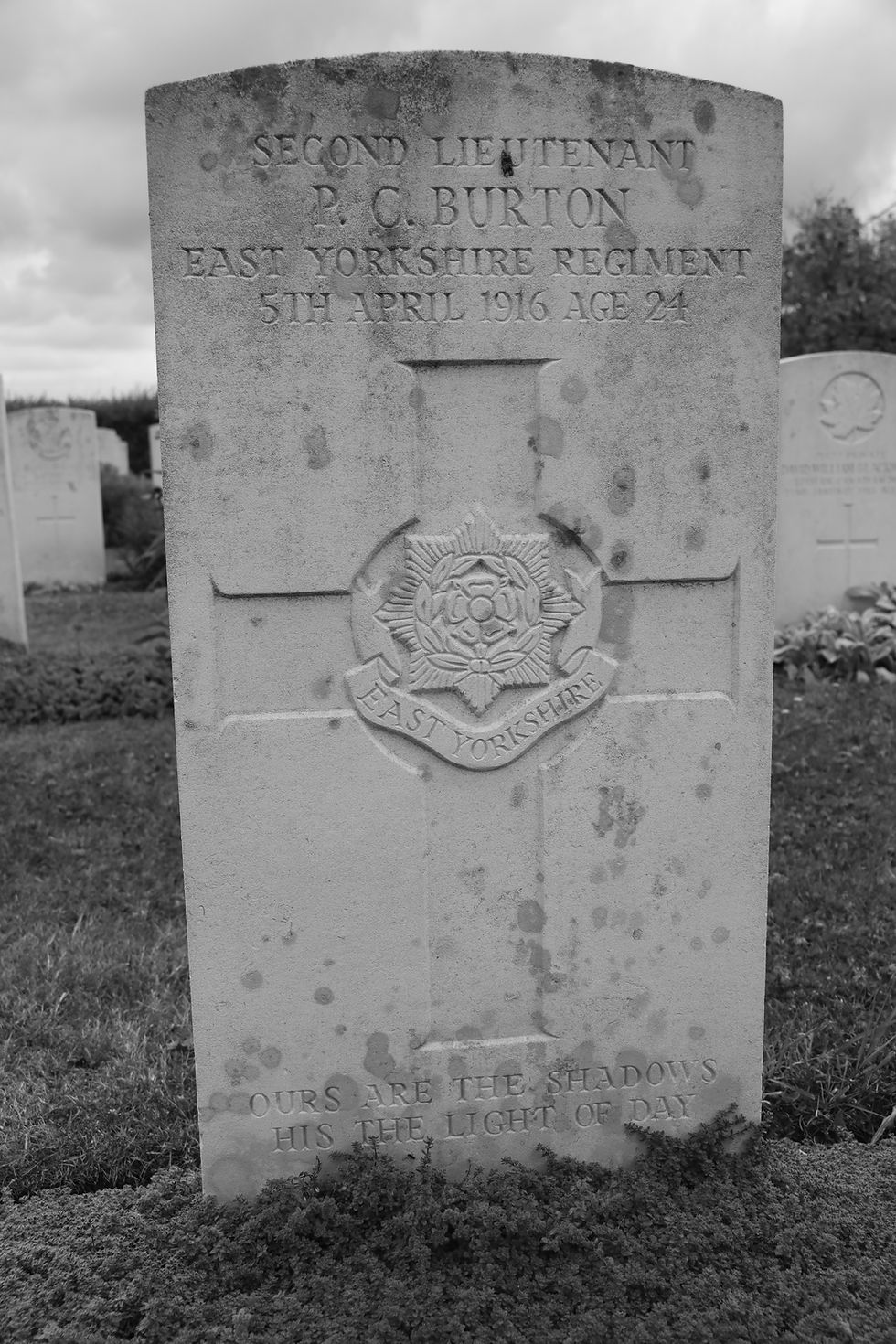
4th Battalion East Yorkshire Regiment, 150th Infantry Brigade, 50th Division
Second Lieutenant Percy Charles Burton, 4th Battalion East Yorkshire Regiment, Killed in action 5 April 1916, age 24. Grave I.H.8. Son of Edith E. Burton, of Springfield Terrace, Stamford Bridge, York, and the late Walter Burton. They also had a daughter, Doris. Percy was employed as a Clerk by Horsley, Smith, and Co. timber merchants, when he enlisted and was serving as a Sergeant-Instructor in the 5th Battalion when he was gazetted on 24 July 1915. The Battalion were in the trenches at Spanbroekmolen with the War Diary recording that: ‘A quieter day. Headquarters shelled by a few 5.9’’ in the morning. Casualties 2nd Lieut. C.P. Burton killed, wounded Other Ranks two.’

Second Lieutenant William Fergus Carlton, 4th Battalion East Yorkshire Regiment, Killed in action 17 June 1916, age 25. Grave I.J.13. Son of Robert Hall Carlton and Hannah Carlton, of 'Martonfield,' Marton Road, Bridlington. He was working as a drapers assistant when he enlisted and serving as a Private in the Royal Fusiliers when he was gazetted. The Battalion were in the trenches at Spanbroekmolen and took over the line from the 5th Battalion Yorkshire Regiment on 12 June. On the 17 June the Battalion trenches at F.4 were shelled with poison gas with the War Diary recording the casualties as: ‘.. officers killed 1, wounded 3: other ranks killed 10 wounded 74 missing 1. 5 other ranks of the wounded subsequently died at the dressing station at LINDENHOEK.’ On the 18 June the War Diary records: ‘… 2nd Lieut Carlton and 17 other ranks were buried at LINDENHOEK cemetery N.27c: these were casualties on 17.6.16. Six were killed by shell fire, 11 died of gas poisoning, 2 more of the wounded died in hospital, and 2 others were buried at LOCRE.’

In November 1915, 250 Tunnelling Company took over responsibility for a front of nearly 3,000 yards extending from Bois Carre south to Kruisstraat Cabaret, with Wytschaete village opposite the centre of the line. The 250th Tunnelling Company was working on the three mines at Hollandscheschuur Farm and on 17 June the War Diary records that: ‘1 OR from 4 General Base Depot – II Lieut G.J. Roberts – 2 OR (RE) + 1 OR (attached infantry) died from Gas Poisoning – 4OR (RE) 2OR (attached infantry) – 2OR (Own mining Corps) Gassed (enemy) + admitted to hospital.’ Royal Engineers – Tunneller 121551 Sapper Charles Henry Cuff, 250th Tunnelling Company, Killed in action 17 June 1916, age 22. Grave IK.7. Son of Mr. and Mrs. Cuff, 27 Chance Street, Landport, Portsmouth. His records show that he died from gas poisoning. Read more about the 250th Tunnelling Company and the mines at Hollandscheschuur
154th Field Company, Royal Engineers, 37th Division
There are two men killed in action on 22 and 23 July 1917 and buried here. The 154th Field Company had their HQ at Lindenhoek at Coesteker Farm, and were working in the Wytschaete sector. They were working on the Reserve Line and communication trenches, building concrete shelters at Derry House, an Observation Post at ANZAC Farm, and laying tramway track, and working on the Wytschaete to Kemmel road. The War Diary does not record any casualties however, working in the open in daylight was one of the hazards faced by the Field Companies. The work at Derry House and ANZAC farm was close to the front line. 166507 Sapper Harry Buckley Newton, Killed in action 22 July 1917, age 45. Grave I.C.3. Son of John Buckley Newton and Sarah Jane Newton, of Lancashire. He was married to Alice Maud Newton, and they lived with their four children at 32 Edward Street, Hall Street, Moston Lane, Moston, Manchester. 146612 Sapper Stephen Tom May, Killed in action 23 July 1917, age 20. Grave I.F.2. Son of Charles and Mary Ann May, 70 High Street, Hastings, Sussex.


107555 Sapper Albert Tanswell, 152nd Field Company, Killed in action 23 July 1917, age 31. Grave I.D.4. Albert was married to Lucy Mary and they lived with their two children Mary, born on 30 May 1912, and Frederick, born on 17 February 1914, at 186 Abbey Foregate, Shrewsbury. He gave his trade as Carpenter/Cabinet maker when he enlisted on 23 November 1915. He went to France on 10 September 1916. The Company was south of Wytschaete when they took over the front and outpost lines from 154th Company on 12 July. Two sections and one platoon moved to forward billets about one mile behind the front line. On the 23 July the War Diary records that shelling of the advanced billets with a new type of gas shell took place. The officers and men did not appreciate the ‘delayed action’ of the gas nor the fact that once smelt it was difficult to tell if it had cleared away or not, consequently box respirators were removed too soon. Casualties were ‘2 officers & 40 men were affected & admitted to hospital.’
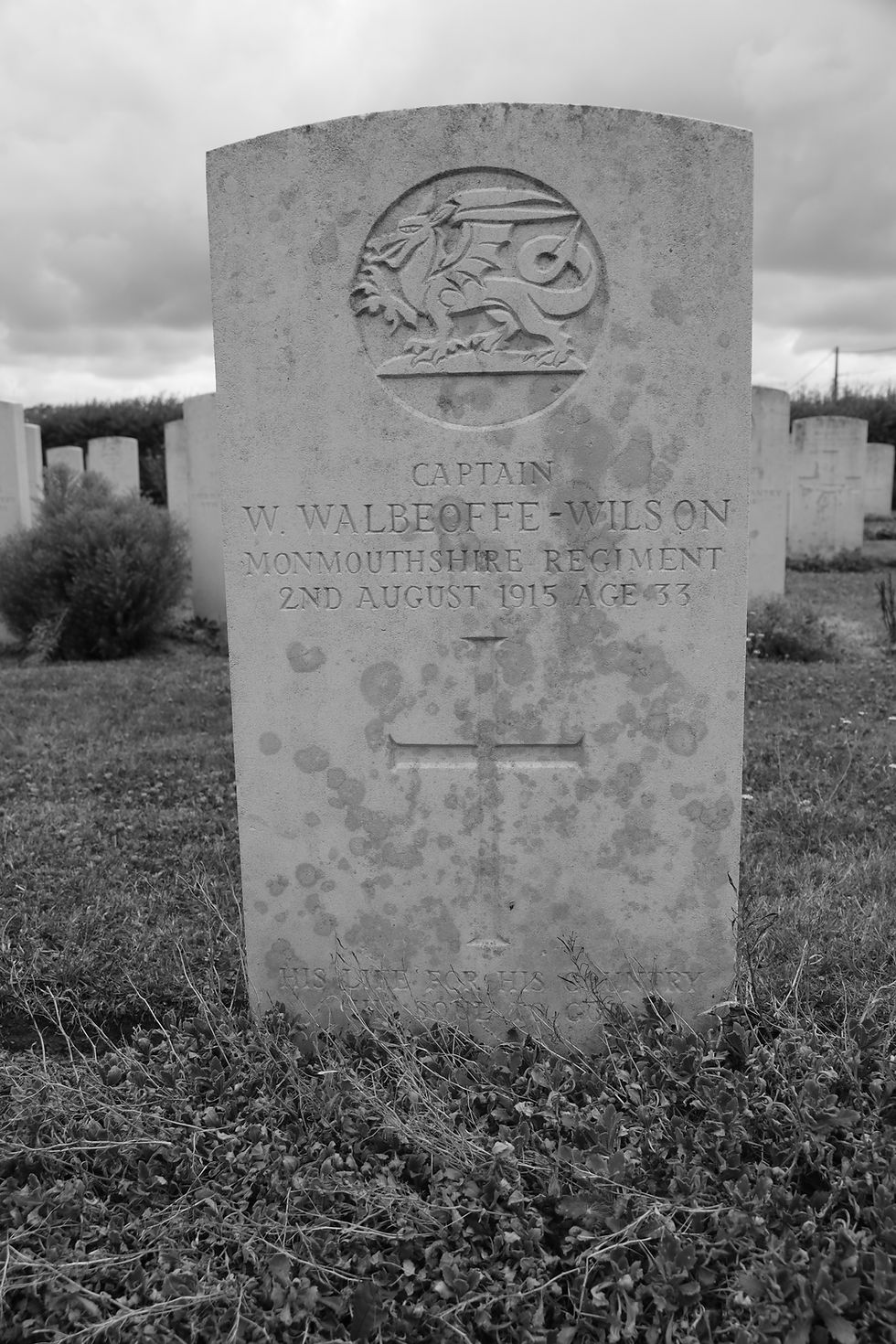
3rd Battalion Monmouthshire Regiment,
Captain William Walbeoffe-Wilson, Killed in action 2 August 1915, age 33. Grave I.F.9.
Son of the late Major William Henry Herbert Walbeoffe-Wilson, R.M.E.M. J. P. of Abergavenny, and of Emily Walbeoffe-Wilson, of Les Oliviers, Cap D'Antibes, A. M., France. He was educated at Closelet School and was Scout Master of the Abergavenny Boy Scouts. He was gazetted Second Lieutenant in the Monmouthshire Regiment on 17 August 1909, and promoted to Lieutenant on 25 May 1911, and then to Captain on 16 October 1914. He landed in France in July 1915. On the 2 August 1915 the War Diary records: ‘Quiet night. Capt Wilson shot through the head while looking over the parapet and killed instantly.’

Royal Army Medical Corps
102198 Private Alexander Carlisle, 96th Field Ambulance, RAMC, 30th Division. Killed in action 20 September 1917, age 29. Grave Special Memorial A.2. Oldest of two sons of Alexander and Mary Carlisle, 435 Blackburn Road, Haslingden. He was unmarried and employed as a Weaver when he enlisted on 28 September 1915. He went to France on 9 October 1916. 96th Field Ambulance was at Lindenhoek and providing medical support for the troops in the line at Wytschaete, including stretcher bearers. The War Diary does not record casualties from Field Ambulance but does record the number of ‘Sick and Wounded’ who passed through the Field Ambulance. 46237 Private Arthur McDowell, 110th Field Ambulance, RAMC, 36th Division. Killed in action 9 June 1917. Grave I.D.3. Son of Rachel McDowell, 114 McTier Street, Belfast. His brother 273 Rifleman William McDowell was serving with the 8th Battalion Royal Irish Rifles and was killed in action on 17 August 1917. He is listed on the Tyne Cot Memorial. Arthur died of wounds received. The War Diary does not record any casualties however, the Field Ambulance will have been providing stretcher bearer parties for the forward areas.

Royal Field Artillery
L/2368 Gunner Frank H Roberts, ‘A’ Battery, 148th Brigade, Killed in action 21 September 1917, age Grave Special Memorial A.1. Husband of Fanny Roberts, 34 Bartlett Street, Wavertree, Liverpool. The War Diary comments on the success of the attack on the opening day of the Battle of Menin Road on 20 September: ‘From new arrived this morning 2nd & 5th Armies appear to have been successful in their operations of yesterday. Enemy quiet. ‘A’ Btty had 1 OR killed.’ Artillery positions were subject to counter battery fire.
Australian
7017 Private Eric Larson, 4th Battalion Australian Infantry, 1st Brigade, 1st Division. Killed in action 22 March 1918, age 40. Grave Special Memorial A.3. Eric was born in Westmorland, Cumbria and emigrated to Australia. He was working as a Labourer when he enlisted on 21 October 1916, giving his address as the ‘Carrington Club Hotel,’ Carrington, New South Wales. He was unmarried and listed his next of kin as his brother Andrew who was living in Michigan, USA. He sailed from Sydney on 11 November 1916 and landed at Devonport and went to the camp as Larkhill on 30 January 1917. He went to France on 14 May 1917 with a training Battalion and joined the 4th Battalion in the field on 29 May 1917. On the 22 December 1917, he was attached to the 1st Divisional baths for duty and he was killed in action by a shell on 22 March 1918 whilst attached to the Divisional baths at Lindenhoek Camp. 2804 Private William Richard Reeves, 56th Battalion Australian Infantry, 14th Brigade, 5th Division. Killed in action 21 March 1918, age 33. Grave Special Memorial A.4. He listed his sister Lilian Kirby, 6 St John Street, Lewisham, New South Wales, as his next of kin. He was unmarried and working as a Hod Carrier when he enlisted on 14 May 1915 joining the 4th Battalion. He went to the training camp in Egypt on 21 January 1916 and was transferred to the 56th Battalion on 13 February 1916 and then went to France landing in Marseille on 19 June. The Battalion relieved the 53rd Battalion in the line east of Wytschaete on the night of the 20/21 March 1918 with Battalion HQ at Onraet Farm. William was the Battalion Butcher and the War Diary records on 21 March: ‘This afternoon the Battalion Butcher, Pte Reeves, W. was killed at our Q.M. Stores in KEMMEL. This is most unfortunate as he was a splendid butcher and an ‘old hand.’ 122 Corporal Alexander Leslie McLaren, ‘D’ Company, 18th Infantry Battalion, Australian Infantry, 5th Brigade, 2nd Division. Killed in action 26 March 1918, age 22. Grave Special Memorial B.6. Son of Abraham McLaren, 2 Taylor Street, Waterloo, Sydney, New South Wales. He was unmarried and working as a Labourer when he enlisted on 9 February 1915. He saw service at Gallipoli and then went to France on 25 March 1916. He then had a period of time in hospital sick from 31 October 1916 and on discharge from hospital on 3 January 1917 was listed as supernumerary and went to the 5th Training Battalion on 15 January where he attended a course at the bombing school in Lyndhurst and qualified as an instructor in bomb throwing. He rejoined the 18th Battalion from the supernumerary list on 5 August and was then wounded in action on 20 September 1917, gunshot wound to the neck. On discharge from hospital he then enjoyed a period of leave and then went to France from Sandhill Camp on 13 March and joined the Battalion on 22 March 1918. At 10.30pm on 26 March the Battalion mounted a patrol of one officer and twenty five other ranks and a Lewis Gun section leaving their trenches at Wambeke. They left No.2 picquet and moved over No Man’s Land to a ditch and while here were attacked by the enemy. One prisoner was taken and the Battalion casualties were: ‘1OR (No 122. Cpl A L Mclaren) was killed. His body was brought in and subsequently buried at about O.29.d.O5.05.' On his B.103 Casualty Form he is listed as ‘Buried at Cabin Hill Cemetery by Rev. W.N. Higgins.’ On 27 March. The co-ordinates as shown. The GRU Registration lists him as ‘Believed To Be Buried in this Cemetery. Actual grave not known.’ 3491 L/Cpl Walter Francis Eager, ‘C’ Company, 18th Battalion, Australian Infantry, 5th Brigade, 2nd Division. Killed in action 27 March 1918, age 30. Grave Special Memorial B.5. Son of William and the late Eliza Eager of Yass, New South Wales. He was unmarried and working as a Storekeeper when he enlisted on 3 October 1915. His sister Ruby Eager, Minting Orchard, Yass, was listed as his next of kin. He went to the Base camp in Alexandria and from there sailed to France landing in Marseilles on 28 March 1916. He was wounded in action on 5 August 1916, gun shot wound to right hand, left wrist, knee, and neck, and was transferred to a Casualty Clearing Station and then to the 26th Ambulance Train and then to hospital at Perham Downs, England. On 10 October he was granted leave and was then discharged from hospital to duty and joined the Australian Postal Corps in London on 5 December. He then went to Perham Downs Camp on 27 March 1917 and was in hospital again until 10 May. On the 13 August 1917, he went back to France and rejoined his Battalion on 28 August. The War Diary for the 27 March records: ‘At 10.30pm the Germans fired on the Battalion front line with light Minenwerfer and artillery for about thirty minutes. Casualties were one Other Rank killed.’ On his B.103 Casualty Form he is listed as ‘Buried at (Wytschaete map) O.33.a.O5.O5 Cabin Hill Cemetery by Rev. W.N. Higgins.’ On 27 March. The GRU Registration lists him as ‘Believed To Be Buried in this Cemetery. Actual grave not known.’

Boy Soldiers
In the Ypres Salient, we are drawn to the graves of 6322 Private John Condon, 2nd Battalion Royal Irish Regiment, killed in action in May 1915, age 14 and the youngest known battle casualty of the war, although this is now questioned, and the grave of 5750 Valentine Strudwick, 8th Rifle Brigade, killed in action in January 1916, age 15. Strudwicks grave attracts a great deal of attention because of its location at Essex Farm and that locations association with Lieutenant Colonel John McCrae and the poem ‘In Flanders Fields.’ There are many more ‘Boy Soldiers’ buried across the Salient and who are not remembered in the same way and these include three from Falkirk District Private William Jamieson, age 17, Private James Duchart, age 16, and Private Herbert Richmond, age 17. There were many reasons why under age boys enlisted in 1914 and 1915 boredom with their jobs, looking for adventure, and escaping family pressures. The checks on age and qualification to enlist were more relaxed than later in the war. The army preferred younger recruits, there was a history of boy soldiers in the army going back over one hundred years. At Waterloo the army had a number of boy soldiers in their ranks. The army preferred younger recruits as they would follow orders and accept discipline more readily than older men. The boys had a belief in their own indestructibility and were prepared to take more risks. We tend to also forget the number of boys who served in the Royal Navy and we do not seem to have the same passionate response to their service as we do those who fought on the Western Front. With regards to the army, the difference was the sheer number who served on the Western Front and there were more boy soldiers in 1915 than served in Wellington’s army at Waterloo. For further reading on this subject see Richard Van Emden’s excellent book Boy Soldiers of the Great War. There are three Boy Soldiers buried at Lindenhoek Chalet Military Cemetery: 33113 Private John Richard Vodden, 1st Battalion Welsh Regiment, 84th Infantry Brigade, 28th Division. Killed in action 18 August 1915, age 16. Grave I.G.2. One of four sons and two daughters of Robert and Charlotte Vodden, 112 High Street, Battersea, London. The War Diary records that: ‘One man killed, put his head over the parapet & was instantly shot.’ 1620 Private Ernest Samuel Boot, 1st/5th Battalion Leicestershire Regiment, 138th Infantry Brigade, 46th Division. Killed in action 15 April 1915, age 17. Grave II.H.3. Son of Samuel and Fanny Elizabeth Boot, 104 Melbourne Street, Coalville, Leicester. Epitaph: A BRAVE SON OF A NOBLE COUNTRY WHO KNEW NOT FEAR. The Battalion were in the trenches at Kruisstraat. At 8pm they were working on laying trench wire at E.1 to E.2 and the War Diary records: ‘2 men killed 1 in E.1 and 1 in F.2.’ 411 Sapper Bertram Francis Eaton, 1st (North Midland) Field Company, Royal Engineers, later designated the 465th (North Midland) Field Company, 46th Division. Killed in action 19 April 1915, age 17. Grave II.H.1. Son of Mr. and Mrs. F. H. Eaton, 50 Brisbane Road, Smethwick, Staffs. A YOUNG LIFE GIVEN FOR KING AND COUNTRY AT REST IN THE LORD. The Company was working on the trenches at Kruisstraat, making them deeper, creating dugouts, and draining the communication trenches. On the 19 April they were working on E.4 and SP.1, and turning E.6 into a fire trench. The War Diary records that one man was killed in action.
Location
Lindenhoek Chalet Military Cemetery is located 9 Kms south-west of Ieper town centre on a road leading from the Kemmelseweg (N331), connecting Ieper to Kemmel. From Ieper town centre the Kemmelseweg is reached via the Rijselsestraat, through the Lille Gate (Rijselpoort) and straight on towards Armentieres (N365). 900 metres after the crossroads is the right hand turning onto the Kemmelseweg (made prominent by a railway level crossing).
Immediately after passing the village of Kemmel lies the Gremmerslinde, a right hand turning leading from the N331. The cemetery lies 500 metres along the Gremmerslinde on the right hand side of the road.

The cemetery was designed by Charles Holden.
Burials
There are now 315 servicemen of the First World War buried or commemorated in the cemetery, 67 of the burials are unidentified. There are Special Memorials to six casualties known or believed to be buried here, four Australian and two British.
UK – 282
Australian – 10
New Zealand – 8
Canadian – 15
German – 2
Unnamed - 67


Comments