


La Laiterie Military Cemetery
Updated: Jul 29

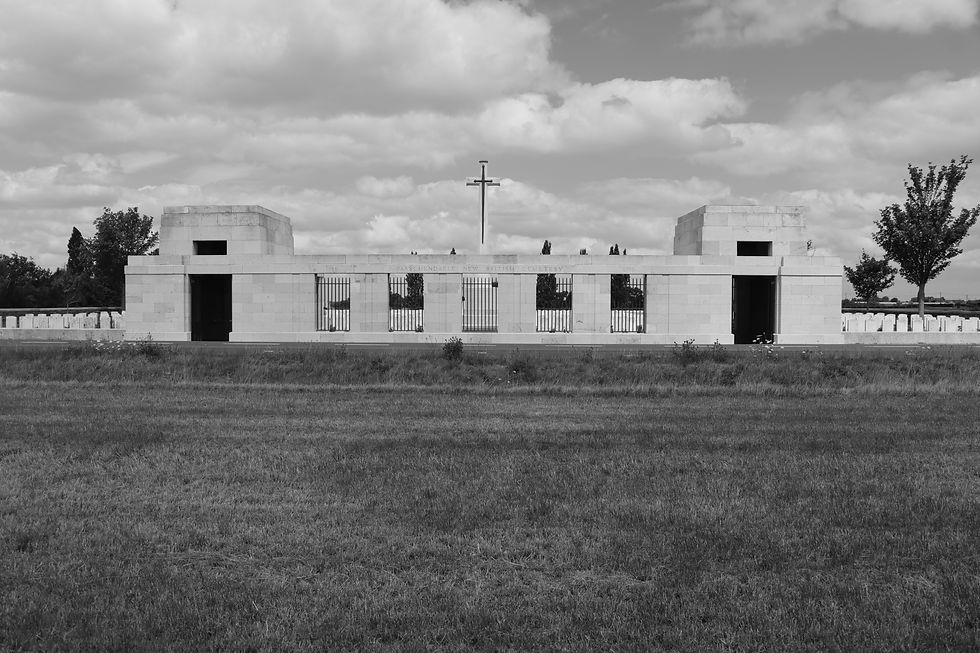
The La Laiterie Military Cemetery, named from a dairy farm which was located nearby, was begun in November 1914 and used until October 1918 by units holding this sector of the front. The different plots were, to a great extent, treated as regimental burial grounds; the majority of the graves in Plots II, III and X, for instance, were those of the 26th, 25th and 24th Canadian Infantry Battalions, respectively, and all but one of the graves in Plot VIII are those of the 5th Northumberland Fusiliers, 149th Brigade, 50th (Northumbrian) Division. On 25 April 1918, the cemetery fell into German hands, but it was retaken at the beginning of September. After the Armistice, 200 graves were brought into the cemetery from the battlefields north and north-east of Kemmel.

YMCA Hut
This was located in the field opposite the cemetery, at the parking space for the CWGC cemetery, and was built into the basement of the building that once stood here. The YMCA building stood close to a field dressing station on the Kemmel to Vierstraat Road. This was one of the last buildings before the front line trenches and was the first stop for a hot drink when the men came out of the trenches. The YMCA also provided the men with a place for writing letters, to socialise, read books, and play table top games. The sandbagged building is the chapel with the entrance into the cellar and the YMCA to the right of this as we look. Also, note the sign that advises against using the ‘Overland Route.’


American Memorial
The road Kemmel to Vierstraat Road that runs past the cemetery was known as York Road on the trench maps and approximately 800m to the north can be found the Memorial to the 27th and 30th US Divisions who fought in the Ypres Salient in 1918.

50th (Northumbrian) Division Monument
The impressive monument to the 50th (Northumbrian) Division stands in the village of Wieltje. This was a Territorial Division that saw action near here during Second Battle of Ypres in the spring of 1915. It took part in the Battle of St Julien, 24 April to 4 May, Battle of Frezenberg 8 May to 13 May, and Battle of Bellewaarde 24 May to 25 May. The Division also took part in the Third Battle of Ypres, the action known as the Second Battle of Passchendaele 26 October to 10 November 1917.


1st/5th Battalion, 149th Infantry Brigade, 50th (Northumbrian) Division
3755 Private John Armstrong, Killed in action 30 May 1916, age 19. Grave VIII.A.1. Son of Mrs Elizabeth Armstrong, 62 Pitt Street, Newcastle-on-Tyne. 2938 Private Robert Bates, Killed in action 30 May 1916, age Grave VIII.B.1. Son of Mrs. Sarah. Ann. Hiskin, 26 Alston Road, Upper Edmonton, London. The Battalion provided 140 men as working parties to dig shelters at R.E. Farm and Siege Farm in case of shelling. One of the working parties was caught by Trench Mortars and five men were killed and five wounded.
1st/6th Battalion, 149th Infantry Brigade, 50th (Northumbrian) Division

4998 Private Robert Alexander, ‘D’ Company, Killed in action 12 June 1916, age 25. Grave XI.B.9. One of two sons and three daughters of Robert and Isabella Alexander, of Newcastle-on-Tyne. The 1911 census lists Robert as the head of the family and that he is living with his brothers and sisters. There is no mention of their parents. Robert is employed as a Bricklayers labourer. His sister Annie is listed as his next of kin on the pension records and she is the recipient of a gratuity on his death. The Battalion was in the line at Byron Farm to Vandamme Farm at Wytschaete with the War Diary recording that: ‘The morning was quiet, but the enemy carried out an organised artillery & trench mortar shoot during the afternoon.’ Robert is listed as the only man killed on 12 June. Lieutenant Gerald Davies Blackwell, attached. 47th Company, Machine Gun

Corps (Infantry), Killed in action 7 June 1917, age 23. Grave II.AA.18. One of two sons of John and Eliza Emily Blackwell of ‘The Gables,’ Granville Avenue, West Hartlepool. He was employed as an Architect and Surveyor when enlisted in the Royal Engineers in August 1914 and received a commission in April 1915. He was posted to the 1st/6th Battalion Northumberland Fusiliers and went to a machine gun course at Camiers in December 1915 and was then attached to the 47th Machine Gun Company. This was part of the 16th (Irish) Division. He took part in the capture of Guillemont and Guinchy in September 1916, at which he was promoted to Lieutenant for his gallant conduct and devotion, his name and deed being entered in the records of the 16th (Irish) Division. On the 7 June 1917, the 16th Irish Division was involved in the Battle of Messines, when the British also blew nineteen mines, known as ‘Cratering the Ridge,’ beneath the German positions on Messines Ridge at 3.10am. The 47th Machine Gun Company was part of the attack on the German positions at Wytschaete. The ten guns of the Company opened a barrage fire at 3.11am and at 6.19am No.27 gun was temporarily knocked out, and No. 21 gun at 7.30am. The remaining guns continued to fire until 7.50am when they stopped to change their barrels and then moved forward were they dug in at Wytschaete before being relieved. The Company casualties were one officer killed, Gerald, and eight Other Ranks wounded.

5th Battalion Yorkshire Regiment, The Green Howards, 150th Infantry Brigade, 50th (Northumbrian) Division
Captain Edward George Clarkson Bagshawe, Killed in action 20 July 1916, age 36. Grave VII.D.12. Son of Harriet Bagshawe, 8 Leonard Place, Kensington and the late County Court Judge William Henry Gunning Bagshawe, K.C. In 1902 Edward joined the Army and was a Lieutenant in the Yorkshire Regiment based in Richmond, North Yorkshire. He served in the latter stages of the 2nd Anglo-Boer War in South Africa in 1902, being Mentioned in Despatches and becoming a staff officer. He was awarded the Queen’s Medal. He resigned his commission
in March 1907 and was living at home with his widowed mother and four unmarried sisters. On the outbreak of the war he rejoined his

Battalion and was promoted to Captain on 29 August 1914, he went to France with the Battalion in May 1915 and was invalided home but rejoined the Battalion in 1916. At the time of his death his home was 13 Campden House Road, Kensington, at the home of Captain Herman Kentigern Bicknell (who was killed in action in Mesopotamia in 1917) and his wife Harriet Frances, a Red Cross nurse. In his will his money and belongings were left to her. The Battalion was in the line at Byron Farm to Vandamme Farm at Wytschaete. The German artillery was active in this area with the Battalion sustaining casualties on previous days in the line. The War Diary recorded: ‘Casualties 3 O.R. wounded, 2 Officers (2nd Lt Jacobs – attached 150th T.M. Battery - & Capt EGC Bagshawe) killed..’

7th Battalion Royal Inniskilling Fusiliers, 49th Infantry Brigade, 16th (Irish) Division
Captain William Henry Collis, ‘D’ Company, 7th Battalion, Killed in action 9 May 1917, age 25. Grave XII.A.31. One of two sons and a daughter of Lieutenant Colonel William G. and Mrs Mabel Collis, of "Snowdon," London Road, Cheltenham. William was born in Hampshire and the family lived in Killsaintann's South, Castlelyons, Cork, Ireland, before moving back to England. The Battalion was in the line at the Diependaal sector, this was to the right of St Eloi and in front of the Bois Confluent. On the 6 May, the War Diary records William reporting for duty and being assigned to ‘D’ Company. On the 9 May the

Battalion was scheduled to be relieved by the 7th Battalion East Lancs and the relief was to begin at 10pm. At 9.15pm the Germans opened an intense bombardment on the front line and reserve lines in the Battalion sector using 5.9s and 4.2 inch shells. The new reserve trench which was occupied by the Battalion, ‘D’ Company on the left, was heavily shelled and took the brunt of the shelling. The War Diary records: ‘..the Bn lost Capt W.H.Collis, killed and 3 ORs killed and 10 ORs wounded. D Coy HQs & telephone office was destroyed almost immediately and communication by him was never established.’ The War Diary record the funeral on 10 May of William and Other Ranks killed: ‘9pm In the evening Capt W.H. Collis, 24681 Pte H Bell, 19638 Pte H Higginson, 43297 Pte F Reynolds all of D Coy buried in the La Laiterie Cemetery on the Vierstraat – Kemmel Road. (these men were all killed on the 9th inst.).’ The CWGC record lists Private Hugh Bell as serving with ‘B’ Company.
8th Battalion Gloucestershire Regiment, 57th Infantry Brigade, 19th Division

Captain William Nehemiah Wookey, Mentioned in Despatches, Killed in action 26 July 1917, age 26. Grave XII.B.5. Husband of Marjorie (nee Ford) Wookey, 16 Walsingham Road, St. Andrew's Park, Bristol. He married Marjorie at Bishopton Parish Church, Bristol on 28 December 1915, and he was employed as a Commission agent and Marjorie was employed as a Cashier. They did not have any children. Following his death Marjorie remarried Hawley Armistead Smith, a Vice Consul with the American foreign service in 1922. He was to die, age 50, in 1943 and is buried in Arlington Cemetery. After his death Marjorie moved to the USA and worked in the British Embassy in Washington D.C. until 1957 when she transferred back to the Foreign Office in London. She retired in 1960 and moved back to the USA. She died of cancer at a nursing home in Washington D.C. in 1976 aged 80 and is also buried in Arlington National Cemetery. She had a son and three grandsons. William’s twin brother Quartermaster and the Hon Lieutenant H F Wookey, RAMC, was serving in Mesopotamia (now Iraq). William was commissioned as a Second Lieutenant in the Gloucester Regiment and was twice wounded in action. He was Mentioned in Despatches in January 1917 before being promoted to Captain. The Battalion was in the line at Oostaverne and working on repairing and improving the front line trenches and the communication trenches. The War Diary records: ‘Capt Wookey, 2Lt Lightbourne killed.’ Lieutenant Robert Lightbourn, age 22. Grave XII.B.4. Son of Theophilus James and Aurelia Adeliza Lightbourn, of Tamarind Vale, Warwick West, Bermuda. He was studying at St John’s College, Oxford, as Bermuda Rhodes Scholar, when he was gazetted as a Second Lieutenant in January 1916.
Royal Army Medical Corps

405095 Sergeant Charles Proctor, 88th Field Ambulance, 29th Division. Killed in action 9 October 1917, age 29. Grave IV.C.2. Son of John Thomas and E. M. Proctor, of Sheffield. He was married to Mary Ann Proctor, 12 Lilac Road, Shire Green, Sheffield. The Field Ambulance was at Wormhoudt. On the 8 October three NCOs and sixty one Other Ranks proceeded to 87th Field Ambulance for stretcher bearer duties. On the 9 May, the War Diary records: ‘3 ORs killed & 8 ORs wounded. 7 of these evacuated to CCS. 1 admitted to own hospital. These casualties occurred in personnel attached to 87th Fld Amb.’ The 87th Field Ambulance was involved in the Battle of Poelcappelle, Third Battle of Ypres. The stretcher bearer squads, 88th Field Ambulance provided 18 squads to assist, were detailed off in squads of 12 and they worked between a relay post in Langemarck and ‘Pig and Whistle’, ‘Reitres, Farm’, and ‘Cement House’. Communication was kept up by runners to the first line Aid Posts and by telephone from Cement House to HQ. The wounds recorded were due mainly to shell fire and limb wounds predominated. The total number of cases evacuated by the 87th Field Ambulance were; stretcher cases 227, walking cases 42. They were moved down the line by Decauville Train, small engines that ran on light railways, and the War Diary of the 87th Field Ambulance records that: ‘The carry from the Line to the A.D.S. was very arduous owing to heavy rain which fell during the preceding night. All the Bearers worked with a will until they were relieved on the afternoon of the 10th, when they were quite fagged out.’


Royal Air Force
Lieutenant Henry Eric Dolan M.C., Killed in action 12 May 1918, age Grave II.D.8. Son of Alfred Archer Dolan, a mining engineer, and Violet Eliza Edgeworth (née Hanrick) Dolan, 11 Horse Fair, Banbury, Oxford. He had a brother, Gerald. Henry moved to Canada and was working as a Clerk on the outbreak of the war and he enlisted in the 3rd Battalion, Canadian Infantry as a Private with the number 9349. On the Battalions arrival in England

Henry was gazetted as a Second Lieutenant and joined the British Army, Royal Field Artillery on the 20 November 1914, and promoted to Lieutenant on 31 January 1916. He was awarded the Military Cross on 1 January 1917. He transferred to the General List on 31 August 1917 and joined the Royal Flying Corps. In early 1918, he was posted to No.74 Squadron which flew SE.5a aircraft and was assigned to ‘A’ Flight, under the command of Major Edward Corringham ‘Mick’ Mannock, V.C., M.C. & Bar, D.S.O.& two Bars. Mannock had 73 victories to his name although he was officially credited with only 61 when he was shot down by small arms fire from the ground on 26 July 1918. He is listed on the Arras Flying Services Memorial. Dolan scored his first victory on 12 April 1918 when he shot down an Albatros D.V and had scored his seventh victory by 11 May. On the 12 May he took off at 5.35pm and was in combat with an aircraft flown by Leutnant Raven Freiherr von Barnekow of Jasta 20, four miles east of Dickebusch Lake at 6.35pm, and was shot down. He was seen to spiral down and crash near Wulverghem. It is said that Mannock was reduced to tears on hearing of Dolan’s death who had been his most promising protégé. This was Leutnant von Barnekow’s first victory and he went on to have ten more victories. In WWII he was on the staff of General von Doring, his old commander at Jasta 1 and 4. Von Barnekow was also a close friend of Ernst Udet, he met him when they flew with Jasta 4, and when Udet committed suicide in 1941 von Barnekow also shot himself.
Canadian

258 Private John Albert Brennan, Borden’s Motor Machine Gun Battery, Canadian Machine Gun Corps, Killed in action 13 January 1916, age 30. Grave VII.B.20. John was unmarried and employed as a Policeman when he enlisted on 15 January 1915. On the 13 January the Battery was deployed in static machine gun positions in the front line opposite Maedelstedt Farm, Wytschaete and at 3.15pm the Germans opened a bombardment on the positions occupied by the Battery and their kitchen searching an area of 50 x 50 yards and destroying one of the dugouts with a direct hit killing Private John Brennan. His body was recovered at 6pm with the War Diary recording that it was ‘much mutilated.’ On the 14 January the War Diary records: ‘Lieut. Holland arrived with a note from Capt. MacCarthy saying arrangements were made to bury Pte Brennan in La Laiterie Cemetery. Took burial party and body to 22nd Battalion Canadian Burying Ground stopping at the 22nd Battn Dressing Station to have M.O look at body and give certificate. Body buried at 11.30am Capt (Father) Doyon officiating at the burial service.’

Borden’s Motor Machine Gun Battery was named in honour of the Canadian Prime Minister Robert Laird Borden and was mobilised on 10 December 1914 in Montreal. The establishment was six officers, one warrant officer, one Sergeant Major, eight Sergeants, nine Corporals and forty five privates making a strength of sixty officers and men. This included twenty-two artificers. They were issued with 18 old Scott Tri-Cars which had been used and abused for many months by the R.N.A.S. and they were also issued with five Studebaker Box Body Cars and nine new Triumph Motor Cycles. They left Shorncliffe Camp for France on 13 September 1915 and was attached to the 2nd Canadian Division. On 19 August 1916 the Canadian Motor Machine Gun Brigade was formed. It consisted of the two original batteries - also known as Sifton A and Sifton B (after the Canadian Minister of the Interior) supplemented by 3 other batteries - 'C' (Borden Motor Machine Gun Battery), 'D' (Eaton Motor Machine Gun Battery) and 'E' (Yukon Motor Machine Gun Battery). Each battery consisted of two sections, each of two armoured cars with two machine guns. A number of motorcycles for reconnaissance and communication duties were included as well. Due to the static nature of the war, the batteries supported The Canadian Corps on foot, e.g. at Vimy Ridge in April 1917 and at Passchendaele (Third Ypres) in the autumn of 1917. During the German March 1918 offensive, the Brigade played a major role as a truly mobile unit, and available units were sent forward to close the large gaps which the German attack made in the British lines.

65400 Private Sunta Gougersingh, 24th Battalion (Victoria Rifles), 5th Infantry Brigade, 2nd Canadian Division. Killed in action 19 October 1915, age 32. Grave X.D.5. Son of Bhola Singh, Santa, of Janbal, Phillour Tahsil, Jullundur District. He was married to Musammat Bishn Kaur, of Janbal, India. He did not list any trade or profession and gave his marital status as Widower when he enlisted on 6 January 1915. On the 19 October the Battalion was providing working parties to work on the forward areas around Petit Bois at trench J.10. Sunta had stated that he knew he must die that night and was killed by a bullet that struck him in the stomach.
Christmas Truce 1915
The 24th Battalion (Victoria Rifles), 5th Infantry Brigade, 2nd Canadian Division, recorded an incident of the Christmas Truce in 1915. They were in the front line at Petit Bois and early in the afternoon on Christmas Day the shelling and rifle fire ceased and German soldiers were seen lifting their heads and shoulders above their parapet and a number climbed out of their trenches and walked into No Man’s Land gesturing to the Canadians to join them. A number of the Canadians went forward to meet the Germans and struck up a conversation with some of them with the Germans telling the Canadians that the ‘Kaiser no damn good.’ This truce went on for nearly an hour with the exchange of cigarettes, food stuffs, buttons, badges, and bottles of beer. Orders were then received by the Canadians to get back into their trenches and when they and the Germans had returned to their trenches a salvo of artillery fire let the Germans know the truce was over.
Boy Soldiers
In the Ypres Salient, we are drawn to the graves of 6322 Private John Condon, 2nd Battalion Royal Irish Regiment, killed in action in May 1915, age 14 and the youngest known battle casualty of the war, although this is now questioned, and the grave of 5750 Valentine Strudwick, 8th Rifle Brigade, killed in action in January 1916, age 15. Strudwicks grave attracts a great deal of attention because of its location at Essex Farm and that locations association with Lieutenant Colonel John McCrae and the poem ‘In Flanders Fields.’ There are many more ‘Boy Soldiers’ buried across the Salient and who are not remembered in the same way and these include three from Falkirk District Private William Jamieson, age 17, Private James Duchart, age 16, and Private Herbert Richmond, age 17. There were many reasons why under age boys enlisted in 1914 and 1915 boredom with their jobs, looking for adventure, and escaping family pressures. The checks on age and qualification to enlist were more relaxed than later in the war. The army preferred younger recruits, there was a history of boy soldiers in the army going back over one hundred years. At Waterloo the army had a number of boy soldiers in their ranks. The army preferred younger recruits as they would follow orders and accept discipline more readily than older men. The boys had a belief in their own indestructibility and were prepared to take more risks. We tend to also forget the number of boys who served in the Royal Navy and we do not seem to have the same passionate response to their service as we do those who fought on the Western Front. With regards to the army, the difference was the sheer number who served on the Western Front and there were more boy soldiers in 1915 than served in Wellington’s army at Waterloo. For further reading on this subject see Richard Van Emden’s excellent book Boy Soldiers of
the Great War. There are five Boy Soldiers buried here three ages 16 and two age 17. 412556 Private Stanley Collins, 26th (New Brunswick) Battalion, 5th Infantry Brigade, 2nd Canadian Division. Killed in action 28 March 1916, age 16. Grave II.C.19. Son of Maurice and Jane Collins, 11 St. George's Buildings, Marshalsea Road, Borough, London. He gave his age as 18 and that he was employed as a farmer when he enlisted on 18 February 1915. The Battalion was occupying trench H.18 in front of Wytschaete when it was heavily shelled after a mine was blown at St Eloi with casualties recorded as ‘7 killed, 18 wounded.’ The Germans also shelled York House, this was located next to La Laiterie Farm on the Vierstraat Road, at noon with 10 direct hits with the casualties recorded ‘one killed, 3 wounded.’ Stanley’s death is recorded as ‘killed in action shell fire.’ 9403 Lance Corporal Daniel Hayes, ‘A’ Company, 9th Battalion Royal Dublin Fusiliers, 48th Infantry Brigade, 16th (Irish) Division. Killed in action 31 May 1917, age 16. Grave VII.A.17. Son of Patrick Hayes, 2 Cottage, Back of 53, High Street, Dublin. The Battalion were in the line to the right of the Vierstraat to Wytschaete Road with Battalion HQ in York House with their forward HQ at S.P.13. near to Byron Farm. The British and German artillery was active throughout the day with the German artillery obtaining several direct hits on the front line. 5713 Private Stanley Clifford Lockwood, 1st Battalion East Surrey Regiment, 14th Infantry Brigade, 5th Division. Killed in action 24 March 1915, age 16. Grave I.B.24. Son of George Arthur and Mary Ann Lockwood, of Nabbott's Farm, Springfield, Chelmsford. The Battalion were in the line to the right of the Vierstraat to Wytschaete Road. During the night there was heavy sniping of their line with casualties of ‘3 killed and 12 other ranks wounded.’ 65285 Private Reginald Harry Driscoll, ‘B’ Company, 24th Battalion (Victoria Rifles), 5th Infantry Brigade, 2nd Canadian Division. Killed in action 29 December 1915, age 17. Grave X.C.11. Son of Ellen Susannah Driscoll, 2594 Esplanade Avenue, Montreal. He was killed by a sniper when the Battalion was in the line at Petit Bois. 3757 Private John Harold Ross, 4th Battalion East Yorkshire Regiment, 150th Infantry Brigade, 50th (Northumbrian) Division. Killed in action 30 July 1916, age 17. Grave III.D.12. Son of John and Dorothy Ross, of Hull. The Battalion was occupying the trench line in front of Maedelstedt Farm with the casualties recorded as two men killed.
Location
La Laiterie Military Cemetery is located 7 Kms south of Ieper town centre on the Kemmelseweg (N331), connecting Ieper to Kemmel. From Ieper town centre the Kemmelseweg is reached via the Rijselsestraat, through the Lille Gate (Rijselpoort) and straight on towards Armentieres (N336). 900 metres after the crossroads is the right hand turning onto the Kemmelseweg made prominent by a level crossing. The cemetery is located on the right hand side of the road, 5 Kms after joining the Kemmelseweg.
The cemetery was designed by Sir Edwin Lutyens.

Burials
There are now 751 Commonwealth casualties of the First World War buried or commemorated in this cemetery of which 180 of the burials are unidentified. There are Special Memorials that commemorate two servicemen whose graves were destroyed in later fighting.
UK – 379
Australian – 3
Canadian – 190
Known Unto God - 77


Comments