


Nieuwkerke(Neuve Eglise)Churchyard

Nieuwkerke (Neuve-Eglise) Churchyard was captured by the Germans on 14 April 1918, after a stubborn defence by the 49th (West Riding) and 33rd Divisions, and remained in their hands until it was retaken by the 36th (Ulster) Division on 2 September. The churchyard was used by Field Ambulances and fighting units at intervals during the war, particularly, in the early days, by the Cavalry and the 5th Division.
A Town Majors Lot
At Christmas 1917 the Town Major of Neuve-Eglise allotted a dilapidated barn to an Australian gun battery and on seeing the standard of the barn the Town Major had to admit that it was way below what was to be expected. He spoke with the irate Australians, they disliked Town Majors as much as Assistant Provost Marshals, and having calmed them he told them he was sorry to have put them in such poor billets particularly at Christmas. He explained it could not be helped but if anyone had ideas on how their billet could be improved he would be delighted to hear them. One of the Diggers shouted, as the Town Major was about to leave, ‘How about shuttin’ the flamin’ gate and keepin’ the wind out of the paddock.’

Action of Assistant-Adjutant Captain James Crowe, 2nd Battalion Worcestershire Regiment, 100th Infantry Brigade, 33rd Division
In April 1918 Neuve-Eglise lay in the path of the advancing German spring offensive on the River Lys and the British were fighting desperate rear guard actions in an attempt to stem the German advance. On the 11 April the Battalion took over the Army Line east of Neuve Eglise with ‘A’ and ‘B’ Companies in the front line and ‘D’ and ‘C’ Companies in close support. The 16th KRRC were on the right with the three machine gun sections of ‘B’

Company, 33rd Machine Gun Battalion positioned forward of the village with one section covering the approaches to Ravelsburg Heights. Meanwhile the Germans had swept over Messines and were advancing down the southern slopes of the Messines Ridge and past Ploegsteert Wood with their artillery now firing almost a point blank range on Neuve Eglise. The Worcesters engaged the German infantry however, they were unaware that the Germans had a second force advancing in their rear and had driven in the 16th KRRC on their right and moved up Leinster Road from Romarin and this had now opened a gap in the line. The Worcesters were now cut off and surrounded and the Battalion HQ, the War Diary states this was in the mayor’s house however, it was the Hospice, was being shelled by trench mortars and was under fire from machine guns on three sides and with ammunition running low and wounded mounting up Crowe asked for permission from his Commanding Officer

Lieutenant Colonel Stoney if he could try and clear a route for the Worcesters to withdraw. The German machine gun west of the Hospice covered the Battalions only route out down the Dranouter Road. Crowe led seven men out of a cow shed just north of the Hospice and attempted to fire on the German position in the meadow to the west however, they were subjected to enfilade fire. Crowe then took two men and crawled his way to a position were he could bring fire on the enemy and cleared them from their position. They then rushed two machine guns with one of the men killed however, Crowe reached the guns and the enemy fled. With their rear now secured the Worcesters, now numbering some thirty men and carrying their wounded, withdrew down the Dranouter Road to Locre. Crowe was awarded the V.C. in the field by King George V. He was also awarded the Croix de Guerre. He is believed to be the only man to be awarded the V.C. when already holding the Long Service and Good Conduct Medal. Also severely wounded in the action at Neuve Eglise was the commanding officer of ‘D’ Company Lieutenant Charles Sargeant Jagger who organised the defence of Trompe Cabaret a building that stood on the Neuve Eglise to Messines Road. He was awarded the Military Cross for his actions. Jagger sculpted the Royal Artillery Memorial at Hyde Park Corner and the Great Western Railway War Memorial at Paddington Station.

Cavalry
Major Clive MacDonnell Dixon, 16th (The Queen’s) Lancers, 3rd Cavalry Brigade, 2nd Cavalry Division. Killed in action 5 November 1914, age 44. Grave J.2. He was one of two sons and six daughters of Sir Raylton and Lady Dixon, of Gunnergate Hall, Marton He was married to Lilian Margaret Dixon, of Chapelgarth, Great Broughton, Cleveland, Yorks, and they had three sons and three daughters. He was a painter and illustrator as well as a soldier best known for his book The League of Ladysmith which he created during the four month siege of Ladysmith during the South African War. He attended Rugby School and then the Military College, Sandhurst and was gazetted Second Lieutenant on 8 October 1890 and joined the 16th Lancers. He was promoted to Lieutenant on 27 January 1893 and then to Captain on 28 January 1899. During the South African War he was appointed to Adjutant of his Regiment on 22 March 1900 and during this time was promoted to brevet Major on 29 November 1900. He resigned from the army in 1902 and on the outbreak of the war he rejoined his Regiment and was given the substantive rank of Major shortly before his death. On the 5 November 1914 the Regiment were in the trenches near Wulverghem when they were subjected to heavy shelling and he was killed in the trench along with Captain Arthur William Macarthur-Onslow who is buried in Wulverghem-Lindenhoek Road Military Cemetery.

Captain Hugh Seymour Blane, 19th Lancers (Fane’s Horse), Sialkot Cavalry Brigade, 1st Indian Cavalry Division attached ‘B’ Squadron, 5th (Princess Charlotte of Wales’s) Dragoon Guards, 1st Cavalry Brigade, 1st Cavalry Division. Died of wounds 31 October 1914, age 29. Grave I.1. He was the youngest son of the late Captain Rodney and Mrs Blane of Montpelier Street, London. He was educated at Aldenham and then Sandhurst and was gazetted Second Lieutenant in august 1905 and was attached to the Wiltshire Regiment for a year before he joined the 19th Lancers in November 1906. He was promoted to Lieutenant in November 1907 and Captain in August 1914. He married Molly in April 1914. On the 31 October 1914 the Regiment was involved in heavy fighting for the village of Messines. He was in the trench line to the south of the village (numbered 5,6,7 in the map). The Germans attacked the trenches with the War Diary recording that the Germans were in different uniforms some were 1st Grenadiers

and some the 125th Wurttemberg Regiment, with a small group of approximately twenty five getting into the left trench, but were driven out by gunfire or bayonetted. All the officers of ‘B’ Squadron were wounded. There is no evidence in the War Diary but the ‘Bond of Courage’ states that he lay in the trench for sixteen hours before he was moved to the Field Hospital, where he died on the morning of 1st November 1914. This seems unlikely as ‘B’ Squadron had withdrawn and held the Convent. It is likely that he was taken to the Field Ambulance with the other wounded were he died of his wounds.

Canadian
2358 Squadron Sergeant Major Henry William Collins, Lord Strathcona’s Horse (Royal Canadians), Canadian Cavalry Brigade, 1st Canadian Division. Killed in action 26 July 1915, age 38. Grave S.4. Son of John and Clara Collins, of St. Philip's Terrace, Gratton Road, Cheltenham. He was employed as a Clerk when he enlisted on 25 September 1914 and was promoted to Warrant Officer on 17 July 1915. On the 5 May 1915 the Squadron arrived in France and it fought dismounted in an infantry role with Seeley’s Detachment, in reality Canadian Cavalry Brigade, part of the 2nd Indian Cavalry Division, 1st Canadian Division. They reconstituted as cavalry on 16 February 1916. On the 26 July 1915 the Squadron were in the trenches north west of Wulverghem in the sector in front of Spanbroekmolen and supplied thirty five men to work on the subsidiary line and ten men to work at One Shell Farm. They were making dug-outs, widening, and deepening the trenches. The Germans shelled the old Dragoon Alley Line near Cookers Farm, known on trench maps as Kingsway, resulting in one man killed and five wounded. The Squadron were relieved and returned to the billets at Neuve Eglise.


RAMC
Major Francis Graham Richards, 14th Field Ambulance, RAMC, 5th Division. Killed in action 5 March 1915, age 40. Grave Q.1. Son of the late Mr. and Mrs. Edward Richards, of Amos Vale, Rostrevor, Co. Down. He was married to Florence Agnes Richards (nee Dawson), 21 Spencer Hill, Wimbledon, London. He was gazetted Second Lieutenant on 17th November 1899 and served in the South African War. On the 5 March 1916 the Field Ambulance was located at Neuve Eglise when they were heavily shelled with the War Diary recording the casualties as: ‘Major F G Richards, RAMC was killed..’ Two other officers were wounded one Other Rank killed and nine wounded. Three patients were killed and eight, already wounded, wounded again. Two Belgian soldiers were also wounded.

Royal Engineers
Second Lieutenant Maurice Croston Rogers, 59th Field Company, 5th Division. Killed in action 25 February 1915, age 20. Grave P.3. Only son of John Croston Rogers and Leily Rogers, of Cloughmore, Warrenpoint however the CWGC list his address as Ellerslie, Athlone. His father was the Inspector of National Schools in Ireland. He was educated at Campbell College, Belfast (1906 to 1912) and won a junior and a senior scholarship and the McNeill Gold Medal for the best maths scholar. He then went to the Royal Military Academy, Woolwich in 1912 and was gazetted Second Lieutenant joining the 59th Company. The Company was working on strengthening the wire entanglements of the second line in the Pack Horse Farm sector near Wulverghem when there was an accident with a trench mortar which resulted in the death of Maurice and one NCO with one other man wounded.
12914 Sapper Jeremiah O’Keeffe, 59th Field Company, 5th Division. Killed in action 23

March 1915, age 29 Grave R.1. He was born in Crosshaven, Cork, Ireland and he had enlisted on 24 August 1903 in the Royal Engineers when aged 18 and on the expiry of his service he joined the Reserve on 20 August 1911 and took up employments as a bricklayer. He was married to Julia and they lived in Crosshaven. On the outbreak of war he rejoined the Royal Engineers. On the 23 March the Company was still based in Neuve Eglise with two sections building a laundry and a platform for a 9.2’ Howitzer and two sections proceeded to the firing line to rebuild trench E.1 in the Pack Horse Farm sector near Wulverghem. There is no mention of casualties. His records show that he died of wounds.
Royal Artillery
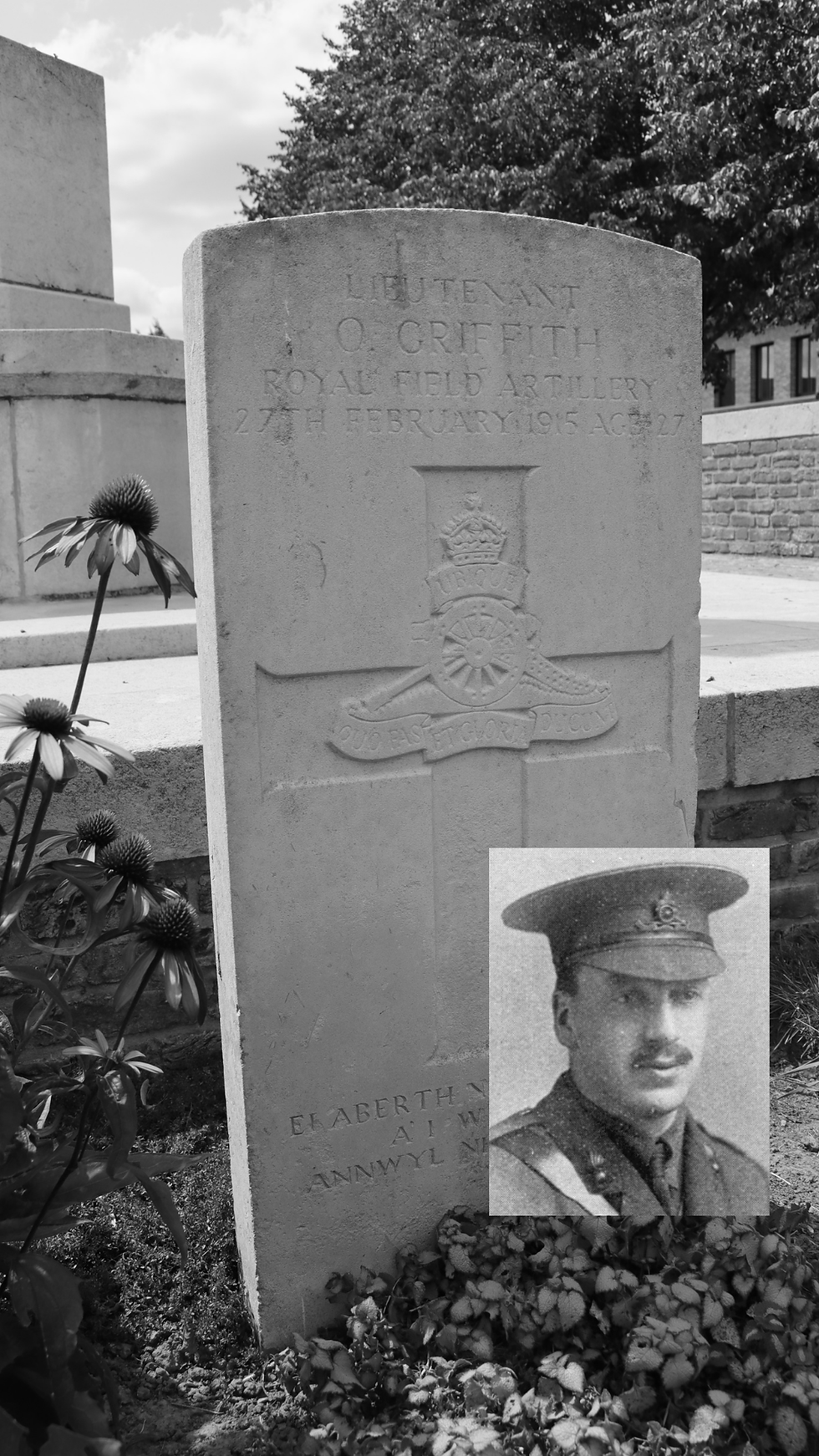
Lieutenant Oswald Griffith, 80th Battery, 15th Brigade, Royal Field Artillery, 5th Division. Killed in action 27 February 1915, age 27. Grave P.4. Son of Robert and Annie Griffith, 5 Park Hill, Bangor. He was educated at Friars School and the University of North Wales in 1906. He was keen sportsman being a member of the Boating Crew and the Rugby team. While at University he joined the Officer Training Corps. On leaving University he took up the post of Headteacher at Hawick School in Gloucester, and he returned to North Wales in 1911 to take up the position of Assistant Teacher at the Caernarfon National School. He only stayed for one year before moving on to Southend to teach at Westborough Road council School. On the outbreak of war he was gazetted as a Second Lieutenant and joined the Royal Artillery. On the 27 February 1915 the War Diary records: ‘Heavy shelling of Neuve Eglise and environs. Shells of big calibre from direction of Warneton. Lieut Griffith (attached to 80th) killed in trenches of D.C.L.I. a little S.E. of Wulverghem.’ The Battery Major wrote: ‘About 10.30 he was in the dug-out with two other officers and remarked to them ‘I think I will go and get something to eat.’ He got up, and, I suppose forgot for a moment to keep his head down, and, being a tall fellow, his head and shoulders showed up for a second on the top of the parapet, and a sniper got him at once at the back of the head.’ Given that he was not present at the time of his death it seems romantic but not unlike most deaths caused by snipers.

Infantry
Manchester Regiment
Captain Erasmus Darwin Parker, 2nd Battalion Manchester Regiment, 14th Infantry Brigade, 5th Division. Killed in action 20 March 1915, age 48. Grave R.2. Son of Francis and Cecile Agnes Parker. He had a sister and a brother who was serving as a Captain with the 2nd Battalion Lancashire Fusiliers when he was severely wounded in the South African war at Wonderfontein, a railway station about 27 miles from Middleburg, and subsequently died of his wounds. Erasmus served in the South African war with the 5th (Militia) Battalion, Royal Fusiliers and had been Mentioned in Despatches. He was a member of the Special Reserve on the outbreak of war and joined the Battalion. On the 20 March 1915 the Battalion was in the line having relieved the Devons on 19 March and the War Diary recorded: ‘Casualties killed – Capt E.D. Parker + 1 man. Wounded – 6 men.’

Staffordshire Regiment
Lieutenant Leonard Charles Billingsley Joynson, 1st/6th Battalion South Staffordshire Regiment, 137th Brigade, 46th Division. Killed in action 6 May 1915, age 25. Grave U.3. Son of Charles and Jane Joynson, Wednesbury, Birmingham. He joined the Territorials in 1908 and served with the Darlston Company, 6th Battalion South Staffordshire Regiment. He went with the Battalion to France on 4 March 1915. On the 6 May 1915 the Battalion was in billets at Bulford Camp on the Nieppe to Neuve Eglise Road and they were cleaning equipment, ammunition and clothing. He was accidentally killed whilst instructing his men in hand grenade practice with the War Diary recording: ‘1 Officer accidentally killed. 2 OR wounded.’
Boy Soldier
In the Ypres Salient, we are drawn to the graves of 6322 Private John Condon, 2nd Battalion Royal Irish Regiment, killed in action in May 1915, age 14 and the youngest known battle casualty of the war, although this is now questioned, and the grave of 5750 Valentine Strudwick, 8th Rifle Brigade, killed in action in January 1916, age 15. Strudwicks grave attracts a great deal of attention because of its location at Essex Farm and that locations association with Lieutenant Colonel John McCrae and the poem ‘In Flanders Fields.’ There are many more ‘Boy Soldiers’ buried across the Salient and who are not remembered in the same way and these include three from Falkirk District Private William Jamieson, age 17, Private James Duchart, age 16, and Private Herbert Richmond, age 17. There were many reasons why under age boys enlisted in 1914 and 1915 boredom with their jobs, looking for adventure, and escaping family pressures. The checks on age and qualification to enlist were more relaxed than later in the war. The army preferred younger recruits, there was a history of boy soldiers in the army going back over one hundred years. At Waterloo the army had a number of boy soldiers in their ranks. The army preferred younger recruits as they would follow orders and accept discipline more readily than older men. The boys had a belief in their own

indestructibility and were prepared to take more risks. We tend to also forget the number of boys who served in the Royal Navy and we do not seem to have the same passionate response to their service as we do those who fought on the Western Front. With regards to the army, the difference was the sheer number who served on the Western Front and there were more boy soldiers in 1915 than served in Wellington’s army at Waterloo. For further reading on this subject see Richard Van Emden’s excellent book Boy Soldiers of
the Great War. There is one Boy Soldier buried here. 3404 Private Joseph Thorneycroft, 1st/5th Prince of Wales’s ( North Staffordshire Regiment), 137th Infantry Brigade, 46th Division. Killed in action 29 May 1915, age 17. Grave U.7. Son of Ann Thorneycroft, 7 Stoneley Street, Burslem, Staffs, and the late George Thorneycroft. The Battalion was in the line near Wulverghem with a Company of 8th Battalion Rifle Brigade attached for trench instruction. There is no mention of casualties.
Location
Nieuwkerke (Neuve-Eglise)Churchyard is located 12 Kms south of Ieper town centre, on a road leading from the Kemmelseweg (N331) which connects Ieper to Kemmel and onto Nieuwkerke. From Ieper town centre the Kemmelseweg is reached via the Rijselsestraat, through the Lille Gate (Rijselpoort) and straight on towards Armentieres (N336). 900 metres after the crossroads is the right hand turning onto the Kemmelseweg (made prominent by a railway level crossing). After passing the village of Kemmel the N331 continues for 4 Kms towards Nieuwkerke. On reaching Nieuwkerke turn right into Nieuwkerkestraat (direction of Armentieres). The churchyard is located 80 metres along the Nieuwkerkestraat on the left hand side of the road.
Burials
Nieuwkerke Churchyard contains 93 Commonwealth burials of the First World War and ten from the Second World War. There are also four war graves of other nationalities within the churchyard.
UK – 76
Australian – 10
New Zealand – 5
Canadian – 1
India – 1
French – 4
Unnamed – 1
During the Second World War, the British Expeditionary Force was involved in the later stages of the defence of Belgium following the German invasion in May 1940, and suffered many casualties in covering the withdrawal to Dunkirk. There are ten men from that action buried here along with three Belgian and one French soldier.


Comments