


Godezonne Farm Cemetery
- Admin
- Sep 8
- 10 min read

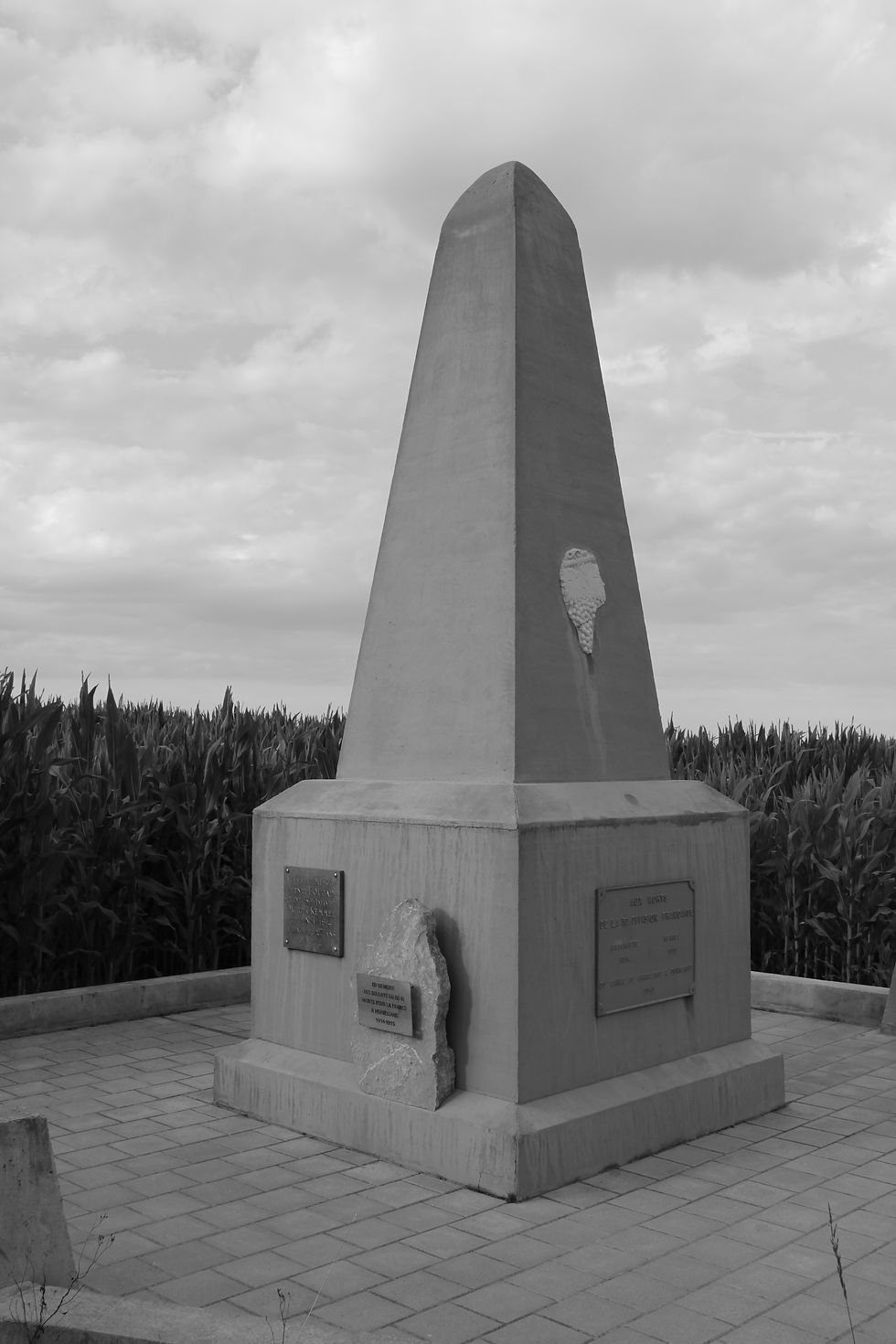
The cemetery was made in the garden of Godezonne Farm, between February and May 1915 by the 2nd Royal Scots and the 4th Middlesex both of 8th Infantry Brigade, 3rd Division. The cemetery is on the road that was known as Cheapside. Three further burials were added in 1916 and the cemetery was enlarged after the Armistice when fifty-nine graves were brought in from a wide area north and east of Kemmel. Further along the road you will find the memorial to the men of the 32nd French Infantry Division who fell in this area in 1914 and in 1918.

Scots Guards
Captain The Honourable Douglas Arthur Kinnaird, 2nd Battalion Scots Guards, 1st Infantry Brigade, 1st Division. Killed in action 24 October 1914, age 35. Grave II.A.1. Master of Kinnaird. Son of 11th Baron Kinnaird, of Rossie Priory, Inchture, Perthshire. He was the eldest of four brothers and was educated at Eton and Cambridge and was gazetted a Second Lieutenant on 22 May 1901, Lieutenant on 1 February 1904, and Captain on 3 February 1912. He was unmarried. He was the Second Captain of ‘F’ Company. On 21 October 1914 F Company were in trenches on the right of the line towards Kortewilde and he wrote home to his mother that: ‘yesterday we had our first experience of advancing under heavy shrapnel fire. It was most exciting to see pits being dug in the ground all round one by shells but it is quite as exciting to see pits being dug in the ground all around as I write, I am sitting at the bottom of a trench while the shells are literally bursting all round us, but the trenches are very safe: we had a bad dose an hour ago, but no casualties…’ He took command of F Company when Captain Fox had to take over the command of Left Flank of the Battalion. F Company had been sent, on the evening of the 22 October, to the east end of Polygon Wood and placed under the command of the Wiltshires, who were in trenches on the Reutel Ridge. Three platoons of F Company were deployed amongst the Wiltshires, with the fourth in reserve. The positions had, at best, only two to three hundred yards of fields of fire on the plateau and were roughly the same distance from the Polygon Wood. The layout of the trenches were unsuitable, particularly when the German artillery got the range, in what was already a poor position in a very exposed salient. The position was made worse when the Germans captured the Poezelhoek from the left company of the Royal Scots Fusiliers and also got into the building in Reutel from which they sniped. The Germans then used dead ground to get in behind the Wiltshires right flank. The Wiltshires did not know about the loss of Poezelhoek and had also received order not to withdraw. When the Germans attacked in front the Wiltshires were also attacked from behind which resulted in the loss of 450 officers and men taken prisoner. F Company, who were with them, were killed, buried alive or taken prisoner.

Lieutenant Ronald Gibbs, of F Company, wrote to his mother that: ‘Yesterday (24 October) was our worst day as my Company 220 men strong has now only 77 men left…. F Company had been sent to reinforce the Wilts but … we had the greatest difficulty in getting to their position…and when we did, found their trenches untenable and had to dig new ones at 1am with no spades, only our entrenching tools. In the morning we were shelled and found the Wilts had run, and the Germans were charging.’ The first attempt to halt the Germans was made by 2nd Battalion Royal Warwicks and about fifty men from F Company

Sergeant John Bell of F Company wrote that though their left was secure their front and right were not and as they moved in to the open from the wood they were ambushed with fire coming from their right rear and they were trapped. They fought back and were extracting themselves, despite losing men, when they came under fire from behind. An English speaking German wearing a British uniform stood up and called out ‘the French are on our right’ Captain Kinnaird raised himself up to look round and began to call ‘cease fire behind we are the Scots G…’ the word never came out and Sergeant Bell, beside him, felt as ‘he dropped his left shoulder against my right shoulder, and with the faintest ‘Oh’ and was dead.’ A bullet had entered his breast and gone through to the hip. Sergeant Bell managed to escape and described how a search party had gone out to recover Captain Kinnaird’s body and he was buried ‘the funeral was carried out with all available military honours , 4 Sergeants, of whom I was one, bore his body to and lowered him in his grave.’ His body was found and reburied on 5 June 1925 it was identified from his officers clothing, badge of rank, and his disc. He was exhumed and reburied at Godezonne Farm Cemetery. His brother Lieutenant The Hon Arthur Middleton Kinnaird M.C., 1st Battalion Scots Guards was also killed in action on 27 November 1917.
Royal Scots – 2nd Battalion, 8th Infantry Brigade, 3rd Division
There are nine men from the Royal Scots buried here. This is a selection.

2nd Lieutenant Charles Stuart Hedderwick. ‘B’ Company. Killed in action 28 February 1915, age 25. Grave I.A.5. Son of Edwin Charles and Mary Hedderwick, 17 Kew Terrace, Glasgow. He was with the Scottish Army Troops Signal Company, enlisting as a Territorial in June 1914, and went to France on 9 October 1914 as a Corporal in the Royal Engineers (T) – Territorial. He was a signaller attached to 4th Army Corps HQ. He was discharged, having applied for a commission in the Regular army, and reenlisted as a Regular in the Royal Scots on 10 February 1915 with a commission. On the 28 February the Battalion was in the line in front of Vierstraat. The War Diary records that: ‘C’ & ‘D’ Companies relieved ‘A’ & ‘B’ Coys. In firing line. Full moon and exceptionally bright night, making movement impossible. Relief caught by severe rifle fire, Lieut. CS Hedderwick was killed about 70yds behind our firing line, going to the relief of a wounded man. Casualties – killed 2Lt CS Hedderwick and two other men. Wounded – nine other ranks.’ His epitaph reads KILLED IN ACTION WHILE AIDING THE WOUNDED BLESSED ARE THE MERCIFUL.

Captain Harry Douglas Saward. Mentioned in Despatches. Killed in action 23 March 1915, age 30. Grave I.A.3. Only son of Major General M. H. Saward, late of the Royal Horse Artillery., and Katherine Isabella, 29 Brechin Place, South Kensington, London. He was educated at Cheltenham College and went on as a cadet to the Royal Military College, Sandhurst. He was commissioned into the Royal Scots on 4 November 1903 as a Second Lieutenant and promoted to Lieutenant on 17 August 1907, and then to Captain on 1 September 1914. He landed in France with the Battalion on 14 August 1914. The Battalion was in the line in front of Vierstraat. He was in M.2 trench when he was killed by a sniper.
Lieutenant Eric Elsdale Molson. Killed in action 1 April 1915, age 21. Grave I.A.9. Son of Major J. Elsdale Molson and Mary Molson, Goring Hall, Worthing. His father was a physician, surgeon, and MP, and a member of the family that owned the Canadian brewing company Molson Coors which still exists today. Eric was the second son and was educated at Cheltenham College and Pembroke College, Cambridge. He served with the Cheltenham College Officer Training Corps between 1909 and 1911. On the 6 August 1914, he completed his application for a commission in the Special Reserve of Officers and on 22 September 1914 was gazetted as a 2nd Lieutenant in the 3rd Battalion Royal Scots and joined the 2nd Battalion on 22 December 1914 landing in France on 24 December. He was promoted to Lieutenant in March 1915. He died on Good Friday 1 April 1915 with the Battalion in the line at Wytschaete the War Diary recording: ‘Lieut. E E Molson killed in gap between.M1 & M.2. Two men wounded.’

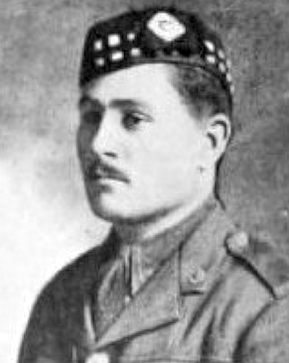


9246 Private David Waugh. Killed in action 28 March 1915, age 26. Grave I.A.8.
Son of Thomas Waugh, 2 Salisbury Square, Edinburgh. He landed in France with the Battalion on 11 August 1914. The Battalion was in the line in front of Wytschaete at trenches M1, M2, and N1. The War Diary records that a fatigue party was carrying rations up to M1 when they were shelled killing two men. 3181 Private Peter Battles, Killed in action 2 April 1915, age 42. Grave I.A.10. Peter was from Motherwell and had a younger brother and two older sisters. He was employed as a Labourer when he enlisted in Linlithgow on 15 August 1914. He went to France on 11 November 1914 and was admitted to hospital with frostbite on 2 January 1915 and discharged seven days later. On the 2 April 1915 the Battalion was in the line in front of Wytschaete, ‘C’ and ‘D’ Companies were in the trenches. The War Diary records that one man was killed.


Middlesex Regiment – 4th Battalion, 8th Infantry Brigade, 3rd Division
There are nine men buried here from the Middlesex Regiment. One served as an Alias and another was a cousin of Field Marshal Sir Douglas Haig.

Lieutenant Lachlan Henry Veitch Fraser. Mentioned in Despatches. Killed in action 24 February 1915, age 20. Grave I.A.7. Son of Major Francis and Alexia Mary Beatrice de Dombal Fraser, of Tornaveen, Torphins, Aberdeenshire. He was the forth of five children, having two older brothers, one older sister and one younger. He was educated at St Helens College, Southsea, and Malvern College where he was a member of the Officer Training Corps. He came from a military family, his cousin was Field Marshal Sir Douglas Haig, then a Lieutenant General, and this no doubt assisted his application and acceptance to the Royal Military College at Sandhurst in December 1912. He went to France in September 1914 and was promoted to temporary Lieutenant in the 4th Battalion Duke of Cambridge’s Own (Middlesex Regiment) on 15 November 1914 and this confirmed on 1 January 1915. He was Mentioned in Despatches for gallant and distinguished service in the field a week before he was killed in action. The Battalion was in the line in front of Vierstraat occupying trenches M1 to M5 and L 5 and 7 with Brigade HQ in Klein Vierstraat Farm. On the 24 February the War Diary recorded that: ‘Nothing happened during the day. Lieutenant (temporary) LHV Fraser and 3 men killed and 4 men wounded during the evening…’ His older brothers Douglas served with the 3rd Battalion Gordon Highlanders, and Francis served with the Seaforth Highlanders and won the Military Cross, and went on to train and serve in the Royal Flying Corps. His younger sister Carey then aged 19 and at Dinan, and later served with the First Aid Nursing Yeomanry earned the Croix de Guerre and Légion d’Honneur in 1918. Both survived the war. Francis went on to serve in World War II.

Alias
11737 Corporal F J Steward (served as John Hackett). Killed in action 15 April 1915, age 31. Grave I.B.6. Son of Elizabeth Hoar (formerly Steward), 340 New Cross Road., London, and the late Samuel Steward. On the 15 April the Battalion were in the line occupying trenches M1 to M5 and L 5 and 7 the War Diary recorded that: ‘Nothing happened during the day. M1 L5 & L7 were again bombarded in the evening…. 1 killed and 3 wounded during the night.’
Boy Soldiers
In the Ypres Salient, we are drawn to the graves of 6322 Private John Condon, 2nd Battalion Royal Irish Regiment, killed in action in May 1915, age 14 and the youngest known battle casualty of the war, although this is now questioned, and the grave of 5750 Valentine Strudwick, 8th Rifle Brigade, killed in action in January 1916, age 15. Strudwicks grave attracts a great deal of attention because of its location at Essex Farm and that locations association with Lieutenant Colonel John McCrae and the poem ‘In Flanders Fields.’ There are many more ‘Boy Soldiers’ buried across the Salient and who are not remembered and these include three from Falkirk District Private William Jamieson, age 17, Private James Duchart, age 16, and Private Herbert Richmond, age 17. There were many reasons why underage boys enlisted in 1914 and 1915 boredom with their jobs, looking for adventure, and escaping family pressures. The checks on age and qualification to enlist were more relaxed than later in the war. The army preferred younger recruits, there was a history of boy soldiers in the army going back over one hundred years. At Waterloo the army had a number of boy soldiers in their ranks. The army preferred younger recruits as they would follow orders and accept discipline more readily than older men. The boys had a belief in their own indestructibility and were prepared to take more risks. We tend to also forget the number of boys who served in the Royal Navy and we do not seem to have the same passionate response to their service as we do those who fought on the Western Front. With regards to the army, the difference was the sheer number who served on the Western Front and there were more boy soldiers in 1915 than served in Wellington’s army at Waterloo. For further reading on this subject I recommend Richard Van Emden’s excellent book Boy Soldiers of the Great

War. 34752 Gunner Alfred John Payne. ‘B’ Battery, 177th Brigade, Royal Field Artillery, attached 16th (Irish) Division. Killed in action 18 November 1916, age 17. Grave I.B.9. Second son, they had five children of William and Annie Payne (Banfield) 16 Gunnersbury Lane, Acton, London. His father died leaving his wife a widow with five children. Annie remarried William Banfield in December 1910, he had five children of his own! Alfred was working as a Clerk aged 15 when he enlisted in July 1915 and like many other Boy Soldiers lied about his age stating that he was 19. Following his general and gunnery training he went to France with his Battery in February 1916. On 18 November the Battery was located near Kemmel and the War Diary records that: ‘Very quiet day. Owing to rain and mist, observation was practically impossible.’
Location
Godezonne Farm Cemetery is located 7 km south west of Ieper town centre, on the Kriekstraat, a road leading from the Kemmelseweg. (Joining Ieper to Kemmel N331). From Ieper town centre the Kemmelseweg is reached via the Rijselsestraat, through the Lille Gate (Rijselpoort), and straight on towards Armentieres (N365). 900 metres after the crossroads is the right hand turning onto the Kemmelseweg. (Made prominent by a railway level crossing). 5 km along the Kemmelseweg lies the right hand turning onto Poperingstraat. 800 metres along the Poperingstraat is the left hand turning onto Kriekstraat. The cemetery itself is located 800 metres along the Kriekstraat on the left hand side of the road.
The cemetery was designed by W.H.Cowlishaw
Burials
Godezonne Farm Cemetery contains 79 First World War burials, 44 of them unidentified.
UK – 74
Australian – 1
Canadian – 1
South African - 3


Comments