


Railway Chateau Cemetery

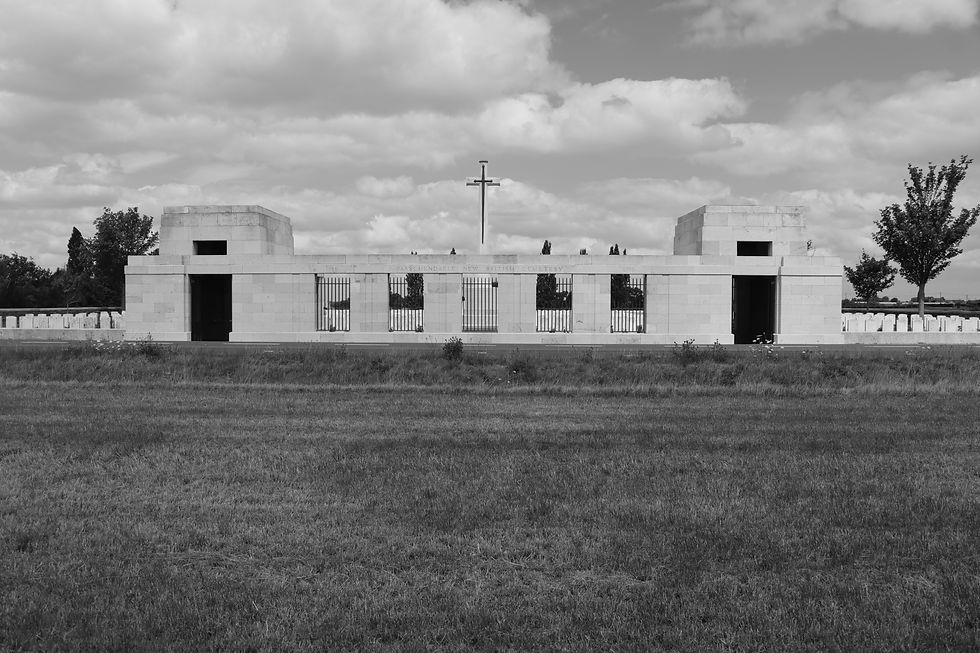
This is a small CWGC Cemetery and Railway Chateau Cemetery (also known as ‘Augustine Street Cabaret’, and ‘L.4 Post’) was begun in November 1914 and used at intervals until October 1916 by troops fighting in the neighbourhood. In Row C, there are the burials of ten men who were killed or wounded, later died of their wounds, on 6 November 1914 when a German shell hit their billet close to the Hotel de Ville in Ypres. The graves are of men killed during First, Second and Third Ypres. There is no record of an Advanced Dressing Station or Aid Post near to this cemetery.

There was an Advanced Dressing Station located at the Hospice du Sacre Coeur, on the Poperinghe to Ypres Road not far from this cemetery. This was in use from February 1915 to November 1917. Various Field Ambulances used the hospital including 84th Field Ambulance of the 28th Division and later Field Ambulances of 5th Division. Images of the Hospice during the war and today

The cemetery next to the Hospice was known as the Asylum British Cemetery and the 265 burials here were removed to Bedford House Cemetery after the Armistice. The original asylum building was destroyed during the heavy shelling of Ypres in the war. It was rebuilt after the war by the same architect, Jules Coomans, and the site is now occupied by the Psychiatrisch Centrum Heilig Hart (Sacred Heart Psychiatric Centre).

One headstone, two soldiers buried here
There are a number of men who share a headstone. The key reasons for two names:
Proximity of Burials: In areas with heavy casualties, like battlefields or hospital cemeteries, soldiers were sometimes buried in narrow trenches or mass graves, side-by-side.
Inability to Separate Remains: If two identified bodies were found together, perhaps intertwined, they were sometimes buried as one unit, requiring a single memorial.
Space Constraints: When burials were close, the Commonwealth War Graves Commission (CWGC) would sometimes use a single stone for two (or even three) men to conserve space, occasionally omitting elements like the cross or regimental badges to fit the names.
Communal Graves: While many communal burials have individual headstones, the 'two names' scenario often arises from adjacent, identified graves where a single marker was more practical.
In essence, it's a practical solution by the CWGC to commemorate identified soldiers when physical separation wasn't possible or feasible due to wartime conditions, ensuring both men received a memorial.
Scottish Regiments
First Battle of Ypres
Three men from the 1st Battalion Scots Guards

5789 Guardsman Alfred John Carr, 1st Battalion Scots Guards, 1st Infantry Brigade, 1st Division. Killed in action, Died of Wounds received, 5 November 1914, age 29. Grave C.7. He was married to Sarah. Ellen, 26 Alexandra Street, Ebbw Vale, Monmouthshire, and he was a regular soldier. He landed in France with the Regiment on 13 August 1914. During the night of the 3 November the Scots Guards and the Black Watch started work on two strong defensive positions, the Scots Guards on the right were partly in and around an orchard, with some buildings, known as Northampton Farm, and a trench line angled back towards Veldhoek Chateau Wood. Just forward of them and to their right up to the Menin Road was a Battalion of Zouaves, French Territorial infantry. They recorded in the War Diary that the 4 November was a quiet day. On the 5 November the Germans opened a heavy barrage on their line. On the evening of the 5 November Lieutenant Winthrop Smith was bringing a draft of replacements up to the front line when he met a group of walking wounded who he thought were from the 2nd Battalion ‘I knew many of them. Their clothes were torn and muddy, some had rifles and some had not, and they all looked pale and haggard, as if they had awakened from a ghastly nightmare. They informed us that the British army was losing heavily, that the Germans were greatly superior in artillery and men, and that the draft which joined the 1st Scots Guards only that morning, was wiped out almost to a man. They wished us luck and

proceeded on their way.’
7357 Guardsman Charles Herbert Hussey, ‘B’ Company, 1st Battalion Scots Guards, 1st Infantry Brigade, 1st Division. Died of Wounds 7 November 1914, age 23. Grave C.12. Son of Mrs Lavinia Hussey, 33 Foreburn Road, Wavertree, Liverpool. On the 7 November there was heavy shelling of the Scots Guards positions and at 3.30pm the Germans, following up their shelling, successfully pushed the Zouaves out of their trenches to the right front of the Scots Guards and they were driven onto the front companies of the Loyal North Lancs behind them both in Veldhoek chateau Wood and Herenthage Chateau Wood, so pushing them back as well. The Scots Guards position was exposed to flanking fire from both the trenches the Zouaves had lost and the wood behind. An attempt was made to eject the enemy with machine gun fire and counterattack and this recovered the Loyal North Lancs trenches and stabilised the line between the Scots Guards and the Menin Road.

7598 Guardsman Arthur Thomas Hinton, 1st Battalion Scots Guards, 1st Infantry Brigade, 1st Division. Died of Wounds 12 November 1914, age 22. Grave B.6. He was married to Ethel Annie and they lived with their daughter at 23 Grove Road, North Finchley, London. His epitaph reads: REST IN PEACE WIFE & DAUGHTER He shares a headstone with 3149 L/Cpl J Bresnan, Royal Munster Fusiliers, Killed in action 12 November 1914.
On the 11 November the Scots Guards positions came under heavy German shell fire from 6am and this lasted for three hours. There was also a mist and the smoke from the exploding shells helped to obscure the British field of vision. The British defence, in addition to the Scots Guards, were dug into a series of fox holes linked by a shallow communication trench on the south side of the Polygon Wood and at right angles to the Black Watch strong point, shown on trench maps as Black Watch Corner. The guns of the 16th Battery, 41st Brigade, RFA, along with the guns of the 9th and 17th were situated down the slope to the west of Nonne Boschen Wood. At 9am the Prussian Guards attacked in an unbroken line moving forward at the jog through the mist and they did not fire but used their bayonets. There was not much resistance as the Scots Guards had not seen them coming. Only five men from the fire trench, 30 from the Orchard trench, and 4 from the strong point and Battalion HQ managed to escape and rejoin the British lines at dusk. The German got to within 200 yards of the British guns before they were driven off with heavy casualties.

9425 Private Richard Cornwall, 1st Battalion Queen’s Own Cameron Highlanders, 1st Infantry Brigade, 1st Division. Died of Wounds, 7 November 1914, age 18. Grave C.5. Son of Richard and Jane Cornwall, Newtongrange, Midlothian. He was Miner at the Lady Victoria Colliery in Newtongrange before he enlisted on 2 January 1913. He had four brothers. The Battalion was in the line at Veldhoek with the War Diary recording that they were subjected to heavy shelling and that they ‘lost some men from ‘D’ Coy.’

9465 Private Hugh Cowan, 2nd Battalion Highland Light Infantry, 5th Infantry Brigade, 2nd Division. Died of Wounds 13 November 1914. Grave B.6. He shares a headstone with 4846 Rifleman J H Jones, King’s Royal Rifle Corps, Killed in action 15 November 1914. Hugh was a regular soldier from Govan, Glasgow and was a Labourer when he enlisted on 1 July 1904. He listed his next of kin as Mrs Annie McLean. He went to France with the Battalion on 14 August 1914. On the 12 November they assembled to support the Oxford & Buckingham Light Infantry in their attack on the north west corner of Polygon Wood however, this was considered impracticable and the Battalion less ‘C’ Company was then ordered to 6th Brigade HQ part of the trench line on their left to support them as the trench positions had been forced. The line was withdrawn to line of the Menin Road on the right. On the 13 November their positions were heavily shelled with 22 Other Ranks being killed or wounded.

2nd Lieutenant Reginald Glover Ker-Gulland, 14th Battalion London Scottish, Killed in action 12 November 1914, age 28. Grave C.9. Son of James and Beatrice Ker-Gulland, 101 Coleherne Court, Earls Court, London. The Battalion had been heavily involved in the fighting at Messines at the beginning of the month, and arrived at Hooge in the Ypres salient on 7th November to join 1 Brigade, 1st Division. On 8th November they moved to Zillebeke and into trenches in the wood 1 ½ miles, south-east of the village. Here they stayed until 13th November, heavily shelled day and night. Their right flank was very vulnerable and a farmhouse on the left flank was occupied by the enemy and caused them problems. Several small attacks were made on their trenches during the first night and on 10th November there was a fierce artillery bombardment that blew the Battalion HQ dug-outs to bits. Some of the trenches were so badly damaged that new ones had to be dug. The next day, 11th November, at 6.30am, the whole of the British line was heavily shelled accompanied by intense rifle fire. Then, from the German trenches, located less than only 100 yards away, came the enemy infantry, advancing in large numbers from the woods behind them. By this time the Battalion was fighting in two separate groups, with men from 2nd Welsh and 2nd Royal Munster Fusiliers between them, and a very strong force of Germans were heading towards the right group. Their right flank was enveloped and things looked serious until a counter attack against the exposed left flank of the enemy was made by some of 2nd King’s Royal Rifle Corps which restored the situation. Later the left half of the Battalion came under heavy attack and this time the situation was saved by bringing up what remained of the Battalion HQ into the line. By the end of the day the Germans had made no gains in this sector. During the night of 13-14th November the Battalion were withdrawn from the line and moved back to a wood near Hooge before going into Corps reserve the next day. Among the casualties was Reginald who died of wounds on 12th November.

Royal Artillery – Second Battle of Ypres
Of the sixteen men from the artillery buried here there are twelve from the Royal Garrison Artillery. I have selected four men killed in action on 24 May 1915 and who were with the 108th Heavy Battery, Royal Garrison Artillery. On the 24 May the Battery was located close to the Asylum on the Poperinghe to Ypres Road and were providing fire support to the infantry and cavalry regiments around Potijze and Bellewaarde Ridge. They were firing at enemy targets at Veldhoek and Polygon Wood and working with aircraft spotters and balloon observers. At 3am on 24 May the Germans opened their attack at Bellewaarde/Frezenberg Ridges and the Battery was called into action by shelling the German positions at Frezenberg. In the afternoon the Germans were reported to be in possession of Wittepoort Farm on Bellewaarde Ridge and a counterattack was being organised and at 2.45pm the Battery opened fire on the German infantry at the rate of one round per gun per minute for 30 minutes and fire was continuous throughout the remainder of the day. A German observation balloon was up all day spotting and late in the afternoon the right sector of the Battery was heavily shelled with the following casualties recorded in the War Diary of one Officer and three Other Ranks killed and seven Other Ranks wounded, with two other men sent to hospital with the effects gas. The dead were 38276 Gunner Wilfred Malta John Bartlett, Age 21. Grave B.2. Son of Thomas and Jane Bartlett, 73 Wallington Street, Reading. He had five sisters. He was unmarried and a Labourer. He went to France on 12 September 1914. 33425 Gunner William Thomas Scarse. Age 23. Grave B.2. Son of Arthur William Scarse, 36 Albion Street, Portslade, Sussex. he had two brothers and three sisters. He listed his trade as Gardiner when he enlisted in Eastbourne on 23 May 1910 age 18. 339 Gunner Audry Kelly, Grave B.2. Son of Mrs Elizabeth King, 10 Queens Street, Swinton. He had a brother and four sisters. Captain Walter Augustus Erskine. Age 34. Grave B.3. He was born in Edinburgh the second son of the late Hon. Augustus William and Harriet Susannah Erskine, Bowscar, Penrith. He was the grandson of Walter Coningsby, Tenth Earl of Mar and Twelfth Earl of Kellie. He was gazetted as a Second Lieutenant on 4 May 1901 and joined the Royal Garrison Artillery. He was promoted to Lieutenant in November 1904 and to Captain in May 1914.


First Battle of Ypres
2nd Lieutenant Arthur Nelson Coxe, Mentioned in Despatches. 105th Battery, 22nd Brigade, Royal Field Artillery, 7th Division. Died of Wounds 3 November 1914, age 20. Grave C.10. He was born in Bengal and was the third son of Henry and Louisa Coxe. His father was a judge at the High Court in Calcutta. Arthur was educated at Eastbourne college from 1908 to 1912 and he was a Colour-Sergeant in the college OTC. On leaving college he went to the Royal Military Academy at Woolwich in December 1912 and was commissioned into the Royal Artillery. On the 1 November the Battery was in position near Hooge and supplying fire support and shelling the German position around Zandvoorde and the woods just west of the windmill at Veldhoek to Zandvoorde Road. On the 2 November the Germans attacked along the Menin Road and in the afternoon one section of the 105th Battery was sent forward to the crossroads east of the 6th Kilo marker on the Ypres to Menin Road with the War Diary recording that: ‘Did excellent work. Germans driven back. Lt Coxe dangerously wounded.’
Labour Corps
Third Battle of Ypres
There are four men from the 192nd Company Labour Corps buried in Row A killed in action on 30 October 1917. They were originally with the 3rd Battalion Seaforth Highlanders. The headstones do not mention that they were a member of the Labour Corps. In 1919 it was decided that the headstone of a member of the Labour Corps, who previously served in any other unit, should record his connection with his previous regiment. The company was formed on May 14, 1917, as part of the general reorganisation and centralisation of labour units into the newly established Labour Corps. It originated from existing labour sections, specifically the former E1, E2, and E3 sections of the Army Service Corps (ASC) Labour Company. The 192nd Company moved to the Second Army area in July 1917, operating near Proven and Ypres. The Labour Corps was vital for maintaining the war effort, undertaking a wide array of tasks, including:
· Maintaining roads and railways, sometimes under shell fire.
· Digging reserve positions and new camps.
· Moving ammunition and general battlefield clearance.
The personnel in the Labour Corps were generally medically unfit for frontline infantry duty due to age, poor health, or injury, but were still able to perform essential manual labour. Many men were transferred from infantry regiments like the Seaforth Highlanders and Royal Garrison Artillery after being wounded or found physically unsuitable for active combat roles. S/14734 Private James Gallacher, age 31. Grave A.8. Son of Henry and Mary Ann Gallacher. He was married to Elizabeth McHugh Gallacher, and they lived with their three children at 50 Lyon Street, Cowcaddens, Glasgow. Their youngest child James was to die on 11 May 1918 just one year old. His wife had to endure the devastation of her husband’s death and that of her youngest child all within one year. S/14504 Private Donald MacDonald, age 20. Grave A.8. Son of John and Annie MacDonald of Knockline, Bayhead, Lochmaddy, North Uist. S/14550 Private James MacKay. Grave A.8. He lived in Kirkintilloch, Dumbarton and enlisted in the Seaforth Highlanders at Stirling Castle. S/14068 Private William Whyte, age 36. Grave A.8. Son of William and Mary Watt Whyte. He was married to Jessie Sim Whyte, 50 Hardgate, Aberdeen. Native of Old Meldrum, Aberdeen.

Location
Railway Chateau Cemetery is located 2 Kms west of Ieper town centre, on the Adriaansensweg, a road leading from the Poperingseweg (connecting Ieper to Poperinge).From Ieper town centre the Poperingseweg (N308), is reached via Elverdingsestraat then straight over two small roundabouts in the J.Capronstraat. The Poperingseweg is a continuation of J.Capronstraat and begins after a prominent railway level crossing. 1 Km along the Poperingseweg is the right hand turning onto the Adriaansensweg. Avoiding the road forking off to the right, the cemetery is located 500 metres along the Adriaansensweg, on the left-hand side of the road.

The cemetery was designed by W H Cowlishaw.
Burials
The cemetery contains 105 First World War burials, six of which are unidentified.
UK – 99
Unidentified – 6


Comments