


Woods Cemetery
Updated: Mar 21

Woods Cemetery, CWGC, Ypres, is the nearest to the road of the three cemeteries located on The Bluff. The other two being Hedge Row Trench Cemetery and First DCLI Cemetery, The Bluff. Woods Cemetery was begun by the 1st Battalion Dorsets, 15th Infantry Brigade, 5th Division, and the 1st Battalion East Surreys, 14th Infantry Brigade, 5th Division. in April 1915; it was used until September 1917 by units holding this sector, and by the Field Ambulances of their divisions. Many of the graves are of men from 2nd, 3rd, and 10th Battalions, Canadian Infantry, and the London Regiment. The graves of the London Regiment are from battalions of the 47th (London) Division who were in this sector from late 1916 their burials are in Plots IV and V. It is thought that buried in Plot I, Row B, are six men. The irregular shape of the cemetery is due to the conditions of burial at the times when the front line was just beyond the wood.


The Bluff
The Bluff was created from the spoil thrown up from a large cutting when the Ypres to Comines Canal was being constructed. The trench lines ran between Verbrandenmolen on the left and The Bluff and the early trenches were constructed by the French in 1914. The British then took over the line and the trenches were numbered, as opposed to being named trenches, and the fighting here went on for four years. The 1st and 4th Battalions Gordon Highlanders of 3rd Division held the trenches here for one month in July 1915 and the command post on the raised ground on the northern canal bank between the Bluff and Spoilbank was named Gordon Post. Writing in her ‘Battle Book of Ypres’, Beatrix Brice quotes Lieutenant-Colonel H, d’Arch Smith, 2nd Suffolks who describes the work in reclaiming land from the overflowing water, and consolidating their trenches: ‘We floundered in the mud, we endeavoured to stop or rather to divert the endless flow of water which the Boche, being as always in higher ground than ourselves, cleverly poured into our trenches to join streams that flowed in from our back area. In fact we became amphibious. With keenness, ingenuity, and cunning we dug where we could, erected parapets where we could not, and filled hundreds of sandbags, with a sort of porridges of mud as a foundation before anything could be built up… The arrival of timber and of ready-made duck-boards helped matters, and support and communication trenches began to look as though they might resist a puff of wind, though the front-line ones had not much more strength than what a barrier of barbed wire lent them.’

Mine Warfare at the Bluff
Mine warfare was a prominent feature with many craters still visible today. On the 10 October 1915, the 10th Battalion Argyll & Sutherland Highlanders, 9th (Scottish) Division held the trenches numbered 27, 28 and 29 at the Bluff. This was one of the best places in the Salient for observation and was therefore one of the first places that mine warfare developed. The dispositions of the 10th Argyll’s saw three Companies ‘A’, ‘B’, and ‘C’ occupy trenches the trenches and ‘D’ Company was in reserve in dugouts at Spoilbank. ‘A’ Company had two platoons in the firing line and two platoons in support in dugouts on the Bluff. On the evening of 12 October, the Battalion was relieved by the 6th Battalion Royal Scots fusiliers who took over trenches 27 and 28 leaving 10th Argyll’s holding trench 29 with ‘A’ Company and the other companies in reserve in Canal Bank and Spoilbank. At 6am on 13 October the Germans exploded a mine underneath an old crater in trench 29 and the War Diary records: ‘At 6am the enemy exploded a large mine under the old CRATER in trench 29. This did a lot of damage in front and on the BLUFF and was most regrettable in that we lost about 70 men, 14 of whom were killed and 16 missing. All dugouts nearby were completely blown in, causing many men to be buried.’ Two Falkirk District men were killed in this action Private David Burt from Camelon and Private John Dow from Falkirk

An extraordinary incident occurred on 30 December 1915 which was recorded in his diary by Billy Congreve, Brigade-Major, 76th Brigade, 3rd Division: ‘Some excitement today. About 7am this morning, all the water in the big Bluff crater suddenly disappeared with a rush and left exposed in the south-west corner of it the entrance to a Boche gallery. Brisco (2nd Lieutenant R B Brisco, Royal Engineers) at once went up and started off down the gallery by himself, leaving a man armed with a rifle at the

entrance. After going about sixty feet, he heard somebody coming towards him, so he slowly retired. When he had got close back to the entrance again he waited and, as soon as the Boche showed his head round the corner, fired with his revolver. He missed. The man who was with him, in his excitement, let off his rifle. It flew up and hit Brisco a whack on the nose that nearly knocked him out, so the Boche got away. I went up in the afternoon to see how things were and found the crater almost dry. Many tons of water must have run down the Boche gallery…… I found three grenadiers of the RWF sitting on top of the block! These I hurriedly withdrew to a safe distance. About half an hour later the Boche blew up his gallery from the inside without doing us any damage, so now all is quiet…’
Retaking The Bluff – March 1916
Before the attack on Verdun the Germans initiated a series of diversionary attacks along the allied line. One of these attacks was against the British line at the Bluff in the Ypres Salient. They exploded a mine in front of the Bluff on 22 January and shelling half a mile of front line trenches, including the Bluff itself, on the 14th February. The front line was defended by the 17th Division’s 51st Brigade which had relieved the 76th Brigade on 7th February. The Bluff was held by a single platoon of the 10/Lancashire Fusiliers when the Germans attacked. Their positions were blasted by artillery and the men sought cover in the Bluff’s tunnels. This was a fatal mistake as the Germans exploded a small mine beneath and buried the occupants. The captured trenches were consolidated and repeated attacks to retake them failed. It was concluded by the commander of V Corps that to retake The Bluff and the lost trenches would require a more detailed plan and the attack to be undertaken by troops who knew the ground. For this reason 76th Brigade were recalled from reserve and placed under the command of 17th Division for the attack on 2 March. Brigadier General H.C.C. Uniacke, GOC Royal Artillery, V Corps, was brought in to arrange artillery co-operation. All four of 76th Brigades Battalions would be taking part in addition to 7/Lincolns and 10/Sherwood Foresters from the 51st Brigade.

The plan was for the 2/Suffolks, supported by the 10/Royal Welch Fusiliers to storm The Bluff as well as the canal bank where the German mine workings were suspected. Companies of the 1/Gordon Highlanders were to attack on the left and the 8/King’s Own to attack the centre. The difficult area was The Bluff because of its height and the ability for surveillance. It was considered impossible for the 2/Suffolks to cross No Man’s land without supporting artillery cover. To do this would forewarn the Germans. It was estimated that two minutes was all the time the Suffolks needed to cover the ground. It was Uniacke who came up with the answer. He would arrange for a battery to fire a salvo at The Bluff, followed by another salvo two minutes later and this pattern would be fired at irregular intervals day and night leading up to the day of the attack. Only at zero hour would one salvo be fired and while the Germans were taking cover expecting the second salvo the Suffolks would cross and storm the German positions. At 4.30am after the guns fired for two minutes being the usual salvo the Germans had been expecting at 4.32am as the fire ceased the assault went in. the Germans were taken by surprise and except for the loss of one of the tunnelling parties and three platoons of ‘A’ Company, Gordon Highlanders who were practically annihilated by machine-gun fire, all objectives were achieved. Two men from Falkirk District died in the action by the Gordon Highlanders Private John Anderson of Larbert and Private Charles Mason of Plean, Falkirk.
FALKIRK AND DISTRICT MEN BURIED IN WOODS CEMETERY
Stenhousemuir
15060 Gunner James Brown
59th Battery, 18th Brigade, Royal Field Artillery
Age 42
28.9.17
II.BB.1
Husband of Mary McVay & brother of Mrs Campbell, Raemount Place
Artillery Burials
Buried together in what is a field grave and is possibly an old gun pit are three men. 76229 Bombardier George Murray Brand, "D" Battery, 124th Brigade, Royal Field Artillery. Killed in action 12 November 1917. age 33, Grave II.Z.1 The son of Edward and Amelia Brand. He was married to Elizabeth Clara Brand and they at 83 Cadogan Terrace, Victoria Park, London with their two children Winnifred and George. He was working in a Saw Mill as a Labourer when he enlisted and he landed in France on 30 July 1915. 227470 Gunner John Wann, "D" Battery, 124th Brigade, Royal Field Artillery. Killed in action 12 November 1917. age 31. Grave II.Z.2. He was the eldest son of David and Mary Wann, of Cupar, Fife. He was married to Mary Johnstone Wann, they married on 7 April 1917, and they lived at 8 Spottiswood Street, Edinburgh. He was employed as a Draper when he enlisted in the RFA on 10 April 1917 and went to France on 2 September 1917. 129569 Gunner Wilfred Morton, "Y" 37th Trench Mortar Battery, Royal Field Artillery. Killed in action 12 November 1917. Age 21. Grave II.Z.3. He was the youngest of two sons of Alexander and Mary Morton, 1 Gill Lane, Haslance, Grassmoor, Chesterfield. It is possible that all three were killed while manning a trench mortar as these weapons were used in close proximity to the enemy trenches.


Royal Army Medical Corps
Lieutenant Bernard Bradley Gough attached 8th Battalion South Staffordshire Regiment, 51st Infantry Brigade, 17th Division. Killed in action 17 February 1916, age 42. Grave I.C.3. Son of the late Henry Gough (Barrister-at-Law), of Red Hill, Surrey. He was married to Annie Sophia Gough, of East Harptree, Bristol. He was serving as a Staff Sergeant in the RAMC when he was commissioned on 25 June 1915. On the 17 February 1916, the Battalion Dressing Station received a direct hit from a German 8 inch shell killing Bernard and another officer along with twelve Other Ranks, stretcher bearers.

Canadian
The Canadian graves largely date from April 1916. 8190 Private Frederick Elwyn Calderon, 2nd Battalion (Eastern Ontario Regiment), 1st Canadian Infantry Brigade, 1st Canadian Division. Killed in action 3 April 1916, age 42. Grave II.G.11. He was born in London and educated at Rugby after which he worked in the Maritime Department of Canada from 1907 to 1914. His father was a member of the Royal Academy. He gave his address as living at 11 Hill Road, London when he enlisted on the 23 September 1914 in Canada. He had previously served for five years in the Middlesex Rifles as a Territorial. He was unmarried. His sister Marguerite and his mother Clara were his Legatee and Next of Kin. He went to France with the Battalion on 8 February 1915. On the night of the 2/3 April 1916, the Battalion took over trenches 33 to 37 from the 6th Battalion DCLI. The War Diary records that the Battalion was engaged in building a new cemetery, Woods Cemetery. The record that the enemy snipers were

active. A/10456 Private Leonard Endicott, 2nd Battalion, (Eastern Ontario Regiment), 1st Canadian Infantry Brigade, 1st Canadian Division. Killed in action 25 April 1916, age 26. Grave II.G.2. Son of Samuel and Jemima Endicott. He was married to Etta Endicott and they lived at 205 Slater Street, Ottawa. He was employed as a Fireman when he enlisted 1 March 1915. He landed in the UK on 4 July 1915 and went to the Canadian Camp at Shorncliffe and from here to France as part of a draft on 25 August 1915. On the night of the 23/24 April 1916, the Battalion took over trenches 38 to 44 on Hill 60 from the 5th Canadian Battalion. On the 25 April they recorded that the day was fairly quiet and that the Germans shelled ‘the Dump’ and the Railway cutting. They worked all night repairing trenches. There is no mention of any casualties. On the 26 April the Germans blew a mine beneath Trench 42, bays 6,7, and 8, and buried fourteen men of No.13 Platoon.
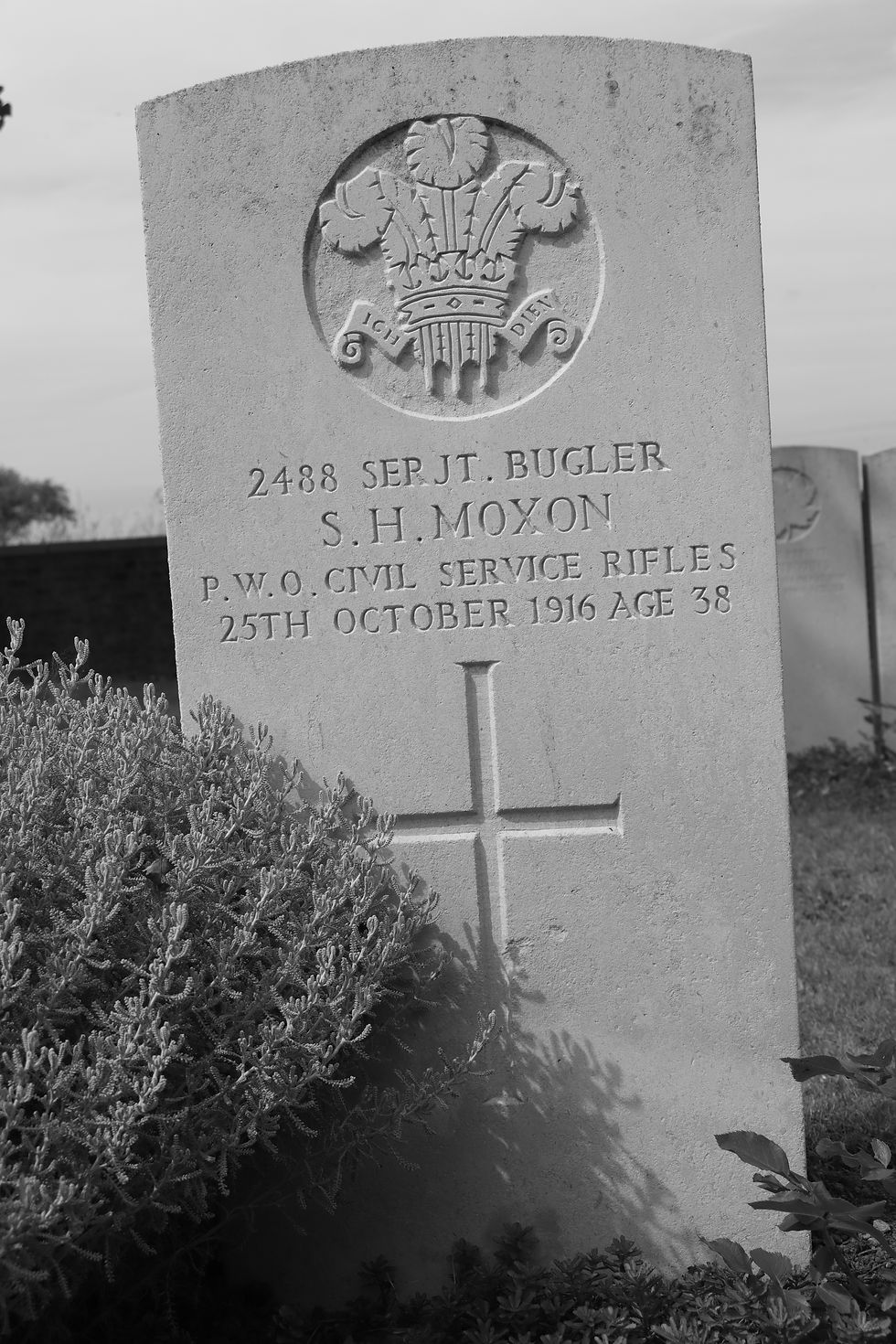
Bugler
2488 Sergeant-Bugler Sidney Harvey Moxon, 1st/15th Battalion, London Regiment (Prince of Wales’s Own Civil Service Rifles), 140th Infantry Brigade, 47th Division. Killed in action 25 October 1916, age 38. Grave V.B.2 He was a King's Trumpeter, Member of Royal Society of Musicians, and a Free Mason. The son of George J. and Eliza Moxon. A regular soldier when war was declared, when he was killed his possessions went to his sister Louise and her husband Frederick Sibley. On the 19 October 1916, the Battalion took over the front line on the Bluff from the 8th Battalion London Regiment. The War Diary recorded Battalion casualties on 25 October as ‘2 killed, 6 wounded.’
Boy Soldiers
In the Ypres Salient, we are drawn to the graves of 6322 Private John Condon, 2nd Battalion Royal Irish Regiment, killed in action in May 1915, age 14 and the youngest known battle casualty of the war, although this is now questioned, and the grave of 5750 Valentine Strudwick, 8th Rifle Brigade, killed in action in January 1916, age 15. Strudwicks grave attracts a great deal of attention because of its location at Essex Farm and that locations association with Lieutenant Colonel John McCrae and the poem ‘In Flanders Fields.’ There are many more ‘Boy Soldiers’ buried across the Salient and who are not remembered in the same way and these include three from Falkirk District Private William Jamieson, age 17, Private James Duchart, age 16, and Private Herbert Richmond, age 17. There were many reasons why under age boys enlisted in 1914 and 1915 boredom with their jobs, looking for adventure, and escaping family pressures. The checks on age and qualification to enlist were more relaxed than later in the war. The army preferred younger recruits, there was a history of boy soldiers in the army going back over one hundred years. At Waterloo the army had a number of boy soldiers in their ranks. The army preferred younger recruits as they would follow orders and accept discipline more readily than older men. The boys had a belief in their own indestructibility and were prepared to take more risks. We tend to also forget the number of boys who served in the Royal Navy and we do not seem to have the same passionate response to their service as we do those who fought on the Western Front. With regards to the army, the difference was the sheer number who served on the Western Front and there were more boy soldiers in 1915 than served in Wellington’s army at Waterloo. For further reading on this subject see Richard Van Emden’s excellent book Boy Soldiers of the Great War. There is one Boy Soldier buried in Woods Cemetery. 406355 Private Hubert Dean Mills, 1st Battalion (Ontario Regiment), 1st Canadian Infantry Brigade, 1st Canadian Division. Killed in action 26 April 1916, age 17. Grave II.E.7. Son of John D. and Martha E. Mills, of Fort Erie, Hamilton, Ontario. Hubert was employed as a Labourer when he enlisted on 14 May 1915 giving his age as 19 years and 4 months. He arrived in England on 28 June 1915 and went to France an joined the Battalion on 26 October 1915. On the 26 April 1916 the Battalion were in the trenches at Mount Sorrell when at 6.30pm the Germans opened a heavy barrage all along their front and then tried to occupy the Canadians SAP at trench 46 but were driven back. The Canadian casualties for the day were fifty men killed or wounded. His epitaph reads OUR HUBERT PEACEFULLY SLEEPING RESTING AT LAST PARENTS.
Cemetery Location

Woods Cemetery is located 4 Kms south-east of Ieper town centre, on the Verbrandemolenstraat a road leading from the Komenseweg, connecting Ieper to Komen (N336). From Ieper town centre the Komenseweg is located via the Rijselsestraat, through the Rijselpoort (Lille Gate) and crossing the Ieper ring road, towards Armentieres and Lille. The road name then changes to Rijselseweg. 1 Km along the Rijselseweg lies the left hand turning onto Komenseweg. 2.5 Kms along the Komenseweg lies the right hand turning onto the Vaartstraat. 900 metres along the Vaartstraat lies the left hand turning onto the Verbrandemolenstraat. 400 metres along the Verbrandemolenstraat a short distance from the road is the cemetery.

The cemetery was designed by Sir Edwin Lutyens.
Burials
Woods Cemetery contains 326 First World War burials, 32 of them unidentified.
UK – 212
Australian – 3
Canadian – 111
Known unto God - 32


Comments