


White House Cemetery, St. Jean-Les Ypres
Updated: Apr 9


White House Cemetery, St.Jean-Les Ypres, CWGC, St Jean (Sint Jan), Ypres, was begun in March 1915 and used until April 1918 by units holding this part of the line. It then comprised most of the present Plots I and II after the Armistice these Plots were completed, and III and IV added, when graves were brought in from the battlefields around Ypres (now Ieper) and from a number of small burial grounds. Beyond the cemetery wall is the Bellewaarde stream and on its banks used to stand a white house from which the cemetery was named. There are four men who were Shot at Dawn, one recipient of the Victoria Cross, and three Boy Soldiers buried here. There are also four men from Falkirk District who served in the Argyll & Sutherland Highlanders and Gordon Highlanders.
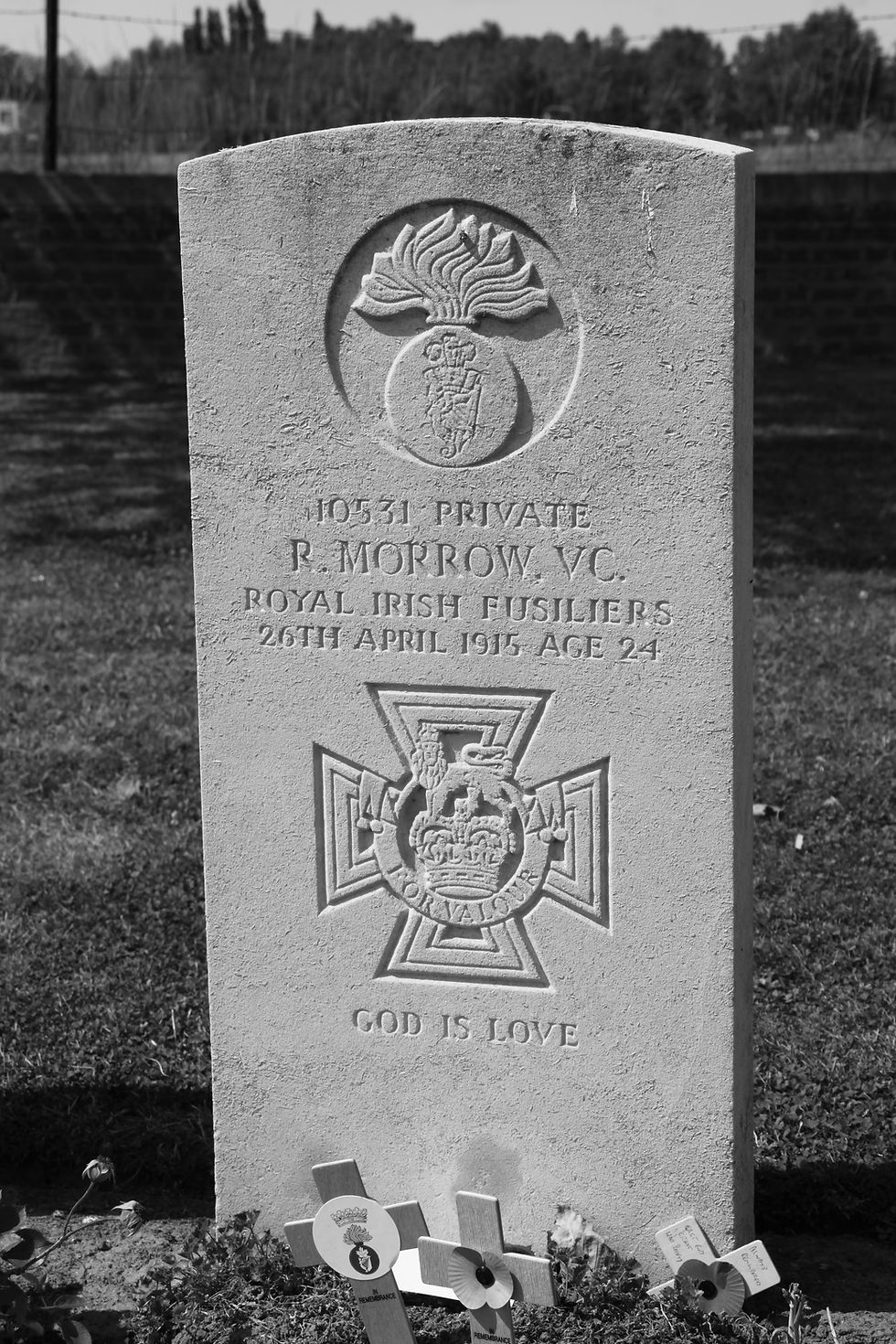
Victoria Cross Holder Buried here
Grave IV.A.44 10531 Private Robert Morrow, V.C., 1st Battalion Royal Irish Fusiliers (Princess Victoria’s), 10th Brigade, 4th Division. Died 26 April 1915, age 24. He was the son of Hugh and Margaret Jane Morrow, of Sessia, Newmills, Dungannon, Co. Tyrone.
He won his V.C. on 12 April 1915 for rescuing wounded comrades from no man’s land south of Messines. An extract from "The London Gazette", No. 29170, dated 22nd May 1915, records the following:- "For most conspicuous bravery near Messines on 12th April 1915, when he rescued and carried successively to places of comparative safety, several men who had been buried in the debris of trenches wrecked by shell fire. Private Morrow carried out this gallant work on his own initiative and under very heavy fire from the enemy."
FALKIRK AND DISTRICT MEN BURIED HERE
Carron & Carronshore
7th Battalion Argyll & Sutherland Highlanders
Age 22
24.5.15
III.C.8
Son of Thomas & Maggie Buist, Carronhouse, Carronshore Rd. Husband of Jessie Ferguson Buist, Carronhouse
7th Battalion Argyll & Sutherland Highlanders
Age 19
24.5.15
III.C.7
Son of John & Ann McDonald, 166 West Carron
Stenhousemuir
'A' Company, 7th Battalion Argyll & Sutherland Highlanders
Age 22
26.4.15
IV.A.45
Polmont
8/10th Battalion Gordon Highlanders
24.8.17
III.L.23

There are four men who were executed and whose graves were concentrated here after the Armistice.
Cavalry

Lieutenant Sir Richard William Levinge, 1st Life Guards, 7th Cavalry Brigade, 3rd Cavalry Division. Killed in action 24 October 1914, age 36. Grave I.D.28. Son of the late Sir William Henry and Lady Emily Levinge. He succeeded his father as the 10th Baronet in 1900. He was Deputy Lieutenant for the County of Westmeath, and his residence was at Knockdrin Castle, near Mullingar. He married Irene Lady Levinge on 15 February 1910, she remarried now Mrs. R. V. Buxton, of Thatchways, Priors Hardwick, Byfield, Northants. They had one son. He served with the 8th Hussars in the South African War in 1900. On 1 September 1914, he joined the 1st Life Guards from the Reserve of Officers. The Life guards were in the line at Zandvoorde from 24 October for 48 hours. The War Diary records that the trenches were heavily shelled all day: ‘Both nights heavy firing opened about 9pm, but no actual attack was made. Firing lasts about ½ hour, & the same was repeated at about 2am.’ Richard was killed in this action. His body was exhumed from Basseville Farm German Cemetery, Zandvoorde, and reburied here after the Armistice. He was originally recorded as ‘Unknown British Officer’ and he was identified from his clothing.

Indian Army
Lieutenant Colin McDiarmid Allardice Mentioned in Despatches, 14th King George’s Own Ferozepore Sikhs, attached 47th Sikhs, Indian Army, Killed in action 26 April 1915, age Grave III.A.18. He went to the Royal Military College Sandhurst and was commissioned in 1906 as a Second Lieutenant in the East Lancashire Regiment, and promoted to Lieutenant in 1908. He was transferred to the Indian Army in 1911 and posted to the 14th King George’s Own Ferozepore Sikhs. He was in the UK when war weas declared and he was ordered to Aldershot and joined the Royal Scots holding the rank of temporary Captain. He went to France in November 1914 and joined the 47th Sikhs and was Acting Adjutant. He was mentioned in Field Marshal sir John French’s despatch on 31 May 1915. His brother Lieutenant-Colonel Harry Allardice was killed on 1 July 1916 on the Somme while commanding the 13th Battalion Northumberland Fusiliers. On the morning of 26 April 1915, the Lahore Division, which included the 47th Sikhs, prepared to attack the German positions near to Wieltje. After a short 40 minute shelling of the German positions the Division went forward at Hill Top Ridge and in no time was taking heavy casualties from severe frontal cross fire from rifles and machine guns as well as chlorine gas. The leading battalions slowed and halted and progress into what was later to be named Colne Valley in front of Canadian Farm was made. The casualties of the Indian Army Corps units were appalling. The 47th Sikh’s who attacked the first line lost 348 out of 444 men or 78 per cent of the Regiment. Dominiek Dendooven, historian, on recounted the attack by the 47th Sikhs and their terrible casualties and noted that: ‘But we only have 14 of their names inscribed on the Menin Gate. The rest have vanished from history.’ For Dendooven, Ieper’s function as a memorial to the First World War remained flawed. ‘The history of the war as is commonly understood here is a very Eurocentric history, but in fact more than 50 non-European cultures were involved,’ the result of the use of colonial troops by the British and French. (Article in Global Jigsaw: The forgotten Indian soldiers of Flanders Fields)

Royal Flying Corps
Captain William Arthur Lloyd Poundall M.C., Pilot, 53 Squadron Royal Flying Corps. Killed in action 31 October 1917, age 23. Grave I.D.19. Son of A. B. and Elizabeth Poundall, 13 High Street, Crawley, Sussex. Native of Wimbledon, London. He took off at 11.25am and was flying an RE.8, A4214, on an artillery patrol south east of Gheluvelt when he and his observer Second Lieutenant Eric Richard Ripley were killed in action. Second Lieutenant Eric Richard Ripley, Observer, 53 Squadron Royal Flying Corps. Killed in action 31 October 1917, age 23. Grave I.D.20. Son of William Pickard Ripley, 68 Cromwell Avenue, Highgate, London. He enlisted as a Private in the London Regiment and went to France on 9 March 1915. He joined the RFC as a Cadet on 14 May 1917 and was gazetted Second Lieutenant on 30 July 1917 and placed on the General List and joined the Squadron as an Observer. Incorrect listing. The CWGC records, based on the original Graves Registration Report Form, show them as 33 Squadron they flew with 53 Squadron. No. 53 Squadron of the Royal Flying Corps was formed at Catterick on 15 May 1916. Originally intended to be a training squadron, it was sent to France to operate reconnaissance in December that year. The squadron was equipped with the B.E.2e and swapped for the R.E.8 in April 1917.
Boy Soldiers
In the Ypres Salient, we are drawn to the graves of 6322 Private John Condon, 2nd Battalion Royal Irish Regiment, killed in action in May 1915, age 14 and the youngest known battle casualty of the war, although this is now questioned, and the grave of 5750 Valentine Strudwick, 8th Rifle Brigade, killed in action in January 1916, age 15. Strudwicks grave attracts a great deal of attention because of its location at Essex Farm and that locations association with Lieutenant Colonel John McCrae and the poem ‘In Flanders Fields.’ There are many more ‘Boy Soldiers’ buried across the Salient and who are not remembered in the same way and these include three from Falkirk District Private William Jamieson, age 17, Private James Duchart, age 16, and Private Herbert Richmond, age 17. There were many reasons why under age boys enlisted in 1914 and 1915 boredom with their jobs, looking for adventure, and escaping family pressures. The checks on age and qualification to enlist were more relaxed than later in the war. The army preferred younger recruits, there was a history of boy soldiers in the army going back over one hundred years. At Waterloo the army had a number of boy soldiers in their ranks. The army preferred younger recruits as they would follow orders and accept discipline more readily than older men. The boys had a belief in their own indestructibility and were prepared to take more risks. We tend to also forget the number of boys who served in the Royal Navy and we do not seem to have the same passionate response to their service as we do those who fought on the Western Front. With regards to the army, the difference was the sheer number who served on the Western Front and there were more boy soldiers in 1915 than served in Wellington’s army at Waterloo. For further reading on this subject see Richard Van Emden’s excellent book Boy Soldiers of
the Great War.

There are two sixteen and one seventeen year old buried here. 26688 Private Harry Wharton, ‘C’ Company 7th Battalion King’s Own (Yorkshire Light Infantry), 61st Infantry Brigade, 20th Division. Killed in action 26 June 1916, age 16. Grave I.J.9. He was one of three sons and three daughters of Harry and Angelina Wharton, 5 West Street, Richardshaw Lane, Stanningley, Leeds. On the 26 June 1916, the Battalion was moved up to relieve the 10th Battalion Rifle Brigade in the line around Wieltje. Owing to hostile shelling of the roads the relieve was not complete until 4.30am on 27 June. Battalion casualties are listed as ‘1 killed and 6 wounded whilst going up to relieve.’ 620 Private Arthur Ernest Williams, ‘D’ Company, 8th Battalion, (90th Winnipeg Rifles), 2nd Infantry Brigade, 1st Canadian Division. Killed in action 25 April 1915, age 16. Grave III.E.10. Son of Duncan and Mary Williams, 1408 Alexandra Avenue, Weston, Winnipeg. He was employed as a Clerk when he enlisted on 21 September 1914 and gave his age as 16. Canada changed the age requirement for overseas service several times during World War 1. For the ‘Voluntary Period’ 1914-1916: The minimum enlistment age was generally 18, though many underage boys (16–17) enlisted by lying about their age. However, British standards, which Canadian units often followed, required soldiers to be 19 to serve at the front in France. On the 25 April 1915, the Battalion was involved in the fighting around Boetleer Farm and Gravenstafel Ridge with No.4 Company casualties numbering all the officers and 139 other ranks. They had been surrounded and fought to the end. G/2967 Private George Seeney, 8th Battalion Queen’s Own (Royal West Kent Regiment), 72nd Infantry Brigade, 24th Division. Killed in action 28 February 1916, age 17. Grave III.R.24. Son of Charles and Elizabeth Louisa Seeney, 80 St. James' Park, Tunbridge Wells. The CWGC records record his first name as ‘William’ when it should be George. The Battalion were in the Chateau Belge support dugouts having spent the 19 to 23 February in the line at Sanctuary Wood. The War Diary is very reticent in recording any information.

The Wooden Hut
On the right of the road, some four hundred yards along the road from White House Cemetery towards Sint Jan, is a wooden hut which was built as part of the scheme to solve the immediate post-war housing shortage. Using a grant of 3,000 francs people were encouraged to build their own homes however, the wooden frame homes met with little enthusiasm. This is the only one of its type that remains. The King Albert fund was set up by the Belgian government in 1917 and anticipated the impending housing shortage in the region however, the fund could not meet all the demands for housing in West Flanders following the armistice with only 1,924 huts available to meet the demand of 7,721 in February 1920.
Location
The Cemetery is located north-east of Ieper on the Brugseweg (N313) in the direction of Roeselare/Brugge. From the Grote Markt in Ieper take the road called Korte Torhoutstraat and at the end turn left into Lange Torhoutstraat, follow this road over the roundabout into Kalfvart and continue to the traffic lights. At the traffic lights turn right into Brugseweg and the cemetery is along here on the left before the village of Sint Jan.
The cemetery was designed by Sir Reginald Blomfield.
Cemeteries concentrated here
After the Armistice these Plots III and IV were added, when graves were brought in from the battlefields around Ypres (now Ieper) and from a number of small burial grounds, including the following:- BASSEVILLE FARM GERMAN CEMETERY, ZANTVOORDE, on the Zantvoorde-Zillebeke road, where five soldiers from the United Kingdom were buried in November 1914. BAVARIA HOUSE CEMETERY, YPRES, at an Advanced Dressing Station near Verlorenhoek and close to the Potijze-Zonnebeke road. Here were buried, in September-November 1917, 17 soldiers from the United Kingdom, four from Canada, four from Australia, three from New Zealand and one from the West Indies. BEDFORD HOUSE CEMETERY, ENCLOSURE No.1, ZILLEBEKE, on the East side of the Ypres-St. Eloi road. In this, the oldest of the five Bedford House "Enclosures," ten French soldiers were buried in 1914 and 1915, and 14 soldiers from the United Kingdom in 1915 and 1917. COTTAGE GARDEN CEMETERY, ST. JEAN, close to the main street of the village. Here were buried, in 1914-1915, 44 soldiers from the United Kingdom and one from Canada. GREEN HUNTER CEMETERY, VLAMERTINGHE, close to the cabaret "In den Groenen Jager," a little West of the Vlamertinghe-Voormezeele road. Twenty soldiers from the United Kingdom were buried here in 1915 and 1918. HENGEBAERT FARM CEMETERY, DICKEBUSCH, 600 metres North of Dickebusch village, where 16 soldiers from Australia and ten (all R.F.A.) from the United Kingdom were buried in 1915-1917. NORTH BANK CEMETERY, VOORMEZEELE, (also called Lankhof Cemetery), between Lankhof Farm and the canal. In this cemetery, which was completely destroyed, eleven Canadian soldiers were buried in April and May 1916. WILDE WOOD CEMETERY, ZONNEBEKE, a little North of the Ypres-Roulers railway line, where 17 soldiers from the United Kingdom were buried in July-September 1917.
Burials
There are now 1,163 Commonwealth servicemen of the First World War buried or commemorated in this cemetery of which, 322 are unidentified. There are special memorials to 16 casualties known or believed to be buried among them. Other special memorials record the names of 28 casualties who were buried in other cemeteries, but whose graves could not be found on concentration. The cemetery also contains eight British and one Belgian Second World War burials, all dating from May 1940.
UK – 974
Australian – 40
New Zealand – 25
Canadian – 73
South African – 5
Bermuda – 1
British West Indies – 1
Unnamed 325


Comments