


Voormezeele Enclosures No.1 and No.2
Updated: Aug 15

The Voormezeele Enclosures No.1 & No.2 (at one time, there were a total of four, but now reduced to three with Voormezeele Enclosure No.3 Cemetery, the largest of these burial grounds located 100 yards along the road) were originally regimental groups of graves, begun very early in the First World War and gradually increased until the village and the cemeteries were captured by the Germans after very heavy fighting on 29 April 1918. Voormezeele Enclosure No.1 and No.2 are now treated as a single cemetery. Enclosure No.1 is the larger and furthest from the road. Plot I was begun by the 28th Division in March 1915 and carried on by the 17th, 3rd and other Divisions (and later by the Artillery) until April 1918. A few graves in Row N were added by the Germans, and a few more by Commonwealth forces in September and October 1918. One grave was brought into Row F after the Armistice from a position in the village. Enclosure No.2, now Plot II, was begun in March 1915 and used until April 1917. After the Armistice, 42 graves from Enclosure No.4 were brought into Rows B, C and D. Enclosure No.4 was behind a brewery a little south of Nos.1 and 2. It was begun by the French 3rd Regiment of Zouaves in December 1914 and used by the 4th Rifle Brigade, 80th Brigade, 27th Division, and other Commonwealth units from January to November 1915.

There are two British bunkers located at Voormezeele. The first is on Wittenhuisstraat and is a frontline bunker of April 1918. It shows signs of damage from artillery fire and it was taken by the Germans and recaptured by the US 119th Infantry Regiment, 30th US Division in August 1918. The second is on Abdijmolenstraat and there were originally seven shelters in a row in the field. Today there are two and the best time to see them clearly is winter. These shelters were used by the Australian 4th Division Ammunition officer and the Salvage officer. There was a light railway network which connected with the main Elzenwalle sidings.
FALKIRK AND DISTRICT MEN BURIED HERE
Bainsford
4/5th Black Watch (Royal Highlanders)
Age 30
3.5.18
I.M.30
Husband of Kathleen G. Dick, 15 Bridge Street., Louth, Lincs
Royal Flying Corps
There are three men from the RFC buried in this cemetery.
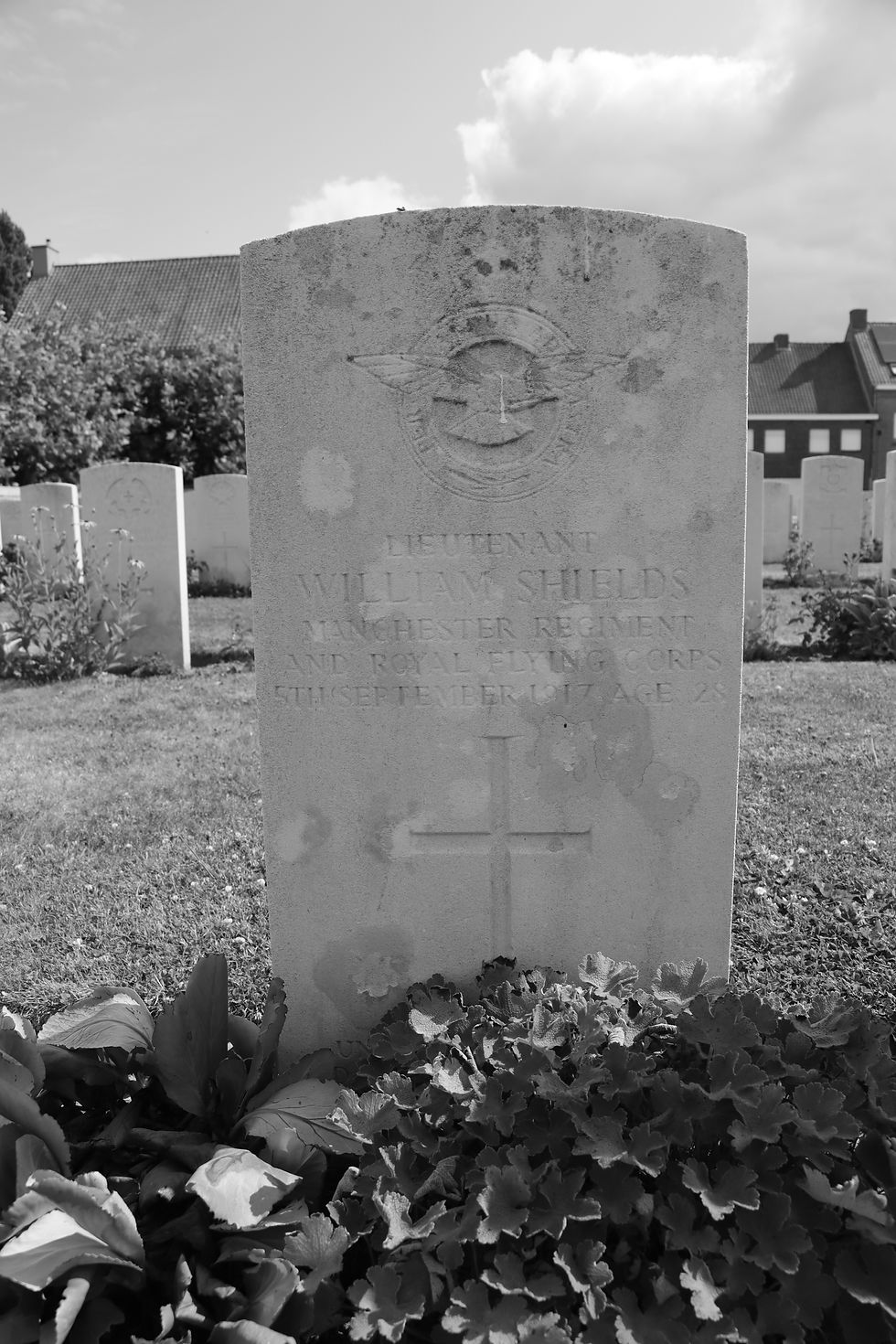
Lieutenant William Shields, 45th Squadron and 14th Battalion Manchester Regiment. Killed in action 5 September 1917, age 28. Grave I.H.41. Son of Samuel and Sarah Shields, 33 Upper Frank Street, Belfast. His father was a servant and coachman. William was studying at Queens University, Belfast and enrolled in the Officer Training Corps on graduating he was employed as a National School Teacher and was in training at Skegoneil School in Belfast on the outbreak of war. He had enlisted as a Private in the North Irish Horse at Belfast on 18 February 1915 and immediately applied for a commission. He was gazetted Second Lieutenant on 21 March 1915 and was posted to the Manchester Regiment and was promoted to Lieutenant on 1 October 1915. He went to

Egypt in early 1916 and later returned to the UK and joined the 14th Battalion Manchester Regiment. On the 17 April 1917 he was attached to the Royal Flying Corps and underwent training as a pilot and was posted to 45 Squadron on 22 August 1917. On the 5 September 1917 he took off at 7.10am, as part of a squadron northern operational patrol, flying a Sopwith Camel (B3838) and was shot down in combat with aircraft from Jasta 4 with his aircraft crashing in No Man’s Land near Comines. His was one of two aircraft shot down that day in combat with Jasta 4. His body was recovered and buried here. A letter from his Squadron Commanding Officer to his father was featured in the Belfast News of 25 September 1917: ‘Your son was killed in aerial combat. Eye-witnesses whom I have questioned inform me that your son put up a most magnificent fight. It appears that he was fighting a Hun 'plane, and would have shot it down, when another German plane, which your son couldn't see, dived down on his tail. Your son was killed instantaneously, as his machine fell completely out of control in front of our lines. His body was recovered, and buried behind the lines with military honours.’ Three of William’s brothers also served in the war. Sergeant Samuel Shields of the 8th Battalion, Royal Irish Rifles, was awarded a Military Medal, and was

killed in action on the Somme on 2 July 1916. Private Neil Shields served in the 14th Battalion, Royal Irish Rifles, before joining the Tank Corps. Private Robert Shields served in the Royal Flying Corps. 42822 Private Louis Ellis Brook, 6th Squadron (Wireless) attached 218th Siege Battery, Royal Garrison Artillery. Killed in action 3 August 1917, age 25. Grave I.E.22. Son of Ernest and Annie Brook, of Batley, Yorks. He was married to Frances Mary Brook, of "Oakridge," West Park Street, Dewsbury, Yorks. He was the link between the artillery battery and the aircraft which were spotting and reporting via wireless on the effectiveness of the artillery barrage from the 218th Siege Battery. The Germans were also undertaking counter-battery observation with the 218th Siege Battery War Diary for 29 July 1917 noting that: ‘Hostile Artillery again active on the I.31.c & d square (this was a map reference). Aeroplane separately interrupted by

Hostile Observing planes patrolling in front of battery.’ On the 3 August the War Diary records: ‘Wireless station was hit by a 5.9’ How shell in the morning. Second Airman Brook was killed and 2nd Lt Richardson wounded (shell shock).’ 44354 Air Mechanic 2nd Class Alfred Edwin Winstone, 6th Squadron and 18th Siege Battery, Royal Garrison Artillery. Killed in action 20 August 1917, age 19. Grave I.G.8. Son of Ernest and Louisa Winstone, 68 Southmoor Road, Oxford. The Battery was in the vicinity of Vlamertinghe on the 20 August and were firing in support of the British attack known as the Battle of Langemarck. The War Diary makes no mention of casualties in the August entries, unlike July and September. It is likely that Alfred was a victim of counter-battery fire.

Royal Engineers – Two Officers of 227th Field Company, 39th Division Major Stewart Hugh Joseph, Three times Mentioned in Despatches, Commanding 227th Field Company, Killed in action 18 August 1917, age 23. Grave I.G.5. The only son of Henry Hope and the late Helen Christina Joseph, she died on 1901 when Stewart was age 3, 112 Belgrave Road, London. Stewart was born in Hong Kong, his father was a Manager with P&O and on the death of his wife they returned to England in 1901 and Stewart grew up in Paddington. He was gazetted from the Royal Military Academy at Woolwich in December 1912 and joined the Royal Engineers and went to France in August 1914 and was promoted to Major in June 1917. He was Mentioned in Despatches on 1 January 1916, 4 July 1917, and 11 December 1917. On the 18 August 1917 the Field Company was working

on the Pontoon Bridge known as Norfolk Bridge, located near to today’s Oak Dump Cemetery in The Bluff, and the War Diary records that: ‘Major S H Joseph O.C. 227th Field Company RE wounded in action admitted to hospital.’ At 7.30pm they record: ‘Information received from 134 Field Ambulance (Collecting Station) that Major S H Joseph RE had died of wounds received this day.’ On the August the War Diary records: ‘Major S H Joseph RE funeral took place at I31.C3.8 Belgium (today Voormezeele Enclosures No.1 & 2) CRE 7 Capt Meares RE attended funeral besides officers & ORs of the Coy.’
Lieutenant John Frederick Cullinan Fogerty, 227th Field Company, Killed in action 25 September 1917, age 21. Grave I.J.40. He was the eldest son Mr and Mrs Fogerty, Bank Place, Ennis and was educated at Galway Grammar School and the Royal Military Academy , Woolwich. He was gazetted

Second Lieutenant in October 1915 and went to France in July 1916. He was promoted to Lieutenant in September 1917. On the 25 September 1917 the War Diary records that the Company, sections 2 and 3 under the command of John and Second Lieutenant Beach, took parties to work on a strong point near Dumbarton Lakes near the Menin Road and on returning from this work John was killed by a stray shell and Second Lieutenant Beach was wounded.
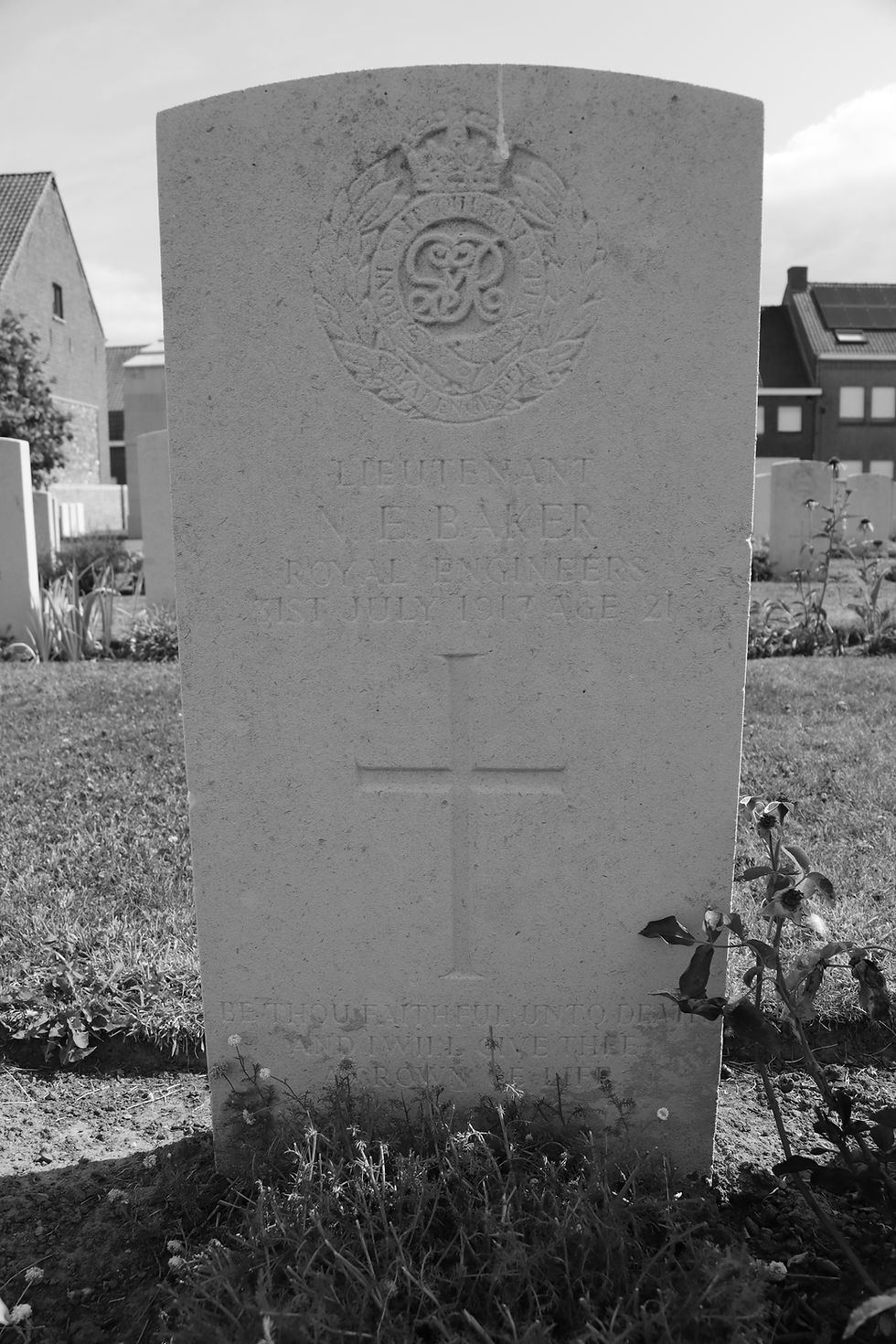
Lieutenant Neville Ernest Baker attached 2nd Tank Brigade. Killed in action 31 July 1917, age 21. Grave I.E.27. Son of Ernest Edward and Beatrice Baker, of The Glebe House, Weston-Super-Mare and they had two sons and two daughters, Neville was the youngest. His older brother, Captain Aubrey Halliwell Baker was killed in action in Mesopotamia on the 8th March 1916 while serving with the 4th (Territorial Force) Battalion, Somerset Light Infantry. Neville was educated at Clifton College and Trinity College, Oxford where he was a member of the Officer Training Corps. On the outbreak of war he enlisted in the Royal Engineers and was a Corporal Motor Cycle Despatch Rider when he was gazetted Second Lieutenant, Royal Engineers (Signals) in January 1915 and then Lieutenant and Brigade Signal Officer in 1915 and in 1917 was attached to the HQ 2nd Brigade Tank Corps. On the 31 July the 2nd Tank Brigade composed of ‘A’ and ‘B’ Battalions and allotted to II Corps took part in the opening day of the Third Battle of Ypres and they attacked at Hooge with the objective of taking the Broodseinde Ridge. The War Diary of the 2nd Tank Brigade described the ground they encountered: ‘In bad weather, on ground rendered almost hopeless by shelling and rain, against an enemy with good observation and fully warned of the attack, the marvel is that so many Tanks ever reached the German trenches…. The amount of shattered woodland in the area of the attack left only three avenues of approach up which Tanks could come, and one of these, the Hooge gap came in for very heavy shelling all the time…The attack itself for various reasons was not a great success. Tanks ditched again and again, a large number received direct hits and those that did struggle on were able to make little headway. The 2nd Brigade objective [sic] were roughly on a line from Shrewsbury Forest through Inverness Copse and Glencorse Wood to Westhoek. The route round north of Bellewaarde Lake proved very bad going and the southern routes came in for very heavy shelling. To quote a contemporary report, “a good deal of very gallant work was carried on under exceptionally adverse circumstances”, casualties amounted to 24 killed and 180 wounded.’ Lieutenant Neville Baker was hit by shell fire and died of his wounds. The 2nd Tank Brigade had five officers killed on 31 July with three buried in Hooge Crater Cemetery and one at Birr Crossroads Cemetery.

Lieutenant Joseph Patrick Coghlan M.C., 228th Field Company, 41st Division. Killed in action 20 September 1917, age 27. Grave I.K.2. Son of Denis and Louisa Coghlan, 15 Waltham Terrace, Blackrock, Co. Dublin. Joseph was educated at Blackrock College and University College Dublin where he graduated with an Honours degree. He joined the Royal Military Academy, Woolwich and then the Royal Engineers School at Chatham and went to France in September 1916. He was awarded the Military Cross in July 1917 for gallantry when constructing defensive wire fencing in the build up to the Battle of Third Ypres. The Official Citation read: "For conspicuous gallantry and devotion to duty. He showed great determination and resource in constructing a fence under severe machine gun fire. By his personal example he successfully completed the work, which was of vital importance, under most difficult circumstances." On the 20 September the Company had gone forward with the attacking troops in the attack on Tower Hamlets Ridge Joseph

who was commanding No.4 section went forward with the 11th Battalion Royal West Kents in the second wave, carrying light bridging material for crossing the Bassevillebeek. The attacking troops were held up temporarily by ‘deadly machine gun fire’ about 250 yards in front of the British front line. It was at this point that Joseph was wounded and as he was being taken to the dressing station was wounded a second time and died.
Artillery
Second Lieutenant Vernon Page M.C., ‘D’ Battery, 315th Brigade, Royal Field Artillery. Killed in action 22 September 1917, age 32. Grave I.J. 31. Son of Edward H. and Kate E. Page, of "Ballynona," Sandown, Isle of Wight. He was educated at Farnham Grammar School. He was working

as a Stock Jobbers Clerk in Chancery Lane, London, when he enlisted in 1910 as a Shoeing Smith with the London Mounted Brigade, Ammunition Column, Honourable Artillery Company and was promoted from Gunner to Corporal in November 1915 when the Brigade was in Egypt. He was discharged from the HAC on the termination of his engagement on 11 December 1915 in London. He was gazetted as a Second Lieutenant on 16 June 1916 and joined the 315th Brigade. He was awarded the Military Cross in July 1917. During World War I, many standard Military Cross awards (especially those published in large honours lists) were announced with a short, universal formula rather than an individualized narrative description his citation reads: ‘For conspicuous gallantry and devotion to duty in the field.’ On the 20 September 1917 the Brigade was south of the Menin Road with Brigade HQ in Manor Farm near Zillebeke Lake to prepare for the Battle of the Broodseinde Ridge part of the Third Battle of Ypres. The Brigade was under constant counter-battery fire with casualties amongst both the men, the mules and horses and on the 22 September Vernon was wounded and subsequently died of his wounds.

Infantry
7th Battalion Seaforth Highlanders, 26th Infantry Brigade, 9th (Scottish) Division
Lieutenant John Gordon Douglas, Killed in action 12 April 1918, age 20. Grave I.L.59.
Eldest son of John Cameron Douglas and Susan Barwick Douglas, 19 Roxborough Street East, Toronto, Ontario. He was one of four brothers who enlisted William and James were serving as Gunners with the Canadian artillery, Kenneth enlisted in the 19th Battalion Canadian Infantry. John also enlisted in the 19th Battalion on the 10 November 1914 but was commissioned as a Second Lieutenant in the ‘Imperial’ forces in May 1916. He was wounded on 15 October 1916, shell shock. On the 12 April 1918 the Battalion was in the line at the Damm Strasse near St Eloi with the 11th Battalion Royal

Scots on their left at White Chateau Stables and Oak Support trench. The Seaforth Highlanders line was extended along the far side of he Damm Strasse with numerous strong points pushed up the rising ground in front into Ravine Wood, through Pheasant Wood and into Denys Wood with the HQ in Shelley Farm. On the 11 April at 8am the German attacked in strength trying to use the morning mist as cover and the Battalion opened fire into the enemy who were less that 150 yards from their positions casing heavy casualties. The Battalion counter-attacked and a line of posts under the command of John was established on the ground taken from the enemy however, the Germans had established a line along the crest of Ravine Wood and fighting continued throughout the day. On eh 12 April there was a lot of shooting on both sides and a heavy barrage fell on the Seaforths positions on the Damm Strasse and John was killed by this shell fire along with forty Other Ranks killed or wounded. 235083 Private David Anderson, Killed in action 12 April 1918, age Grave I.K.52. Died of wounds.

Rifle Brigade
Captain William Michael Victor Banbury, 16th Battalion formerly 4th Battalion, Killed in action 18 August 1917, age 32. Grave I.E.7. Son of Edward and Frances Mary Banbury, 60 Eaton Place, Eaton Square, London. Educated at Eton and was gazetted Second Lieutenant in the Norfolk Artillery (Militia) from 1903 to 1906 and was then commissioned in the Rifle Brigade and joined the 4th Battalion in Malta in 1906 serving with them in Egypt from 1906 to 1912. Promoted Lieutenant on 24 March 1910 and then resigned his commission on 23 November 1912 and went on the reserve of officers. On the outbreak of war he was promoted to Temporary Captain in the 11th (Service) Battalion and went to France with this Battalion in the summer of 1915. On the 15 August 1917 the Battalion moved to Hollebeke sector relieving the Royal West Surrey regiment and became the Battalion reserve. On the 17 August they moved to Battle Wood relieving the 17th Battalion King’s Royal Rifle Corps with the War Diary recording: ‘Casualties – Captain W.M Banbury killed in action. 4 other ranks killed in action. 17 other ranks wounded in action. 1 other rank wounded at duty. 1 other rank missing in action.’ He was killed by shell fire while assisting a Rifleman to cover during the phase of the Third Battle of Ypres known as the Battle of Langemarck.

Captain Elliot Krolik M.C. 16th Battalion, 117th Infantry Brigade, 39th Division. Killed in action 23 October 1917, age 22. Grave I.L.32. One of four sons of Gottfried Lippmann, a metal agent and diamond broker, and Rose Edith Krolik (nee Weil), 72 Finchley Road, London. Elliot was born in Hendon to a German father and Austrian mother. Elliot was awarded a posthumous M.C., for action on 21/21 September 1917 it is recorded in the War Diary on 31 October 1917, and gazetted on 5 April 1918 the citation read: ‘For conspicuous gallantry and devotion to duty. He showed splendid leadership and skill in leading his company in an attack. When the advance was in danger of being held up by unexpected resistance from an enemy strong point, with great courage and determination he captured it and led his company forward to their objective.’ The Battalion was in the Tower Hamlets sector south of the Menin Road with Battalion HQ in Canada Street Tunnels with the War Diary recording: ‘Capt. E Krolik killed in action.’
Boy Soldiers
In the Ypres Salient, we are drawn to the graves of 6322 Private John Condon, 2nd Battalion Royal Irish Regiment, killed in action in May 1915, age 14 and the youngest known battle casualty of the war, although this is now questioned, and the grave of 5750 Valentine Strudwick, 8th Rifle Brigade, killed in action in January 1916, age 15. Strudwicks grave attracts a great deal of attention because of its location at Essex Farm and that locations association with Lieutenant Colonel John McCrae and the poem ‘In Flanders Fields.’ There are many more ‘Boy Soldiers’ buried across the Salient and who are not remembered in the same way and these include three from Falkirk District Private William Jamieson, age 17, Private James Duchart, age 16, and Private Herbert Richmond, age 17. There were many reasons why under age boys enlisted in 1914 and 1915 boredom with their jobs, looking for adventure, and escaping family pressures. The checks on age and qualification to enlist were more relaxed than later in the war. The army preferred younger recruits, there was a history of boy soldiers in the army going back over one hundred years. At Waterloo the army had a number of boy soldiers in their ranks. The army preferred younger recruits as they would follow orders and accept discipline more readily than older men. The boys had a belief in their own indestructibility and were prepared to take more risks. We tend to also forget the number of boys who served in the Royal Navy and we do not seem to have the same passionate response to their service as we do those who fought on the Western Front. With regards to the army, the difference was the sheer number who served on the Western Front and there were more boy soldiers in 1915 than served in Wellington’s army at Waterloo. For further reading on this subject see Richard Van Emden’s excellent book Boy Soldiers of the Great War. There are three Boy Soldiers buried here. 4558 Private John Dalton, ‘C’ Company, 1st Battalion Royal Irish Regiment, 82nd Infantry Brigade, 27th Division. Killed in action 12 March 1915, age 17. Grave II.A.5. Son of John and Margaret Dalton, of Ballyrichard Road, Carrick-on-Suir, Co. Tipperary. The Battalion was in the line at St Eloi with casualties recorded as ‘4 killed and 11 Wounded of other ranks.’ 11650 Private Alexander Szize, 13th Battalion The Kings (Liverpool Regiment), 8th Infantry Brigade, 3rd Division. Killed in action 27 March 1916, age 17. Grave I.D.19. Son of John and Mary Szize, 16 Jasper Street, Chatham Street, Liverpool. On the 27 March 1916 the Battalion relieved the 1st Battalion Northumberland Fusiliers at St Eloi. The War Diary makes no mention of casualties. Z/1744 Rifleman Donald Ernest John Churchyard, 4th Battalion Rifle Brigade, 80th Infantry Brigade, 27th Division. Killed in action 20 March 1915, age 17. Grave II.D.10. Son of Harry and Kate Churchyard 78 Military Road, Colchester. His epitaph: REMEMBRANCE. He was originally buried in Enclosure No.4 and reburied here in September 1920. The Battalion was in the line at St Eloi with the War Diary recording: ‘Casualties 1 killed and 2 wounded.’
The cemetery was designed by Sir Edwin Lutyens.
Cemetery Location
Voormezeele Enclosures Nos.1 and 2 are located 4 Kms south-west of Ieper town centre, on the Voormezeele Dorp, a street in the village of Voormezeele. From Ieper town centre the Kemmelseweg is reached via the Rijselsestraat, through the Lille Gate (Rijselpoort), and straight on towards Armentieres (N365). 900 metres after the crossroads is the right hand turning onto the Kemmelseweg (made prominent by a railway level crossing). Turn right onto the Kemmelseweg and follow this road to the first crossroads, turn left here into Ruusschaartstraat. The cemetery is located 1 Km after this junction on the right hand side of the road just in Voormezeele Dorp.

Burials
There are now 593 Commonwealth servicemen of the First World War buried or commemorated in this cemetery. Forty of the burials are unidentified and 14 graves destroyed by shell fire are represented by special memorials. Other special memorials record the names of two casualties buried in Enclosure No.4 whose graves were also destroyed. The cemetery also contains 6 German war graves.
UK – 502
Australian – 17
New Zealand – 2
Canadian – 53
German – 6
Unnamed - 43


Comments