


James Maxwell - Link to Bo'ness
16816 Private, 2nd Battalion King’s Own Scottish Borderers, 13th Infantry Brigade, 5th Division.
Age: 21
Date of death: 5.5.15
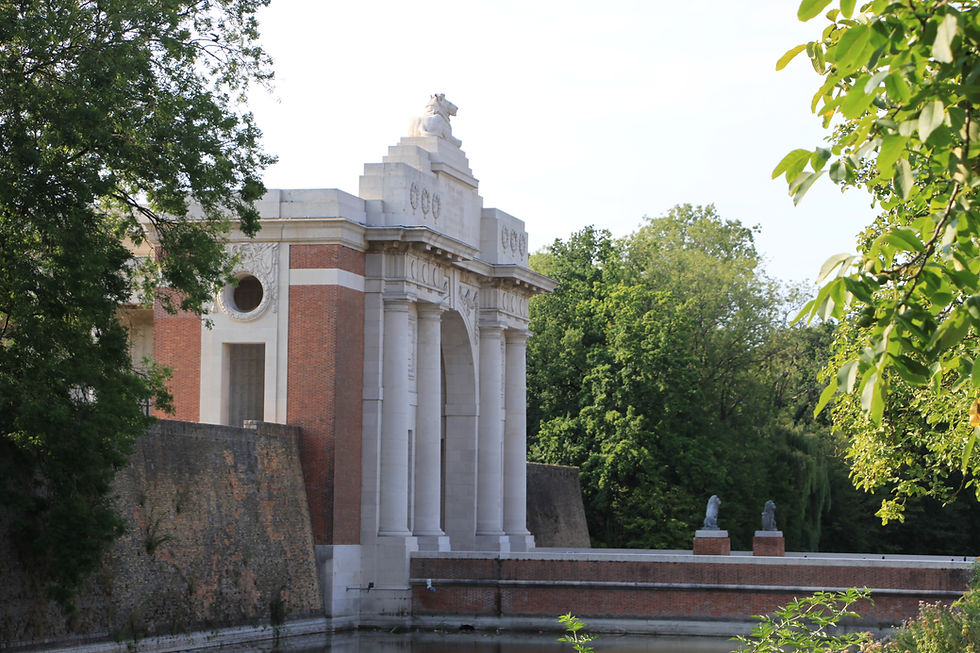
Buried: Menin Gate Memorial Panel 22
Family history: Youngest son of John and Margaret Maxwell, formerly of 109 Furnace Row, Bo'ness. They also had two other sons and three daughters and the family moved to Lochore, Fife in 1912. James married Mary in October 1914 and they lived with their son John, born on 10 December 1914, at 18 Peveril Place, Lochore. Mary remarried William Murphy a miner on 17 July 1916. James was employed as a miner when he enlisted in Cowdenbeath in November 1914.
Action leading to his death
Hill 60 was 60 metres high and had been created from the spoil when creating the Ypres to Comines railway. Given the flat nature of Flanders any high ground was strategically important. Hill 60 gave dominating views over the British lines and into Ypres itself.
Hill 60 was fought over for four years and was the scene of some of the most desperate fighting as well as mining by both sides. The British detonating two mines here on 7 June 1917.

At 8.45am on the 5 May 1915 the Germans released chlorine gas opposite the British line on the crest of Hill 60 being held by the 2nd Duke of Wellingtons, attached to 13th Brigade. Lieutenant C.W.G. Ince wrote: ‘We had not received gas masks yet, only a piece of gauze soaked in a preparation prepared by the medical authorities. The solution after a few minutes required renewing, a procedure absolutely impossible, of course, in action. On came the terrible stream of death, and before anything could be done, all those occupying the front line over which it swept were completely overcome, the majority dying at their posts – true heroes.’ The Battalion went into the line the day before with 500 men and only 150 answered the roll call.

There was now a gap in the British front line, the support trenches having held, as the gas had drifted along the front line rather than penetrated through it. The British moved troops forward to support however, it did not prevent the crest of Hill 60 falling into German hands. At 9pm 13th Brigade arrived with three Battalions one of which was the 2nd Battalion KOSB and with orders from 5th Division to counterattack and recapture Hill 60. The 2nd Battalion KOSB was ordered to attack Hill 60 itself with two companies and holding two companies in reserve for consolidation. The 1st Royal West Kents were to attack on the left with the aim of taking the trenches on the north of the hill with the attack planned for 10pm and at 9.40pm a short twenty minute barrage was opened on the German positions and this simply alerted the Germans that an attack was imminent and add to this that both Battalions

would be attacking over an already scarred battle field. The official history of 2nd KOSB records: ‘C’s attack was crushed instantaneously by heavy fire. D reached their objective, but were exposed to enfilade fire from the Caterpillar, and were also bombed from close range. Both companies had to retire and occupy the trenches from which they started.’ The attack was also witnessed by Lieutenant A. Greig of the 1st Cheshires from his position in Trench 40 and he provides a graphic account: ‘At the allotted time they climbed over the parapet. The order was to go half right. They were met with a storm of rifle and machine gun fire from the hill. Our artillery had not yet stopped and soon theirs started. The poor Scots were simply blown back with lead. They started again and went half left. Their wounded were pouring into my trenches. The sounds were terrible, men shrieking, the fierce cackle of machine gun fire and the cruel shriek of the shrapnel. This was battle. When the next volley of star lights went up there were noticeably more bodies in no man’s land. Wounded and belated Jocks were still returning, some helping other wounded back or bringing back the body of some comrade. The shattered remains of a fine regiment all found their way back to my already overcrowded trench and its continuation to the right.’ The KOSB casualties were 130 dead wounded and missing and they had achieved nothing. The Royal West Kents also made no progress. James’s body was lost and he is his listed on the Menin Gate Memorial to the Missing.


Comments