


Alexander Wardrope Mathieson - Link to Falkirk
Updated: Dec 23, 2025
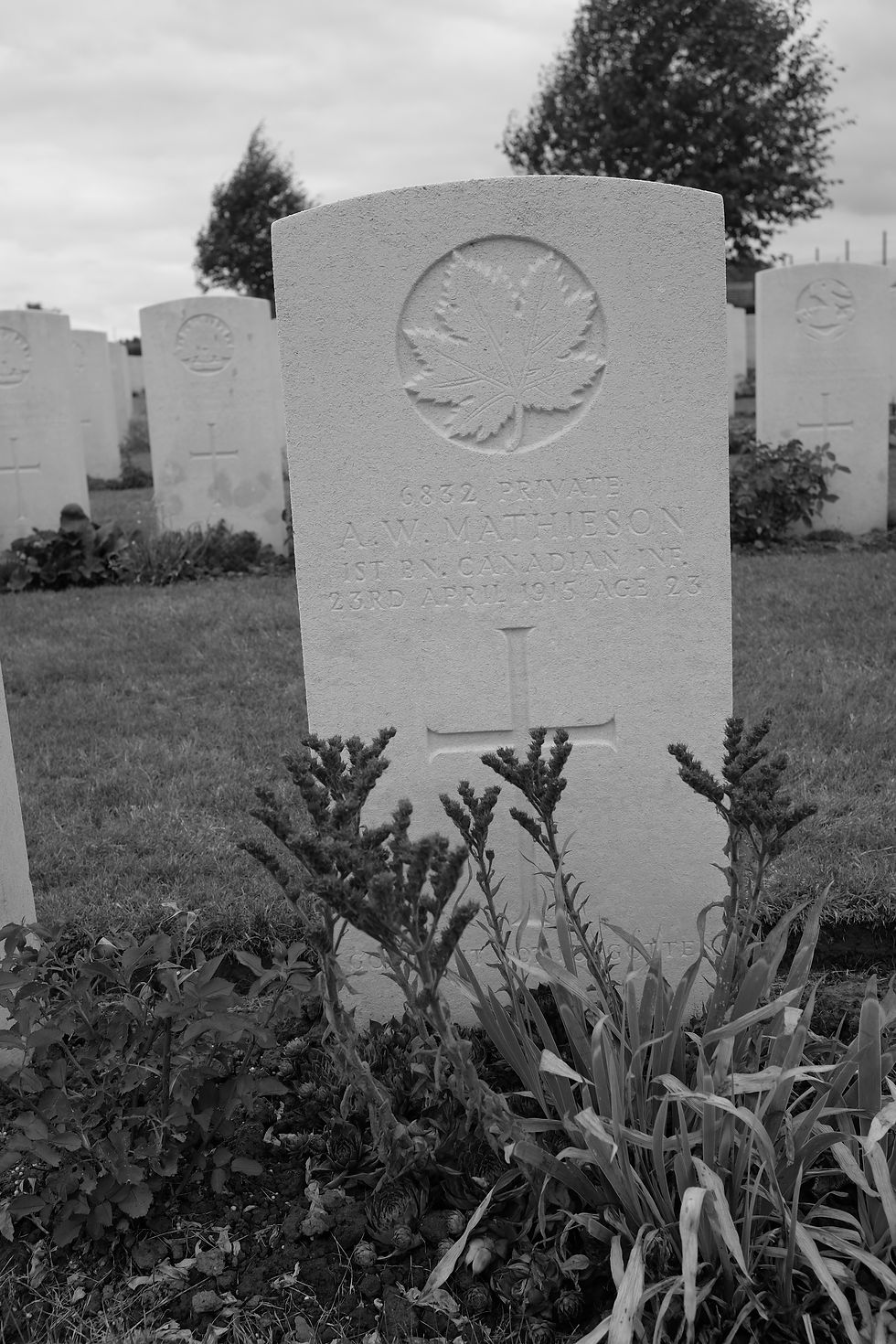
6832 Private, 1st Battalion (Ontario Regiment), 1st Canadian Infantry Brigade, 1st Canadian Division.
Age: 23
Date of death: 23.4.15
Family history: Son of John and Margaret Mathieson of Bracebridge, Ontario. Born in Falkirk. Alexander was unmarried and listed his trade as a Moulder when he enlisted at Valcartier Camp, Quebec on 24 September 1914, in the 23rd Regiment, Northern Pioneers and was then taken on the strength of the 1st Battalion when they sailed for England in October 1914. This Battalion was formed on 2 September 1914, at Valcartier Camp, Quebec, and drew the recruits from Military District 1 (Western Ontario). The Battalion sailed to England on 3 October and arrived on 14 October with a Battalion strength of 45 Officers and 1121 Other Ranks and were deployed to France in February 1915.
Action leading to his death
The Battalion was involved in the Second Battle of Ypres which began on 22 April 1915 with the Germans using poison gas for the first time of the Western front. Learn more about Gas and Chemical Warfare They released the gas between Langemarck and Gravenstafel with this sector of the line being held by French troops of the 87th Territorial Division and of the 45th Infantry Division. The French sustained 3,000 casualties of which 1,400 were dead and the line was broken with a gap of 3.7 miles left undefended. Into this gap the British rushed troops from the 27th and 28th Division and the Canadian troops ant the southern end of the break-in taking the brunt of the German assault. On the 23 April the 1st and 4th Canadian Battalions were involved in supporting a French counterattack towards Pilckem with the aim of retaking the lost ground of 22 April and had taken up positions east of the Yser canal with their left flank resting on the Ypres-Pilckem Road. To their right was a composite British force known as ‘Geddes Force’ and was commanded by Colonel John G Geddes and it was to participate in the counterattack by supporting the Canadian attack. This force had been hurriedly put together primarily from reserve British Battalions and was instrumental in closing the gap in the line following the German gas attack on 22 April. Geddes was to be killed on 28 April 1915 when a German shell hit his HQ at Potijze.


The French attack was timed to begin at 5am. The Canadians had 45 minutes to prepare for this attack and assemble slightly behind Hill Top Ridge with 4th Battalion deployed in four lines along a 200 yard front and No.2 and No.4 Companies of the 1st Battalion were to follow in two lines behind with the remaining two companies held in reserve. The first objective was Mauser Ridge, a low hill some 1500 yards beyond, and close to the top of this gently sloping rise was a farm named on British maps as Turco Farm. Meanwhile, the Germans had a clear view of the approach and were busy digging in and preparing barbed wire entanglements. At 5.25am the Canadians mistook French movement on his left and gave the order to advance, the French attack never actually went ahead in any meaningful form, and the Canadians attacked up Mauser Ridge on their own and with very little artillery support. The 4th Battalion reached half-way with light casualties as the Germans were holding their fire and as the Canadian Battalions got to within 600 yards of the German line they opened fire with intense rifle and machine gun fire as well as artillery fire. The Canadians were still going forward but sustaining heavy casualties and No.1 Company of 1st Battalion attempted to contact the French on their left but their runners were all killed. The reserve Companies of the 1st Battalion joined the action together with the Middlesex Regiment from Geddes Force and they drove the Germans from Turco Farm and this was the high water mark of the advance and they had to abandon the Farm as their own gunners were shelling them. The 1st and 4th Battalions were now unable to retreat across the fire swept ground and dug in. the attack of the Canadians and Geddes Force had deterred the Germans from pressing home their advantage from the 22 April.
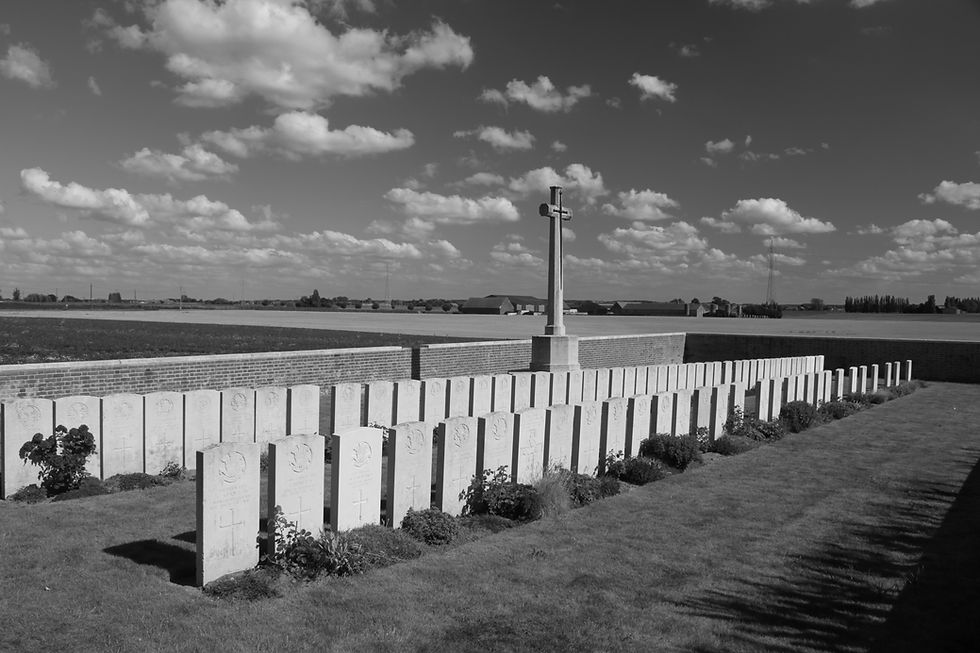
Alexander was originally buried in Brielen Military Cemetery which was on the outskirts of the village of Brielen and his body was exhumed and reburied at Hagle Dump Cemetery along with three other Canadians and twenty other men after the Armistice.

The St Julien Memorial – The Brooding Soldier
The St. Julien Memorial, also known as The Brooding Soldier, is a Canadian war memorial and small commemorative park located in the village of Saint-Julien, Sint-Juliaan. The memorial commemorates the Canadian First Division's participation in the Second Battle of Ypres which included fighting in the face of the first poison gas attacks along the Western Front. The memorial was designed by World War I veteran and architect Lieutenant Frederick Chapman Clemesha, and was selected following a design competition organized by the Canadian Battlefields Memorials Commission in 1920. The memorial is found on the northern fringe of the village of Saint Julien at the intersection of the N313 road and Zonnebekestraat. During the war, the location where the memorial is located was known as Vancouver Corner. Visible for miles around, the memorial stands 11 metres tall.


Comments