


Alexander Hugh McLachlan - Link to Falkirk
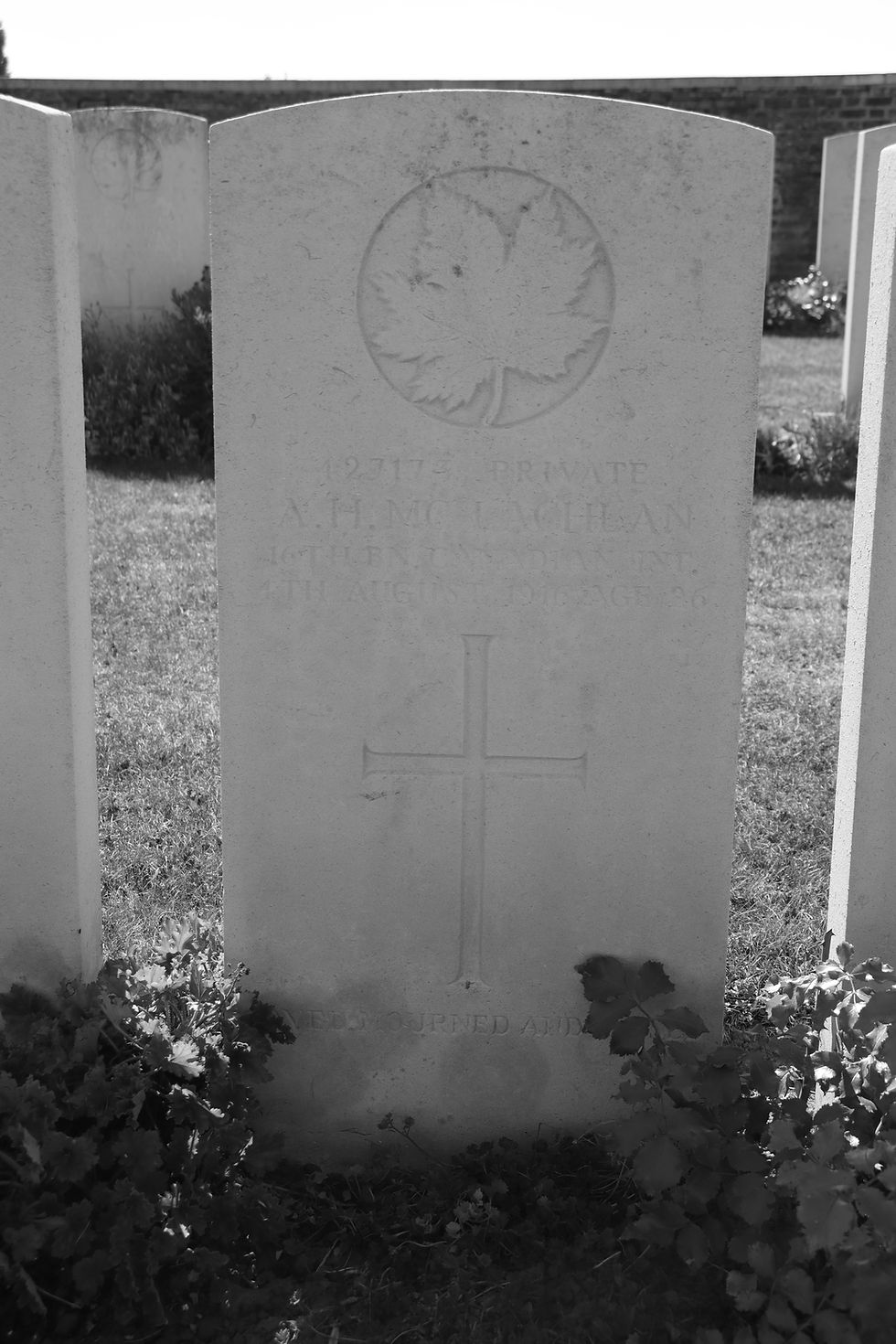
427173 Private, 16th Battalion (Canadian Scottish), 3rd Canadian Brigade, 1st Canadian Division.
Age: 26
Date of death: 4.8.16
Buried: Larch Wood (Railway Cutting) Cemetery. Grave IV.G.10
Family history: Husband of Ellen McLachlan, 154 Barnsbury Road, Islington, London. He listed his trade as Farmer when he enlisted on the 8 May 1915 in Moose Jaw, Saskatchewan. He also listed his next of kin as his aunt Mrs George Matchett, Trehern, Manitoba, he later changed this when he married Ellen. His wife received his medals following his death. He initially joined the 46th Battalion and he sailed from Halifax on 21 October 1915 and landed in Devonport on 30 October and was then at Bramshott Camp, this Camp was near Aldershot established in 1915 on the heathland between Bramshott and Liphook and it was established to relieve the space limitations at Shorncliffe. He was posted overseas on 17 June 1916 and joined the 16th Battalion in France and he undertook a training course and qualified as an ‘Entrenching Grenade’, he could handle and throw grenades known as a 'bomber'.

Action leading to his death
The Battalion moved to Hill 60 on 16 July 1916 and spent seven weeks in this sector and at Mount Sorrell. On the 3 August 1916, the Battalion was in the line in trenches 39 to 44, the trenches at Hill 60 being little more than fifty yards apart. The Canadians had decided to do something about the German saps that had been threatening British mining activity, and an operation was planned to remove the saps without damaging the British mine networks. Learn more about Cratering the Ridge and mining at Hill 60. The plan was to place two small camouflets, small mine charges, which explode downwards at a shallow depth and it was expected that two craters would be formed partly in the German lines and partly in No Man’s Land. However, the ground conditions were hard to predict and any miscalculation could cause the Canadians as many problems as the Germans. And so it proved to be. The charges were to be blown under the German lines, so it was thought, at 10pm on 3 August and the 16th Battalion would occupy and consolidate the craters and this included ten bombers, with a further ten in reserve, with a digging party of twenty men, six men with sandbags, with ten in reserve, a wiring party, and a party to hold the enemy trench in front of trenches 39 and 40. The charge was blown at 10pm however, it blew back wrecking the Canadian trenches and partially burying the bombing party and some were crushed to death. When the remnants of the bombing party rushed forward to secure the flanks of the crater on the enemy side, that they had expected to be in what had been the German trench, instead found themselves confronted by an intact trench, the mine having been blown short, and it was now a case of holding off German counter-attacks until the British side of the crater could be consolidated.

An Experience of Hill 60 and Larch Wood
Canon Frederick George Scott, Senior Chaplain to the Canadian 1st Division, wrote of his experiences of Hill 60 and Larch Wood in his memoirs ‘The Great War As I Saw It’ published after the War: ‘At the front, we held Hill 60 and the trenches to the south of it. In a railway embankment, a series of dugouts furnished the Brigade that was in the line with comfortable billets. The Brigadier’s abode had a fire-place in it. One of the dugouts was used as a morgue, in which bodies were kept till they could be buried. A man told me that one night when he had come down from the line very late, he found a dugout full of men wrapped in their blankets, everyone apparently asleep. Without more ado, he crawled in amongst them and slept soundly till morning. When he awoke, he found to his horror that he had slept all night among the dead men in the morgue.’


Comments