


Suffolk Cemetery
- Admin
- Sep 5, 2025
- 5 min read
Updated: Oct 7, 2025

This CWGC cemetery was begun in March and April 1915 by the 2nd Battalion Suffolk Regiment, 8th Infantry Brigade, 3rd Division. Apart from one burial made in November 1917, the cemetery was not used again until October 1918 when the 38th Labour Group buried twenty-eight men killed during the German advance the previous April, all but two of whom belonged to the 1st/4th and 1st/5th York and Lancasters. At this time, the cemetery was called Cheapside Cemetery after the nearby road.
Suffolk Regiment – 2nd Battalion, 8th Infantry Brigade, 3rd Division.
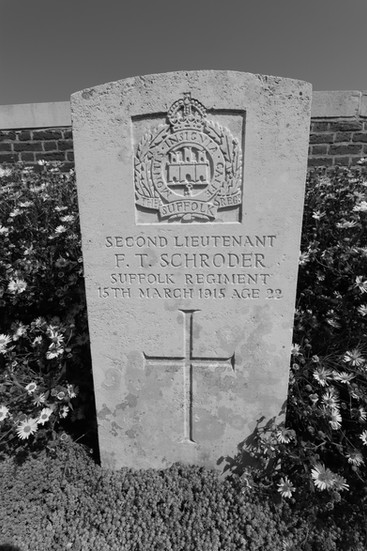
There are eighteen men from the 2nd Battalion Suffolks buried here. I have selected three men killed in March 1915. Second Lieutenant Francis Thomas Schroder. Killed in action 15 March 1915, age 22. Grave B.6. Son of Henry and Minnie Schroder, Hackney, London. One of the first casualties from the Suffolks to be buried here. Educated at the Royal Hospital School at Holbrook he was serving as a Sergeant in the Grenadier Guards when he received his commission and joined the 2nd Battalion in early 1915 in the Salient. The Battalion was in the line in front of Wytschaete. The CWGC records show that he was killed on 15 March this is based on the Graves Registration Report Form however, the Battalion War Diary for 24 March records that’ 2Lt F T Schroder killed, 10 men wounded. A rifle grenade landed in L5 doing most of the damage.’ 3/10240 Sergeant Thomas Rush. Killed in action 20 March 1915, age 40. Grave B.8. Husband of Anna Elizabeth Rush, 33 Trevor Road, Wimbledon, London. The Battalion was in the line at Petit Bois the War Diary records on the 20 March: ‘Sgt T Rush 10240 – Pte H Tricker 15236 killed one man wounded.’ Private Henry Thomas Tricker is buried in Grave B.7. 12816 Private David George William Page. Killed in action 29 March, age 31. Grave B.5. Son of David and Sarah Ann Page, Sheppard's Lane, Holbrook, Ipswich. He was working as a Farm Labourer when he enlisted and landed in France on 27 December 1914 and joined the 2nd Battalion. On the 29 March the Battalion was in the line in front of Wytschaete. The War Diary recorded: ‘Pt H Page 12186 killed 8 men wounded.’



Yorks and Lancaster Regiment - 1/5th (T.F.) Battalion, 148th Infantry Brigade, 49th Division. There are twenty five men from the Yorks and Lancaster Regiment buried here in April 1918. I have selected three men killed in action on 26 April. Second Lieutenant Edward Ambler. Age 19. Grave C.10. Son of Ellen Ambler, 25 Rosslyn Terrace, Chester Road, Sunderland, and the late Levi Ambler. He was educated at Bede Collegiate School, Sunderland. He enlisted as a Private in June 1915 when age 17 in the Durham Light Infantry and reached the rank of Sergeant before he was commissioned on 29 January 1918. He went to France on 14 April 1918. At 1am on the 26 April the Battalion had a strength of 280 men and moved to the trench line north west of Cheapside Road. On their left were the 1/4th Battalion and on their right a composite force of the 9th King’s Own Yorkshire Light Infantry and the 15th Durham Light Infantry. They advanced at 4.25am to reach to the line Vierstraat to Kemmel Road. At 6.25am they had to withdraw to the original start line owing to the strength of the Germans and the weak artillery support they received. The War Diary records that the casualties were ‘Killed 2 off 8 OR, Missing 5, Wounded 3 Off 57 OR.’ 37926 Private William Beatson. Age 29. Grave C.9. 241298 Corporal William Tingle. He was the eldest of five sons and four daughters of Richard and Mary Ellen Tingle. He married Gertrude in the spring of 1912 and they lived at 12 Moss Square, Worsborough Common, Barnsley with their three children. The 1911 Census lists him as single and employed as a Colliers Labourer Underground. He went to France on 19 August 1915. His brother Harold, age 19, was killed in action on the Somme on 1 July 1916.


5922 Private William Scotton, 4th Battalion Middlesex Regiment, 8th Brigade, 3rd Division. Age 19. Son of Mrs Catherine Scotton, 52 Gladstone Road, Walton, Liverpool. His brother, Albert also fell. He was convicted at the end of December 1914 of going absent and on 23 January he went absent again as his battalion was warned for the front line. He surrendered the next day when his battalion came out of the line. He was executed, in Vierstraat, by a firing squad of eight men and an NCO from his own battalion with the whole battalion paraded to watch the execution. He was buried near Suffolk Cemetery however, his grave was lost and he is commemorated on the Menin Gate Panel 49 and 51.
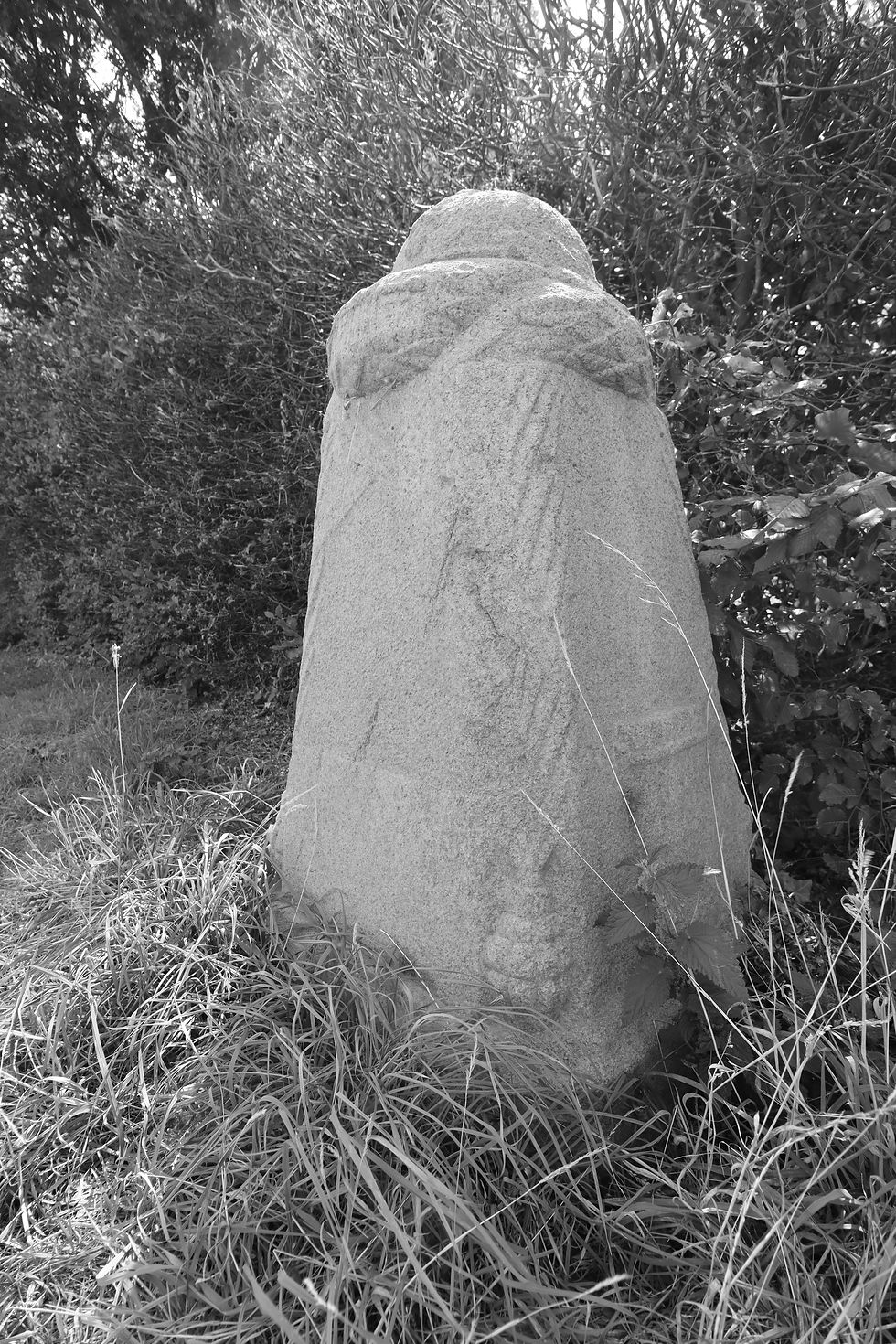
Demarcation Stone
At the cross roads leading to Cheapside Road is a demarcation stone. The Demarcation Stones are a series of sculpted stone monuments to be found along the battle line of the Western Front in Belgium and France. In Belgium the stones are called “Demarcatiepalen”. There were originally 22 in Belgium with 16 funded by the Touring Club de Belgique and 6 by the Ypres League however, three were destroyed during WWII. Each monument is one metre high. On top there is a laurel wreath and a Belgian, British or French helmet depending on the Allied troops which had been holding the sector where it was located. On the left and right sides of the monument there are two pieces of equipment used by the fighting soldier in the form of a carved water bottle and a case for a gas mask. A grenade and flame bursting out of it is carved on each of the four corners. On the monument there is usually an inscription 'Ici fut repoussé l'envahisseur', which translates as 'From here the invader was pushed back'.
Location
Suffolk Cemetery is located 6 Km south west of Ieper town centre, on the Kriekstraat, a road leading from the Kemmelseweg. (Joining Ieper to Kemmel N331). From Ieper town centre the Kemmelseweg is reached via the Rijselsestraat, through the Lille Gate (Rijselpoort), and straight on towards Armentieres (N365). 900 m after the crossroads is the right hand turning onto the Kemmelseweg. (Made prominent by a railway level crossing). 5 Km along the Kemmelseweg lies the right hand turning onto Vierstraat. 800 metres along the Vierstraat is the left hand turning onto the Kriekstraat; the cemetery is located 50 metres further on the right hand side of the road.
The cemetery was designed by J.R. Truelove
Burials
Suffolk Cemetery contains 47 First World War burials, eight of them unidentified.
UK – 47
Unidentified - 8


Comments