


British Airmen-Voormezeele Enclosures No.1 and No.2

The Voormezeele Enclosures No.1 & No.2 (at one time, there were a total of four, but now reduced to three with Voormezeele Enclosure No.3 Cemetery, the largest of these burial grounds located 100 yards along the road) were originally regimental groups of graves, begun very early in the First World War and gradually increased until the village and the cemeteries were captured by the Germans after very heavy fighting on 29 April 1918. Voormezeele Enclosure No.1 and No.2 are now treated as a single cemetery. Enclosure No.1 is the larger and furthest from the road. Plot I was begun by the 28th Division in March 1915 and carried on by the 17th, 3rd and other Divisions (and later by the Artillery) until April 1918. A few graves in Row N were added by the Germans, and a few more by Commonwealth forces in September and October 1918. One grave was brought into Row F after the Armistice from a position in the village. Enclosure No.2, now Plot II, was begun in March 1915 and used until April 1917. After the Armistice, 42 graves from Enclosure No.4 were brought into Rows B, C and D. Enclosure No.4 was behind a brewery a little south of Nos.1 and 2. It was begun by the French 3rd Regiment of Zouaves in December 1914 and used by the 4th Rifle Brigade, 80th Brigade, 27th Division, and other Commonwealth units from January to November 1915.
Royal Flying Corps
There are three men from the RFC buried here.
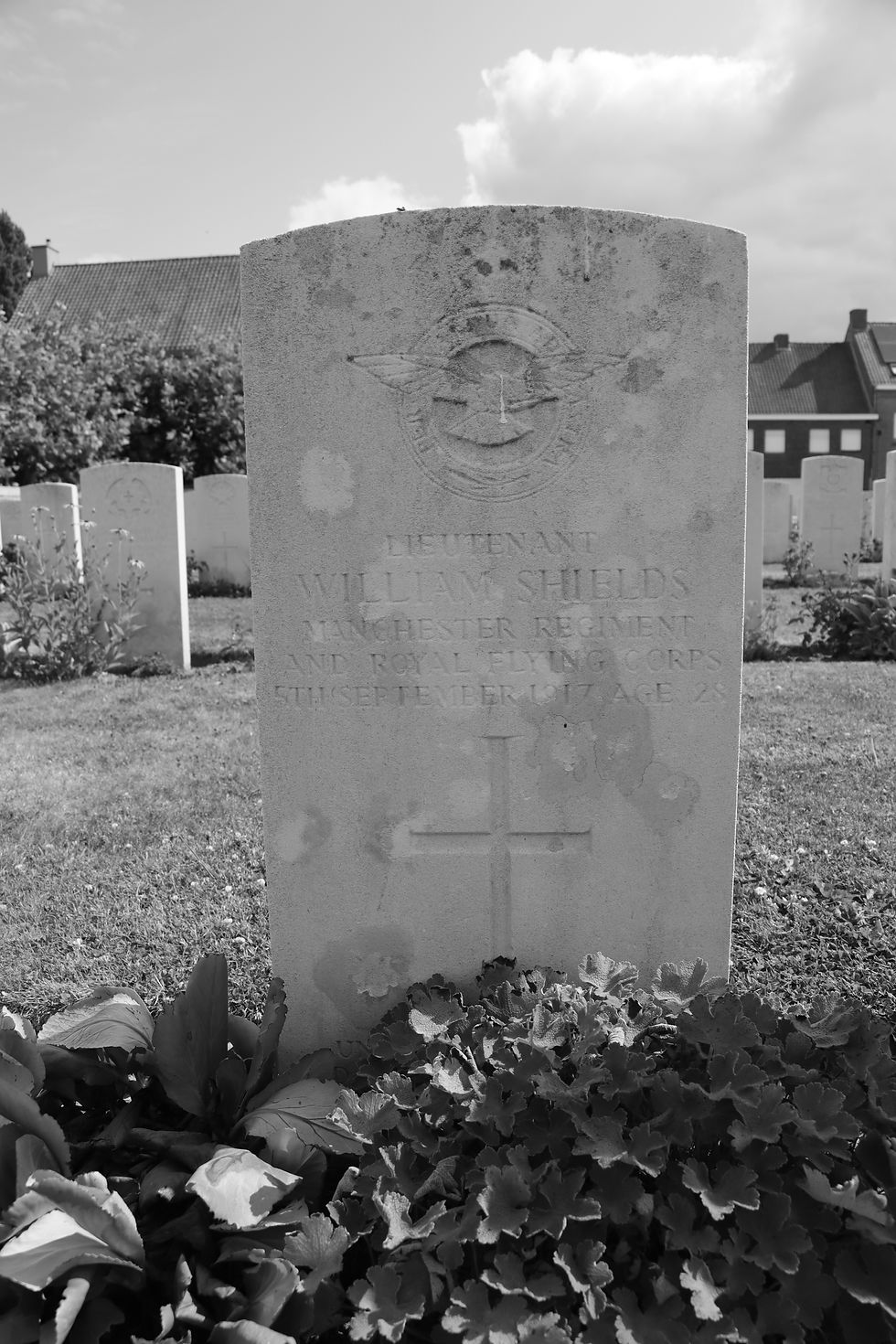
Lieutenant William Shields, 45th Squadron and 14th Battalion Manchester Regiment. Killed in action 5 September 1917, age 28. Grave I.H.41. Son of Samuel and Sarah Shields, 33 Upper Frank Street, Belfast. His father was a servant and coachman. William was studying at Queens University, Belfast and enrolled in the Officer Training Corps on graduating he was employed as a National School Teacher and was in training at Skegoneil School in Belfast on the outbreak of war. He had enlisted as a Private in the North Irish Horse at Belfast on 18 February 1915 and immediately applied for a commission. He was gazetted Second Lieutenant on 21 March 1915 and was posted to the Manchester Regiment and was promoted to Lieutenant on 1 October 1915. He went to Egypt in early 1916 and later returned to the UK and joined the 14th Battalion Manchester Regiment. On the 17 April 1917 he was attached to the Royal Flying Corps and underwent training as a pilot and was posted to 45 Squadron on 22 August 1917. On the 5 September 1917 he took off at 7.10am, as part of a squadron northern operational patrol, flying a Sopwith

Camel (B3838) and was shot down in combat with aircraft from Jasta 4 with his aircraft crashing in No Man’s Land near Comines. His was one of two aircraft shot down that day in combat with Jasta 4. His body was recovered and buried here. A letter from his Squadron Commanding Officer to his father was featured in the Belfast News of 25 September 1917: ‘Your son was killed in aerial combat. Eye-witnesses whom I have questioned inform me that your son put up a most magnificent fight. It appears that he was fighting a Hun 'plane, and would have shot it down, when another German plane, which your son couldn't see, dived down on his tail. Your son was killed instantaneously, as his machine fell completely out of control in front of our lines. His body was recovered, and buried behind the lines with military honours.’ Three of William’s brothers also served in the war. Sergeant Samuel Shields of the 8th Battalion, Royal Irish Rifles, was awarded a Military Medal, and was killed in action on the Somme on 2 July 1916. Private Neil Shields served in the 14th Battalion, Royal Irish Rifles, before joining the Tank Corps. Private Robert Shields served in the Royal Flying Corps.

42822 Private Louis Ellis Brook, 6th Squadron (Wireless) attached 218th Siege Battery, Royal Garrison Artillery. Killed in action 3 August 1917, age 25. Grave I.E.22. Son of Ernest and Annie Brook, of Batley, Yorks. He was married to Frances Mary Brook, of "Oakridge," West Park Street, Dewsbury, Yorks. He was the link between the artillery battery and the aircraft which were spotting and reporting via wireless on the effectiveness of the artillery barrage from the 218th Siege Battery. The Germans were also undertaking counter-battery observation with the 218th Siege Battery War Diary for 29 July 1917 noting that: ‘Hostile Artillery again active on the I.31.c & d square (this was a map reference). Aeroplane separately interrupted by Hostile Observing planes patrolling in front of battery.’ On the 3 August the War Diary records: ‘Wireless station was hit by a 5.9’ How shell in the morning. Second Airman Brook was killed and 2nd Lt Richardson wounded (shell shock).’

44354 Air Mechanic 2nd Class Alfred Edwin Winstone, 6th Squadron and 18th Siege Battery, Royal Garrison Artillery. Killed in action 20 August 1917, age 19. Grave I.G.8. Son of Ernest and Louisa Winstone, 68 Southmoor Road, Oxford. The Battery was in the vicinity of Vlamertinghe on the 20 August and were firing in support of the British attack known as the Battle of Langemarck. The War Diary makes no mention of casualties in the August entries, unlike July and September. It is likely that Alfred was a victim of counter-battery fire.


Comments