


Boesinghe-A Walk Along Huddleston Road, Ypres
Updated: Jan 16
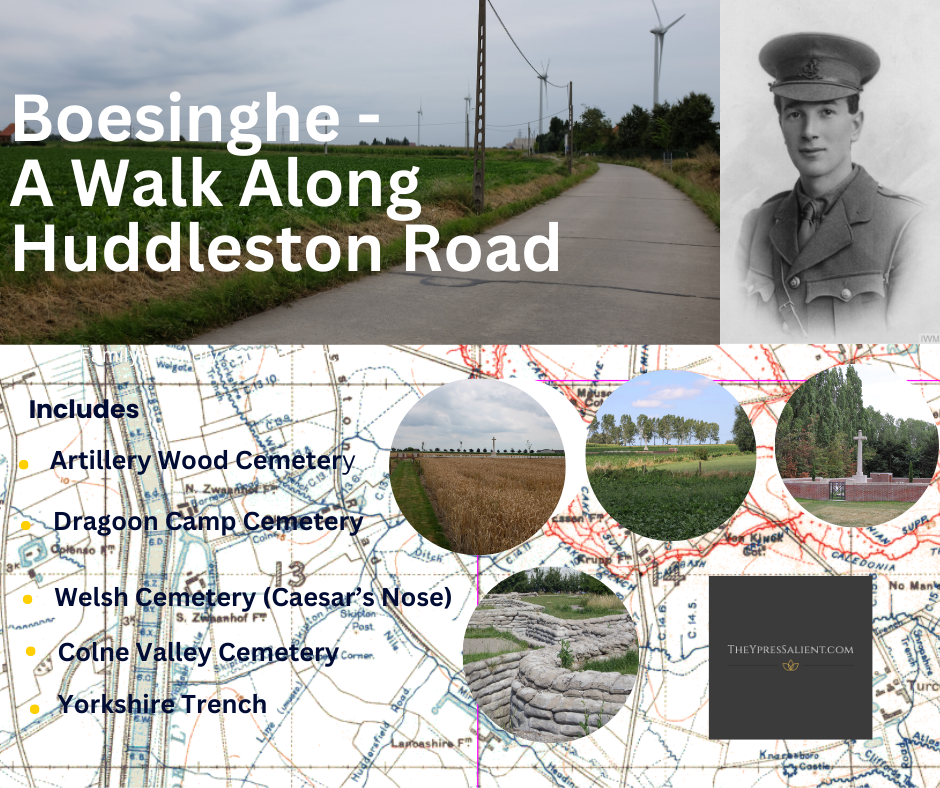
This WW1 Tour is a rewarding walking tour of Ieper (Ypres) battlefields and it is designed for free independent enthusiasts of the Ieper (Ypres Salient) who like to explore and are not interested in being led to the usual suspects of an organised tour. The sector around Boesinghe and Huddleston Road is one of the important areas of the Ypres Salient to explore, often dismissed by visitors as having little significance due to the industrial units obliterating all the battlefield views. I have spent many hours and days over the years wandering with my trench maps, and books following in the footsteps of the men who fought and died in this area of the Ypres Salient. My starting point is at Artillery Wood Cemetery, park your car here, and it takes in one of the four cemeteries that are visited in this tour.

This sector was behind the lines until the German gas attack in April 1915 and from then until the opening day of the Third Battle of Ypres on 31 July 1917 was the new frontline and many of the dead from that period are buried in the cemeteries that are visited on this walk. The canal sector around Boesinghe was the furthest extent of the Ypres Salient held by the British and Commonwealth forces and the trench lines were, in places, no more than 30 yards apart and the combatants engaged in raid and counter-raid, exchanged high explosive shelling, and gas shelling.
The Diggers
The sector sprang to a brief prominence when it was featured in the BBC television programme Forgotten Battlefield Rediscovered first broadcast in 2002. The documentary was about the work of an extraordinary group of Belgian amateur battlefield archaeologists known as ‘The Diggers’ who were given permission to excavate this area of the forgotten battlefield, which was then open fields, ahead of the industrial development we see today. ‘The Diggers’ Flemish government sanctioned work was in the vanguard of what we call today ‘conflict archaeology’ and their work uncovered a large number of the remains of both British and German dead, munitions, weapons, trench lines, trench tramways, and artifacts. Some of the artifacts can now be viewed in the exhibition area within North Zwanhof Farm. The documentary was repeated on the BBC twenty three years later in December 2025.
The Worst Trenches of the Allied Line
By early June 1915, of the two British Corps, VI and V, comprising Second Army, according to R H Mottram writing in ‘Through the Menin Gate’ ‘one ruled from Boesinghe to the Menin Road that runs roughly east from Ypres to Hooge, and divided the salient in two, the other from thence to St Eloi.’ Overlooked by the Pilckem Ridge, the gently rising western escarpment that provided the German artillery spotters with excellent views of the Allied lines, the trenches were described as ‘the worst trenches of the Allied line’ and by June 1915 were protected by extensive barbed wire defences which had become hidden in the summer undergrowth. Second Lieutenant Francis Clere Hitchcock M.C. describing the scene in his classic war memoir ‘Stand To: A Diary of the Trenches, 1915-1918’ as parties of men being despatched at night to clear the undergrowth to give a field of fire: ‘One could see the Germans, who were out on grass-cutting expeditions in No Man’s Land, quite easily when the star-shells went up; and as the Fusiliers also had grass-cutting parties out, they let the enemy carry on in piece. Some of the Boches were singing, we supposed to create a peaceful atmosphere until they finished their job.’ Major Wynn Powell Wheldon D.S.O.,14th Battalion Royal Welsh Fusiliers, 38th (Welsh) Division, when he was in this area, described Colne Valley trench as: ‘No place to stay in, with its broken dugouts and its problem never solved, namely how to get the water which gathered there to run out of the trench and its dugouts, and not always into the same.’ The British units occupied a defensive line running from Turco Farm to a junction with the French XXXVI Corps located just south of the Boesinghe railway bridge, and the British units found a live and let live attitude with the canal situated in the rear of VI Corps with eleven temporary bridges from Halifax Road communication trench to Boesinghe Bridge. These bridges were frequently shelled and under constant repair by the Royal Engineers. The 1st Battalion Somerset Light Infantry War Diary on the 11 June 1915 recording that: ‘..the trenches are appalling – no wire, parapets, about one sandbag thick and with two German saps up to within 20 yds and 10yds of our trenches… Bodies are buried in the parapet and the stench is very bad.’ That same day Second Lieutenant Martin was placed under arrest for shooting 8206 Private Pearce while in the trenches, Pearce was transferred to No.12 Field Ambulance the War Diary of which records: ‘No.8026 Pte Pearce 1st Somerset LI shot in right hand by Officer in trenches, for refusing to stop talking; statement taken and patient transferred to No.11 Field Ambulance.’ Some nine days later No.11 Field Ambulance received Lt Martin as a patient with his condition described as ‘Mental’ and ordered to be retained there under observation. You will learn more about the action along Huddleston Road as we visit each cemetery and location.

Artillery Wood, just east of the canal, was captured by the Guards Division. The Guards began a small comrades cemetery just north of the wood when the fighting was over and it continued as a front line cemetery, being used by other units, until March 1918. Until July 1917, the village of Boesinghe (now Boezinge) directly faced the German front line over the Yser canal, but at the end of that month, the Battle of Pilckem Ridge pushed the German line back and they took an almost empty German front line on the first day of Third Battle of Ypres. The Royal Engineers had to cut through the canal bank to build a bridge over the canal and the Germans mistook this for the British laying a mine. They withdrew some 200m to their reserve lines leaving the line thinly held and as a result, the Guards Division took the line.

Carrefour de la Rose (Crossroads of the Roses)
This is a memorial to the 45th (Algerian) Division and the French 87th (Territorial) Division which was a reserve division made up of men from Brittany and who died during the German gas attack on 22 April 1915. The Carrefour de la Rose became a place of pilgrimage after the war for families from Brittany and a memorial park resembling the Breton countryside was created and dedicated in September 1929. A sixteenth century pink granite calvary was erected and there are also eight Brittany boulders which have the names of the regiments and in front of the calvary there is a prehistoric megalithic dolmen table. Learn more about Gas & Chemical Warfare
Opposite the memorial is a CWGC sign directing you onto Kleine Poelstraat, known to the British as Huddleston Road and to the cemeteries Dragoon Camp Cemetery, Welsh Cemetery (Caesar’s Nose) Cemetery, and Colne Valley Cemetery. As you walk along the road look to your left and you will see Dragoon Camp Cemetery.

This is a small CWGC Cemetery that is approximately 500 yards from the road. Dragoon Camp Cemetery is approached by a track leading from a point near what the British named Dragoon House or named House 10 or Villa Gretchen. This was behind German lines until the opening day of Third Battle of Ypres on 31 July when the site was taken by the 38th (Welsh) Division and the cemetery, called at first the Villa Gretchen Cemetery, was begun by the 13th Battalion Royal Welch Fusiliers on 9 August. It continued in use until October 1917. It seems likely that the burial party form the 13th Royal Welch Fusiliers buried up to forty bodies here that had lain on the battlefield for ten days when they opened the cemetery on 9 August 1917.
Leave the cemetery and rejoin the road. International Trench International Trench was located to the right just before the junction in the road that will take you to Welsh Cemetery (Caesar's Nose). The origins of the name of the trench came from the number of times it changed hands. International Trench was a walled trench some 350 yards in length that had been captured from the French in the spring of 1915. It was constructed of sand bags, wire mesh, and timber into a wall and behind it were a network of communication trenches that were grouped into a concentration of machine gun strongpoints known to the British as Farm 14 and Fortin 17 from the hillocks on which they stood. Fortin is the French term used for temporary or makeshift fortifications. To the rear of the Trench were the German defences known to the British as Zouave House, Hill 10, Gallwitz House and Mackensen Farm. Beyond these were Villa Gretchen, now Dragoon Camp cemetery, Boche House and Sepeur House. These defences shielded the approached to Pilckem Ridge. The British 4th Division mounted a successful local operation here on 6 July 1915 in order to remove the strong points of Farm 14 and Fortin 17. The area was overrun by the British on the opening day of third Ypres on 31 July with many of the buried trenches holding their secrets and their dead from the British operation in July 1915, until ‘The Diggers’ came along and uncovered them. There was a total of 366 casualties from the Battalions who took part in this successful local operation with over 101 buried in Talana Farm Cemetery, 218 names of the dead are listed on the Menin Gate Memorial, many of those uncovered by ‘The Diggers’, and nine of the unidentified British dead buried at Cement House Cemetery.


At the junction turn left and we visit Welsh Cemetery (Caesar’s Nose) For most of the First World War, the east side of the village of Boesinghe (now Boezinge) directly faced the German front line. Welsh Cemetery (Caesar’s Nose) is another little Cemetery that is located on what was the German front line. It was begun on 31 July 1917, at the spot known on British trench maps as Caesar's Nose, by the 38th (Welsh) Division, twenty three from that Division are buried here. It was used until November 1917. Caesar’s Nose was a German salient that jutted into No Man’s Land and the trenches here were only some 30 yards apart and snipers were a particular problem. The cemetery contains the graves of men killed before 31 July and after this area was taken on the opening day of the Third Battle of Ypres. It is safe to assume that those killed before 31 July were in battlefield graves or were in No Man’s Land and brought here and reburied.

Head back to the junction North Zwanhof Farm Nearby is the repositioned North Zwanhof Farm now a free to enter exhibition and museum that has toilet facilities, information points, and an excellent video that explains the significance of this sector during the war. Today, it is the Northern Entry Point to the Ypres Salient. It is also an excellent stop to take in the views of the old battlefield.

The Zwanhof farms, south farm is now gone, were located very close to the front lines and were severely damaged by shellfire. Due to the industrial development much of the original historical context and panoramic views have been lost. Yorkshire Trench Behind the farm house is the preserved Yorkshire Trench uncovered by ‘The Diggers’. Yorkshire Trench was dug by the British in 1915 and today what we see is a concrete sandbag replica that follows the route of the trench and incorporates the now flooded dugout that featured in the BBC television documentary.

Slightly further along the road on the right is Colne Valley Cemetery, CWGC, was once an isolated cemetery situated some five hundred yards from the Yser Canal and is a front-line cemetery, today, it is surrounded on three sides by the sprawling Boesinghe Industrial Estate that was developed in the 1990s. The cemetery is named after the Colne Valley Communication trench which went past Glimpse Cottage. Colne Valley, Skipton Road and Huddersfield Road were names given to trenches by the Duke of Wellington’s (West Riding) Division. Colne Valley Cemetery, a little south of the German strong point shown on British trench maps as Caesar's Nose, was begun by Territorial Battalions of the Duke of Wellington’s West Riding Regiment in July and August 1915. There are three Regiments represented in this cemetery Duke of Wellington’s Regiment, their dead are from July and August 1915, the Rifle Brigade, from December and January 1916, and the King’s Royal Rifle Corps from January to February 1916. The cemetery remained in use until February 1916.

Tramways and Camps
As the Battle of Third Ypres moved the front line forward the British developed tramways and camps along Huddleston Road. It was the work of 96th Company, Royal Engineers, 20th Division, who carried out the work. The 96th Field Company was working in the Huddleston Road area in the northern sector of the Ypres Salient and it was from here that the 38th (Welsh) Division attacked from during the opening day of Third Ypres on 31 July 1917. The 96th Field Company built the plank road to Huddleston Road, working on this for three days, in addition to two sections of the duckboard walk known as Track B. This was the work of No’s 2 and 3 sections who worked on the Huddleston Road to Pilckem duckboard walk while No’s 1 and 4 sections worked on the Decauville track from the Canal to Huddleston Road. On the 11 and 12 August they built a new artillery track from Cactus Junction to Pilckem, formed a wagon track to Cactus Ponton bridge over the Yperlee canal, completed 75 yards of the duckboard track, repaired the Bard Causeway, and were working on forming a dump at Gallwitz Farm. From the 13 august to 16 August they built 150 yards of the Duckboard walkway, built an artillery track from Pilckem Road to Huddleston Road, at Marsouin Farm they made a wireless signal station dugout as well as a RAMC Dressing station, they repaired the Cactus Pontoon track and Bard Causeway, completed the Dump at Gallwitz Farm, completed the double duckboard track to Pilckem Road, and put up signboards on the track from Bard Causeway to Pilckem, while No’s 1 and 4 sections were laying a tramway from near Mackensen Farm to Pilckem. On the right as you enter Huddleston Road from when you cross from Carrefour de la Rose was Huddleston yard and Cable Camp. On the other side of the road was Rose Camp and a collection of huts around the farm named Zouave House. Opposite Fortin 17 was the duckboard track known as ‘Track B’ that led off over Pilckem Ridge. On the site of Fortin 17 was Huddleston Camp and on the left of the road leading to Welsh Cemetery (Caesar’s Nose) was Tamworth, Northampton, and Caddie Trench Camp. These camps were

connected to the tramway system. Continue along Huddleston Road and you will come to an abandoned farm on your right known to the British as Lancashire Farm. Here was located the communication trenches Muirfield Trench, Headingly Way, and on the other side of the road from the farm was Ealing Trench and Fusilier Trench which all led to the front line trenches. Behind the farm was Huddersfield Road which connected with Muirfield Trench and went back to the canal to connect with Bridge No.6B. The unused Lancashire Farm Tram Line ran from Bridge No.6 to just behind the communication trench Headingley Road. The 253rd Tunnelling Company sent one company to each of the Corps making up Fifth Army and they assisted the Tramway Companies laying and maintaining the light railway tracks to battery positions from lorry stands. The Germans had been expecting a mine attack to announced the opening attack of Third Ypres and at Lancashire Farm the spoil heap from the tunnellers work in developing a series of dugouts had alerted the Germans who had drawn their own conclusions. Captain W. Grant Grieve and Bernard Newman in ‘Tunnellers, The Story of the Tunnelling Companies, Royal Engineers, during the World War’, tell us how the Germans got it wrong: ‘…Knowing our conservative methods, the Germans were convinced that, as at Messines, our attack would be pre-ceeded by mines, the firing of which would be the signal for their artillery to open fire. But there were no mines; consequently their barrage was late in falling, which was decided advantage to the attacking troops…’

Iron Harvest
A word of warning, if you find unexploded munitions please leave them well alone not just for your own safety but for that of others who maybe in your party. Remember it is illegal to take this type of ‘souvenir’ back to the UK. Take a photo/video and post it on your social media channel instead.


Comments