


Rifle House Cemetery

Rifle House Cemetery, CWGC, Ploegsteert, was named from a strong point, of which no trace now exists. Deep in the heart of the Ploegsteert Wood, with its tall trees, Rifle House Cemetery is one of the loveliest in the Ypres Salient. Rifle House was a wooden hut constructed by the 1st Battalion, Rifle Brigade as their headquarters. The earliest graves are those of the 1st Battalion Rifle Brigade in Plot IV, Rows E to J, beginning in November 1914. Many of the graves are of those who fell in the Birdcage attack on 19 December 1914. The later burials are from June 1916. The cemetery was in German hands from 10 April to 29 September 1918.

Ploegsteert Wood
Ploegsteert village, or Plugstreet as it was known to the troops, was in the southern sector of the Ypres Salient and close to the French border. It was dominated by the high ground to the north at Hill 63 and by the large wood. After the fighting of First Ypres the trench lines were established to the east of the wood. As the ground was low lying it was quite impossible to dig trenches and breastworks were established; these were defences above ground. The paths, tracks, rides, fire alleys, corners and buildings in and around the Wood had been ‘officially’ named by various regiments serving in the area, and in in the case of the wood a large preponderance have names with a London connection. Not surprising when you know that the London Rifle Brigade were responsible for much of the cartography in the Plugstreet area. Names such as The Strand, Charing Cross, Oxford Circus, Regent Street, Rotten Row, London Avenue, Fleet Street, Hyde park Corner and Bunhill Row. This latter name clearly identifies the London Rifle Brigade as their headquarters was located in Bunhill Row, London.
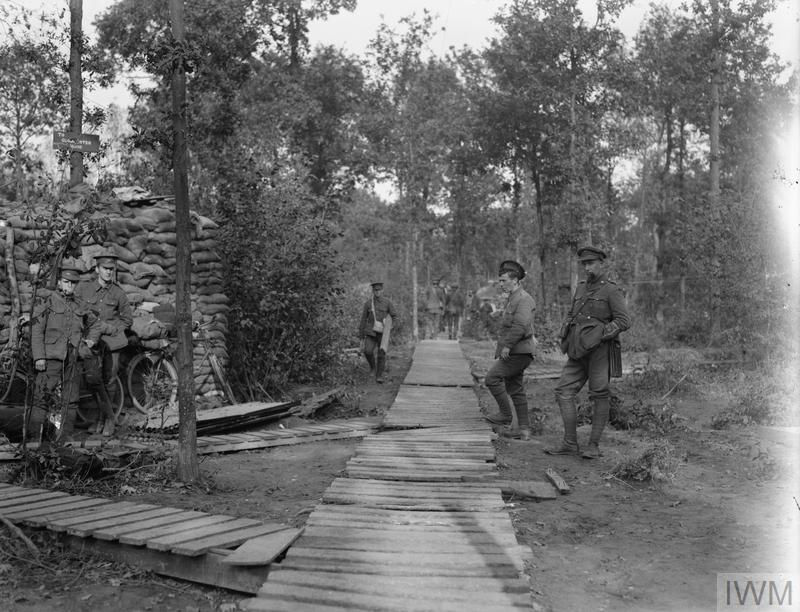
Other names are an example of the British soldier’s penchant for naming and identifying places around him with familiar place names from home. Somerset House, Hampshire Lane, Kent House, Gloster House, Hants Farm, Essex Farm, Lancashire support and Lancashire Cottage are all non-London examples of this penchant. More descriptive names include Mud Lane, Mud Corner, Dead Horse Corner, where the bones of a dead horse were hung from a gibbet and served as a landmark. Blighty Hall, was a concrete structured dressing station in the wood and were the wounded were collected before being shipped down the line and hopefully to ‘Blighty.’ Tourist Line, this was a reserve line that ran parallel to Hunter Avenue, and was thought safe enough to allow visiting dignitaries to visit the area and to feel as though they had gained experience of the front line. Mount Everest, Eel Pie Fort, spy Corner, Moated Farm and many more added to the list. German House, Second and Third House are examples of practicality. The origin of other place names has been lost such as Hull’s Burnt Farm, Maximes, Fort Boyd, Three Huns Farm, White Estaminet and Barricade House.
There were others that didn’t have a place name Touquet Berthe Farm, this was a major location for the concentration of trench stores and materiel, Creslow, Estaminet au

Commerce and Labarre, this was a narrow horseshoe-shaped ditch that enclosed a small garden that was converted into a machine-gun position. Looking at a Trench map of the wood you would think that it shows a road map of small towns and villages as opposed to a wood criss-crossed with rides and tracks.
From their arrival in the wood the British began to fortify it with a series of concrete forts, log-built huts, dugouts, shelters, breastworks and a network of planked roads. The forts were mainly located in the reserve line along Hunter Avenue, these concrete shelters gave no real protection against direct shell fire but did afford a degree of cover from the shrapnel and small arms fire. The concrete structures are still visible today.

Learn more about MP's and son's of MP's buried in the Ypres Salient.
One of the youngest battle casualties of the War
Boy Soldiers
In the Ypres Salient, we are drawn to the graves of 6322 Private John Condon, 2nd Battalion Royal Irish Regiment, killed in action in May 1915, age 14 and the youngest known battle casualty of the war, although this is now questioned, and the grave of 5750 Valentine Strudwick, 8th Rifle Brigade, killed in action in January 1916, age 15. Strudwicks grave attracts a great deal of attention because of its location at Essex Farm and that locations association with Lieutenant Colonel John McCrae and the poem ‘In Flanders Fields.’ There are many more ‘Boy Soldiers’ buried across the Salient and who are not remembered in the same way and these include three from Falkirk District Private William Jamieson, age 17, Private James Duchart, age 16, and Private Herbert Richmond, age 17. There were many reasons why under age boys enlisted in 1914 and 1915 boredom with their jobs, looking for adventure, and escaping family pressures. The checks on age and qualification to enlist were more relaxed than later in the war. The army preferred younger recruits, there was a history of boy soldiers in the army going back over one hundred years. At Waterloo the army had a number of boy soldiers in their ranks. The army preferred younger recruits as they would follow orders and accept discipline more readily than older men. The boys had a belief in their own indestructibility and were prepared to take more risks. We tend to also forget the number of boys who served in the Royal Navy and we do not seem to have the same passionate response to their service as we do those who fought on the Western Front. With regards to the army, the difference was the sheer number who served on the Western Front and there were more boy soldiers in 1915 than served in Wellington’s army at Waterloo. For further reading on this subject see Richard Van Emden’s excellent book Boy Soldiers of the Great War. 5509 Rifleman Reuben Barnett, 1st Battalion, Rifle Brigade. Age 15. Killed 19 December 1914. Grave IV.E.10. He was the son of Phillip and Esther Barnett, of 95, Belgrade Road., Stoke Newington, London.

Two graves from the Rifle Brigade attack on 19 December 1914 are those of Captain The Honourable George Grenville Morgan-Grenville, 1st Battalion Rifle Brigade. Age 27. Grave IV.F.4. He was twice mentioned in despatches. He was Barnett’s Company Commander. Master of Kinloss. Son of Baroness Kinloss, of Moreton Lodge, Buckingham, and the late Major Luis Ferdinand Harry Courthope Morgan-Grenville.

The second-in-command Captain the Honourable Francis Reginald Dennis Prittie, 1st Battalion, Rifle Brigade. Age 34. Grave IV.F.5. Twice mentioned in despatches. Legion of Honour. Son of 4th Baron Dunalley and Baroness Dunalley, of Kilboy, Nenagh, County. Tipperary. Assistant Commissioner, Uganda Boundary Commission, 1910-1914.

FALKIRK AND DISTRICT MEN BURIED HERE
There are six men from Falkirk and District buried here.
Falkirk

11th Battalion Royal Scots
Age 25
12.2.16
I. B. 14

11th Battalion Royal Scots
Age 25
12.2.16
I.E.9
Son of Mary Kerrigan, 7 Baxters wynd, Falkirk
Camelon

11th Battalion Royal Scots
23.5.16
I. A. 9
Larbert

11th Battalion Royal Scots,
Age: 26
13.5.16
I.E.1
Husband of Elizabeth Hastings, Glengowan Buildings, Stirling; son of Janet Penman and of the late Thomas Penman. They had an adopted son, Thomas. Elizabeth remarried on 20 April 1918 to William Forsyth, a Stoker in the Royal Navy on HMS Venetia.
Bainsford

10th Battalion Argyll & Sutherland Highlanders
Age 27
4.5.16
I.C.4
Son of Mrs Elizabeth Baird, 51 Carron Road & the late William Baird
Carron & Carronshore

‘B’ Company, 8th Battalion Black Watch (Royal Highlanders)
Age 29
8.5.16
I.F.5
Son of William Hannah, Bonnybridge. Husband of Mary C Hannah, 19 East Carron
Camelon

11th Battalion Royal Scots
Age 26
24.4.16
I.E.7
Husband of Mary Ann Panton, 16 Maryfield Place, Tamfourhill. Son of David Panton of Fife
Avonbridge

11th Battalion Royal Scots
Age Unknown
29.4.16
I.D.7
The son of James and Janet Lamond, Bridgehill, Avonbridge.
The cemetery was designed by W H Cowlishaw.
Cemetery Location
Rifle House Cemetery is located 12.5 Kms south of Ieper town centre, on a road leading from the Rijselseweg N365, which connects Ieper to Wijtschate and on to Armentieres. From Ieper town centre the Rijselsestraat runs from the market square, through the Lille Gate (Rijselpoort) and directly over the crossroads with the Ieper ring road. The road name then changes to the Rijselseweg. 2 Kms after Mesen lies the left hand turning onto Rue St.Yvon. Immediately after passing Prowse Point Military Cemetery lies a right hand turning onto a small road track (unsuitable for vehicles). 1.5 Kms after this junction lies the cemetery, on the track leading into the wood.
Burials
Rifle House Cemetery contains 230 First World War burials.
UK – 229
Canadian – 1


Comments