


British Airmen - Chester Farm Cemetery
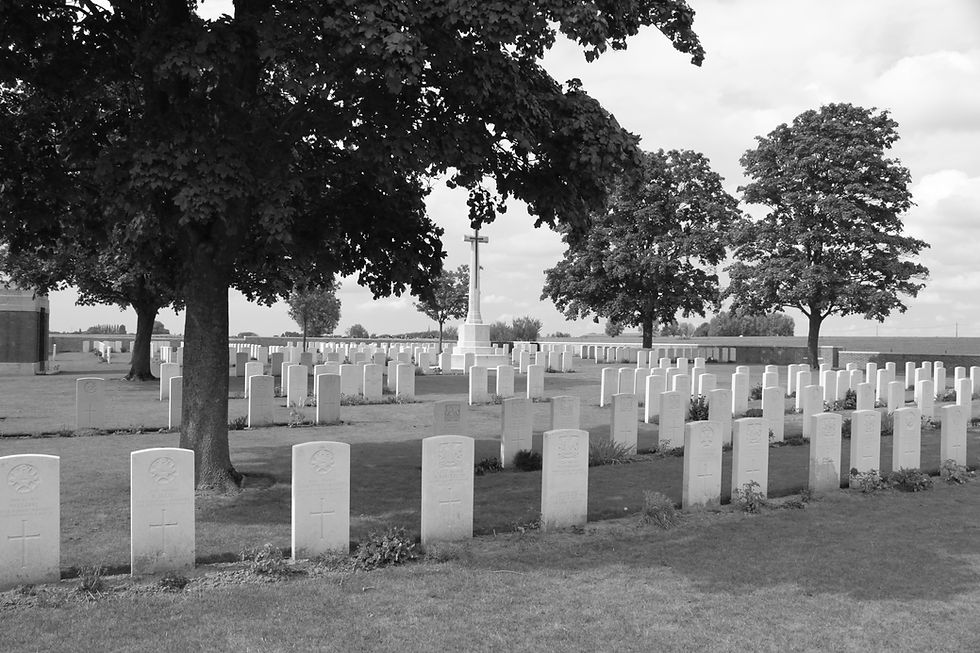
Chester Farm Cemetery, CWGC, Zillebeke, Ypres, was the name given to a farm, probably by the Cheshire Regiment, about 1 Km South of Blauwepoort Farm, on the road from Zillebeke to Voormezeele. There is one Royal Flying Corps Officer buried here. The cemetery was begun on 15 March 1915 when two men from the Norfolk Regiment were buried here both killed on the same day and are buried in Plot II AA1 and AA1A, and was used by front line troops until November 1917. Plot I contains the graves of ninety-two officers and men of the 2nd Manchesters, who died in April-July 1915, there are seventy-two London Regiment burials, thirteen men from the East Surrey Regiment buried here in April 1915, and sixteen men from the 1st and 4th Battalions Gordon Highlanders. The 1st and 4th Battalions Gordon Highlanders of 3rd Division held the trenches here during July and August 1915 and the command post on the raised ground on the northern canal bank between the Bluff and Spoilbank was named Gordon Post.

Captain Harold Jackson, 41 Squadron, Killed in action 7 June 1917, age 21. Grave I.K.31. son of Mr F. T. Jackson of The Spring, Stoke Coventry. Brother of Mr. F. H. Jackson, of "Fairhaven," Palmerston Road, Coventry. He was employed as an apprentice in an engineering works and enlisted in 1915. Soon after the outbreak of war he joined the Ruffy-Beauman school of flying, at Hendon and there obtained his pilot’s certificate. Harold was then granted a commission in the 13th Battalion, Royal Warwickshire Regiment transferring to the RFC three months later. On 1 October 1916, he flew out to France. He was promoted Captain and Flight Commander in March 1917. On the day of his death he was miles over German lines when he sustained a direct hit. Although his foot was blown off and his arm practically severed at the shoulder he brought his machine back. He died at the dressing station shortly afterwards. While equipped with F.E.8s, 41 Squadron participated in the Battle of Arras (April–May 1917) and the Battle of Messines (June 1917). By this time, the unit had become the last 'pusher' fighter squadron in the RFC. In July 1917, No. 41 were re-equipped with DH 5 fighters, which proved disappointing; in October 1917, the squadron finally received S.E.5a fighters, with which they were equipped for the duration of the war. Learn more about 41 Squadron


Comments